Grade

A grade is a maker's designation for one formulation of a polymer, such as Delrin 150 or TIVAR 1000, each with its own data sheet.

Every Grade article of the Plastic CNC Resources, newest first, each written from published standards, research and makers’ data.

Meaning

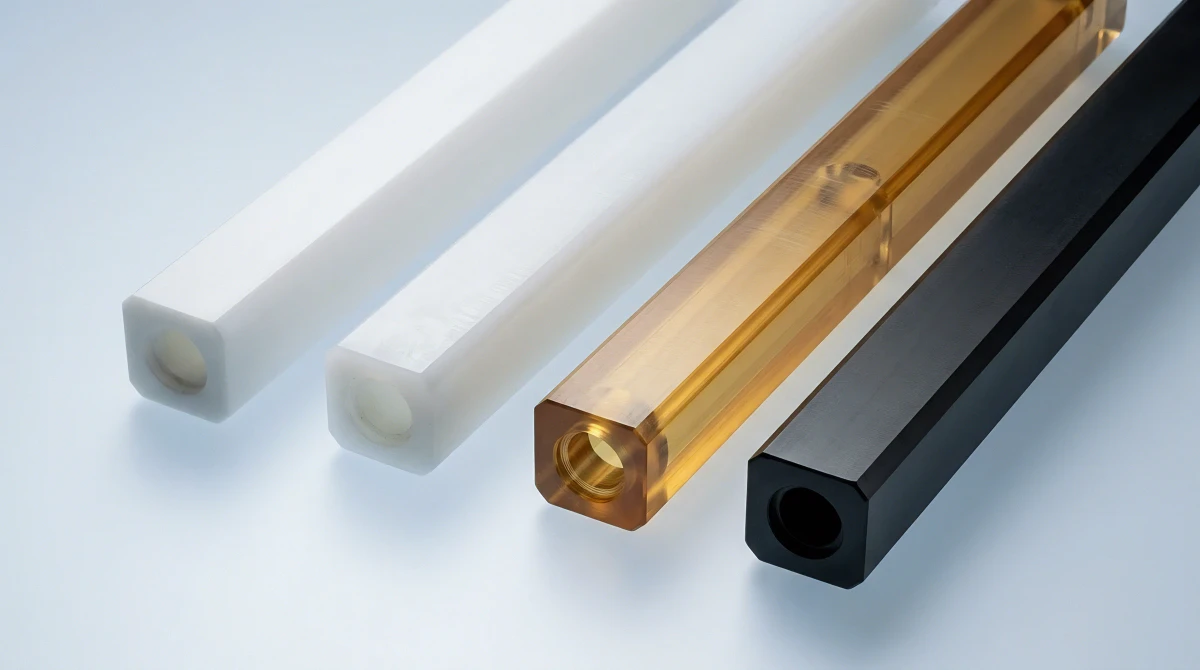
A grade is a maker’s designation for one formulation of a polymer, such as Delrin 150 or TIVAR 1000, each with its own data sheet. The polymer name alone does not fix the properties of a machined part. Two bars of the same polymer from different grades read differently on every sheet in these resources. Naming the grade is the first line of control on a plastic part.

Spread Within a Polymer

Four acetal sheets give heat deflection temperatures from 104 to 125 °C (220 to 257 °F) at the same load. Part of that spread is chemistry and part is grade and maker. The ASTM D648 article in these resources states the rule plainly: a different grade of the same polymer reads differently. The two HDPE sheets differ by 550 points in elongation at break and by 400 MPa (58,000 psi) in flexural modulus. The PEI sheets for unfilled and 30 percent glass grades differ by a factor of three in stiffness.
Read More

Stock Availability

Only a short list of grades exists as rod and plate. Delrin 150, 527UV and 100AF are the ones made for extrusion. A grade outside the stock list means a made-to-order bar. A less common grade, a custom color or an unusual size outside the maker’s stock program takes longer to source.

Process Effect

The grade sets the cutting data, the coolant and the tool. Mitsubishi’s tables are specific to the stock shapes it sells, and the guide warns against using one maker’s values for another maker’s grade. A program for a real part starts from the grade’s own data sheet. Mitsubishi marks one flame-retardant UHMW-PE grade as dry machining only, so the grade decides the coolant as well. With acetal and polyamide a shop can start with HSS and move to carbide. Reinforced grades put diamond tooling in the setup from the first part. The annealing guides group grades differently, so their tables are read for the exact trade name. Quadrant’s 2014 and Mitsubishi’s 2026 hold temperatures differ by 5 to 50 °C (9 to 90 °F) on four rows. The safe source is the current document of the maker of the grade in hand. Polyethylene shows the largest gap, 80 °C (176 °F) against 130 °C (266 °F). A number from another maker’s table serves only as a point of comparison.

Property Effect

A grade can change behavior that the polymer name suggests is settled. Quadrant lists a static-dissipative acetal grade among the parts that absorb moisture and swell. It is dried with the nylons at 60 to 70 °C (140 to 158 °F), unlike standard acetal. Mitsubishi’s tolerance table separates grades within one polymer. PEEK with fillers has its own column, at 0.05 mm (0.0020 in) for a 100 mm (3.94 in) size. Unfilled PEEK sits in a wider group at 0.06 mm (0.0024 in). A tolerance on a drawing is therefore tied to a size and a material, and the material means the grade. Wear is a grade question too. Ensinger prints wear factors of 55 for its acetal homopolymer and 65 for its copolymer. The TIVAR 1000 sheet gives its UHMW-PE a sand-wheel wear of 90 against 100 for AR-01 steel. A part chosen for wear is therefore specified by grade, with the maker that published the wear figure.

Recognition

UL recognizes flammability by manufacturer, grade, color and thickness. A shared base polymer does not transfer a classification from one grade to another. UL’s Yellow Card lists each recognition by grade, color and minimum thickness, so procurement papers match the supplier, grade, color and thickness of the actual part. An unrelated V-0 certificate does not cover a different grade.

Purchase Wording

A drawing or order names the polymer, the maker’s grade, any filler with its percentage, and the color if it matters. The shape and size complete the line. The filler matters for size as well as strength. Linear thermal expansion changes by nearly three times between unfilled and 30 percent glass-filled PEI. For POM, naming the chemistry and the grade closes the gap between homopolymer, copolymer and every filled variant. A quote then stays tied to one bar and does not drift between two that look identical. A second maker’s UHMW-PE will be close to TIVAR 1000, and it will not be the same bar.
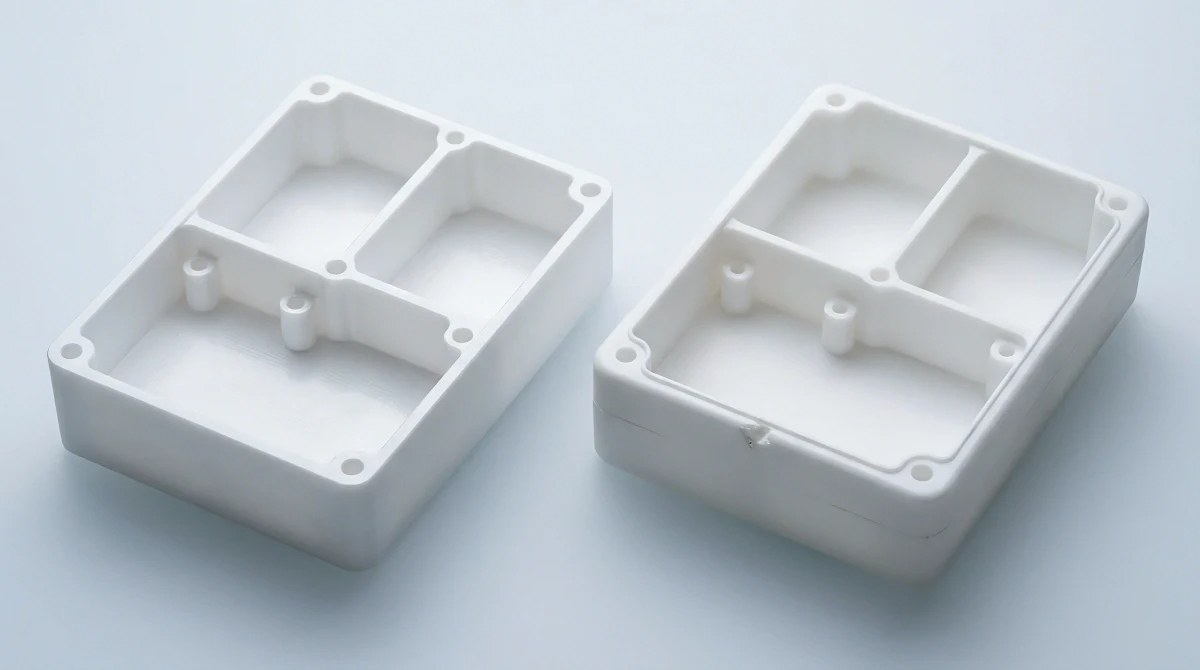
A Flame-Retardant Machined Plastic Batch and Its UL 94 V-0 Record

A machined batch carries a UL 94 V-0 rating only through its record of grade, color, thickness, listing and lot, plus proof the shop cut it dry and thick enough.

What a UL 94 V-0 Record Covers for a Machined Plastic BatchThe record covers the material, not the part. Ensinger, a stock-shape maker, states that combustibility testing to UL 94 is generally performed on the raw material.

Speeds and Feeds for Machining Acetal, Nylon and PEEK

Acetal, nylon and PEEK share wide published cutting windows, and the right point inside each depends on making a chip that carries heat out of the part.

Speeds and Feeds for Acetal, Nylon and PEEK in One TableTable 1 sets the published cutting data for the three materials side by side, from MCAM's 2026 guide and from Tangram Technology, a UK plastics engineering consultancy that publishes indicative values. MCAM groups unfilled PEEK with PET-P and PAI, and filled PEEK with the other reinforced grades; Tangram does not list PEEK.

Drilling Deep Holes in Plastic Without Melting or Cracking

Holes deeper than two diameters trap heat in plastic, so drill grind, peck cycle, coolant choice and cool-down decide whether the part cracks or holds its size.

How to Drill a Deep Hole in Plastic Without Melting or CrackingTreat any hole deeper than two diameters as a cooling problem first and a cutting problem second. Both Mitsubishi Chemical Advanced Materials (MCAM) and Ensinger name the same threshold: heat builds very easily once the depth passes twice the diameter.

Surface Finish of Machined Plastics by Material and Tool

Measured roughness on machined plastics follows feed first, then tool edge and material, and a finish call-out needs its parameter, surface, direction and part condition.

What Surface Finish Machined Plastics Reach and What Sets ItTwo open studies give a measured range for ordinary turning and milling of tough engineering plastics. Turning HDPE and PA6 with a carbide insert produced average roughness (Ra) from about 2.1 µm (83 µin) to about 11 µm (439 µin) across the tested conditions.

Flatness and Warp of Thin Machined Plastic Plates

Thin plastic plates bow when stress, heat, clamping or moisture act on one face more than the other, so flatness is planned through stock, sequence, rest and measurement.

Why Thin Machined Plastic Plates Lose FlatnessA thin plate loses flatness when the stresses on its two faces stop balancing. Mitsubishi Chemical Advanced Materials (MCAM) explains the mechanism in its machining guide: extrusion, molding and machining leave residual stresses inside a thermoplastic, and when material is removed or the part meets elevated temperatures, those stresses redistribute and cause warping or dimensional change.

Shore D and Rockwell Hardness on Plastic Stock Data Sheets

Shore D and Rockwell values on plastic stock sheets rank surface hardness under named methods, cannot be converted into each other, and bind a supplier only when agreed.

What Shore D and Rockwell Numbers Mean on a Plastic Stock Data SheetBoth numbers rank how strongly a plastic resists a hard indenter pressed into its surface at room temperature. Neither is a strength, a wear rating or a design value.

Machining PEEK Unfilled and Carbon-Filled Stock

Unfilled and carbon-filled PEEK share a polymer but differ in stiffness, conductivity, tooling, cutting data and tolerance, so the grade belongs on the drawing.

How Unfilled and Carbon-Filled PEEK Stock Differ for Machined PartsUnfilled PEEK machines like a hard, stiff thermoplastic: short chips, little burr, high feed rates and fine finishes. Carbon-filled PEEK machines like a composite: abrasive to tools, sensitive to fiber direction, and best cut with carbide or diamond at lower speeds.

Cast and Extruded Nylon PA6 Stock for Machined Parts

Cast and extruded PA6 share a name but not their stress, crystallinity, chips or moisture behavior, and a machined nylon part keeps changing size after the cut.

Cast or Extruded PA6 for a Machined PartCast PA6 is usually the better machining stock when the part is large, flat, stiff or close-toleranced. Extruded PA6 is the tougher, more elastic choice for smaller parts where impact strength and elongation matter more than the last hundredth of a millimeter.

Sizing a Machined Plastic Run From Blanks to Batches

A machined run is sized from weeks and consumption, converted to plates and batches, and then matched to cutters and fixtures by run length.

How to Size a Machined Plastic RunCount the parts the program will consume until the next process delivers, add a spare for parts lost in testing, convert the total to blanks by nesting, and group the blanks into batches that share a rest, an oven load and a measuring session. Then choose the cutter and the fixture by the length of the run.

How Long Resting, Annealing and Drying Add to Machined Plastic Parts

In a machined plastic order the cutting takes minutes, while resting, drying and heat treatment take days, so the drawing sets the lead time.

Where the Calendar Goes in a Machined Plastic OrderMost of the elapsed time in a machined plastic order is spent on stock preparation, resting, heat treatment, drying and measurement at a controlled temperature, and the cutting is a small fraction. When a part needs none of those steps, it goes from blank to finished in the machine time plus setup and deburring.

Thermal Expansion of Machined Plastic Parts by Material and Size

Every machined plastic dimension has a temperature, and the material decides how many degrees of drift a given tolerance can absorb.

Thermal Expansion of Machined Plastic Parts per 10 DegreesThe coefficient of linear thermal expansion, CTE, is the fractional length change per degree. Plastic sheets print it in 10⁻⁶ per kelvin or in inches per inch per degree Fahrenheit, and the two convert by a factor of 1.8: one in/in/°F is 1.8 per °C.

Machining Tolerances by Part Size for Engineering Plastics

Published plastic tolerances widen with feature size and split by polymer group, so a drawing has to state size, grade, temperature and rest.

Published Machining Tolerances by Feature Size and Material GroupTable 1 reproduces the Mitsubishi table for nine of its sizes, with inches beside each figure. The five groups are the guide's own: HDPE; the group that holds PET-P, PC, PEEK, PTFE 500, PPS, PEI, PPSU and PSU; the group that holds PA, POM and PTFE 207; PEEK with fillers; and PAI with PBI.

UL 94 Flammability Ratings for Machined Plastic Parts

A flame rating belongs to a material, a color and a thickness, so the call-out has to name all three and the machined wall has to stay inside them.

What UL 94 Covers and What It Leaves OutThe UL standards catalog lists UL 94 as Tests for Flammability of Plastic Materials for Parts in Devices and Appliances, in its seventh edition. Its scope states that the requirements cover tests for flammability of polymeric materials used for parts in devices and appliances, and that they serve as a preliminary indication of acceptability with respect to flammability for a particular application.

UHMW-PE and HDPE Stock for CNC Milling and Turning

UHMW-PE wears longest and HDPE holds shape better, and both need sharp tools, chip control and a stated measurement temperature to hold size.

UHMW-PE and HDPE Differences for Machined PartsBoth are polyethylene, and the difference starts with chain length. Mitsubishi describes its TIVAR 1000 Virgin UHMW-PE as setting the standard for ultra high molecular weight polyethylene shapes, with a combination of wear and corrosion resistance, a low-friction surface and excellent impact strength.

PEI Ultem Stock for CNC Machined Parts

PEI holds stiffness and shape at heat, and it asks for dry cutting, careful fluids and an annealing decision before the first part is cut.

PEI Ultem Properties for Machined PartsPolyetherimide, PEI for short, is an amorphous thermoplastic, and Ensinger, which extrudes it into rod and plate, notes that it is commonly referred to as ULTEM plastic after the resin's trade name. Ensinger describes the material as having high mechanical strength and rigidity, exceptional creep resistance over a wide temperature range and very good hydrolysis resistance, and as inherently flame retardant with low smoke emission, which makes it a preferred material for aircraft interiors.

Acetal Homopolymer and Copolymer Stock for CNC Machined Parts

Homopolymer is stiffer and harder, copolymer is sold porosity-free with less water uptake and less thermal growth, and the stock a part is cut from decides which it inherits.

Acetal Homopolymer and Copolymer Differences in Machined PartsAcetal, the polyoxymethylene or POM family, reaches a machine shop as two chemistries. Homopolymer chains repeat one unit; copolymer chains carry two.

Request a Plastic CNC Quote

Send the 2D drawing and the 3D file, with the quantity and the stage of the project. An engineer replies within 1 working day.

The quote form, the mutual NDA and the private folder for your files are on Protolis Atelier, with Plastic CNC chosen.

Request a Quote