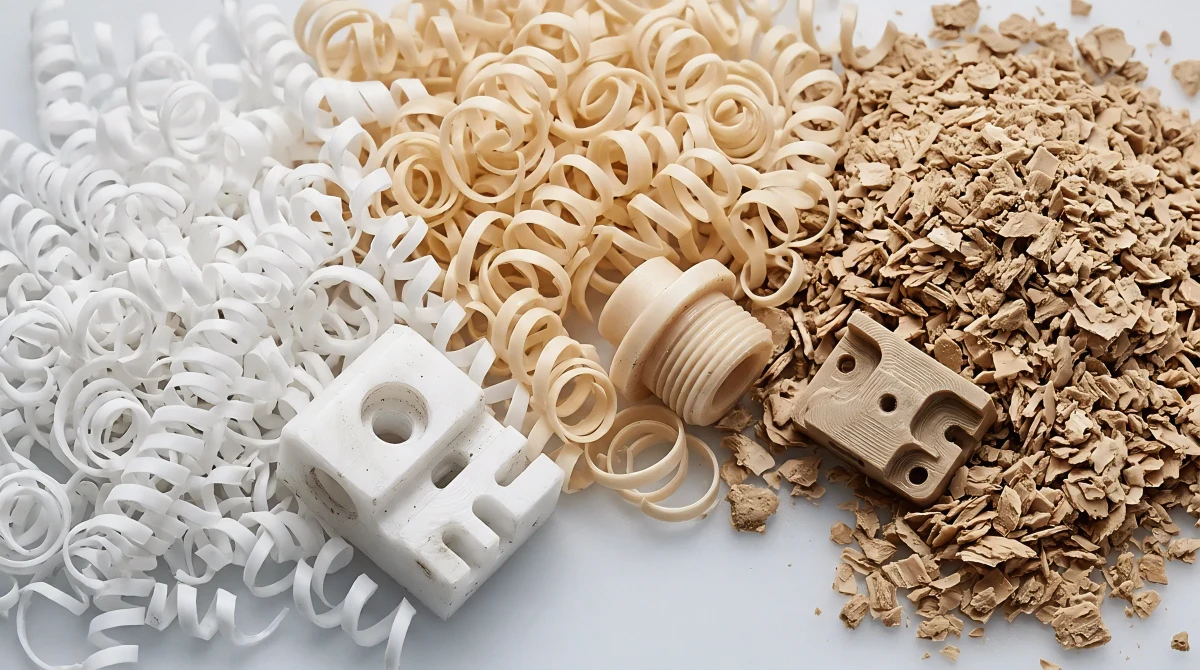
Dimensional Stability

Dimensional stability is a plastic part's ability to keep its machined size and shape through rest, temperature, moisture and time.

Every Dimensional Stability article of the Plastic CNC Resources, newest first, each written from published standards, research and makers’ data.

Meaning

Dimensional stability is a plastic part’s ability to keep its machined size and shape through rest, temperature, moisture and time. It is not one number on a data sheet. It is the combined result of the stock’s history, the cut and the conditions the part meets. Each of the makers in these resources treats it as the goal behind its machining advice.

Stock Origin

Quadrant states that its stock shapes are annealed with a proprietary stress-relieving cycle that generally assures stability during and after machining. Ensinger states that its stock shapes are annealed after production to reduce internal tension. Quadrant adds that annealing small blocks or thin disks right after cutting them from stock can considerably improve it. Mitsubishi states that PAI typically needs no anneal at all, because of its dimensional stability.
Read More

Governing Factor

Ensinger names moisture uptake, stress relaxation and heat input as the factors. Heat enters during machining, annealing, use at high temperature and sterilization. Röhm adds, for acrylic, that moisture influences dimensional stability less than heat does. A part that is stable in one environment may not be in another.

Post-Shrinkage

Ensinger gives post-shrinkage of up to about 1.0 to 2.5 percent for semicrystalline thermoplastics. Amorphous ones reach about 0.3 to 0.7 percent. These percentages explain why a part pre-machined to final size and then annealed ends up off size. They also explain why two parts from one bar can anneal differently.

Standard Requirement

ASTM D6100 lists dimensional stability among the properties an acetal shape has to meet. EN 15860:2018 lists a requirement on dimensional stability after heat treatment for thermoplastic semi-finished products. A buyer who needs stability can name the standard that governs the stock as well as the grade.

Speeds and Feeds for Machining Acetal, Nylon and PEEK

Acetal, nylon and PEEK share wide published cutting windows, and the right point inside each depends on making a chip that carries heat out of the part.

Speeds and Feeds for Acetal, Nylon and PEEK in One TableTable 1 sets the published cutting data for the three materials side by side, from MCAM's 2026 guide and from Tangram Technology, a UK plastics engineering consultancy that publishes indicative values. MCAM groups unfilled PEEK with PET-P and PAI, and filled PEEK with the other reinforced grades; Tangram does not list PEEK.

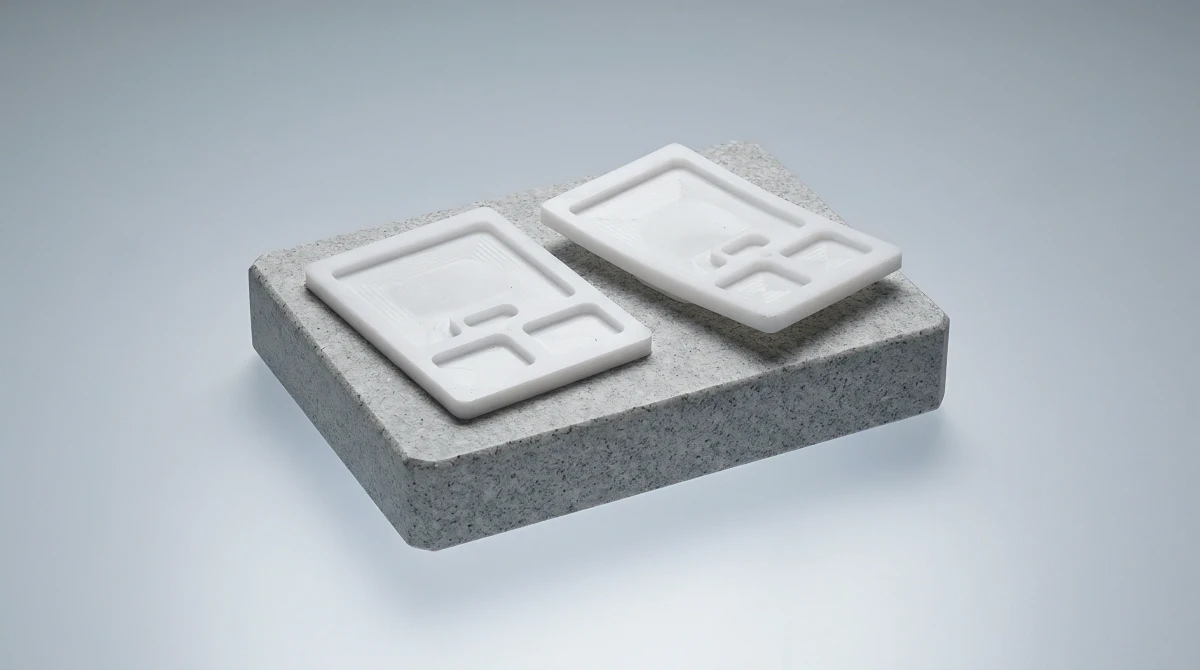
Flatness and Warp of Thin Machined Plastic Plates

Thin plastic plates bow when stress, heat, clamping or moisture act on one face more than the other, so flatness is planned through stock, sequence, rest and measurement.

Why Thin Machined Plastic Plates Lose FlatnessA thin plate loses flatness when the stresses on its two faces stop balancing. Mitsubishi Chemical Advanced Materials (MCAM) explains the mechanism in its machining guide: extrusion, molding and machining leave residual stresses inside a thermoplastic, and when material is removed or the part meets elevated temperatures, those stresses redistribute and cause warping or dimensional change.

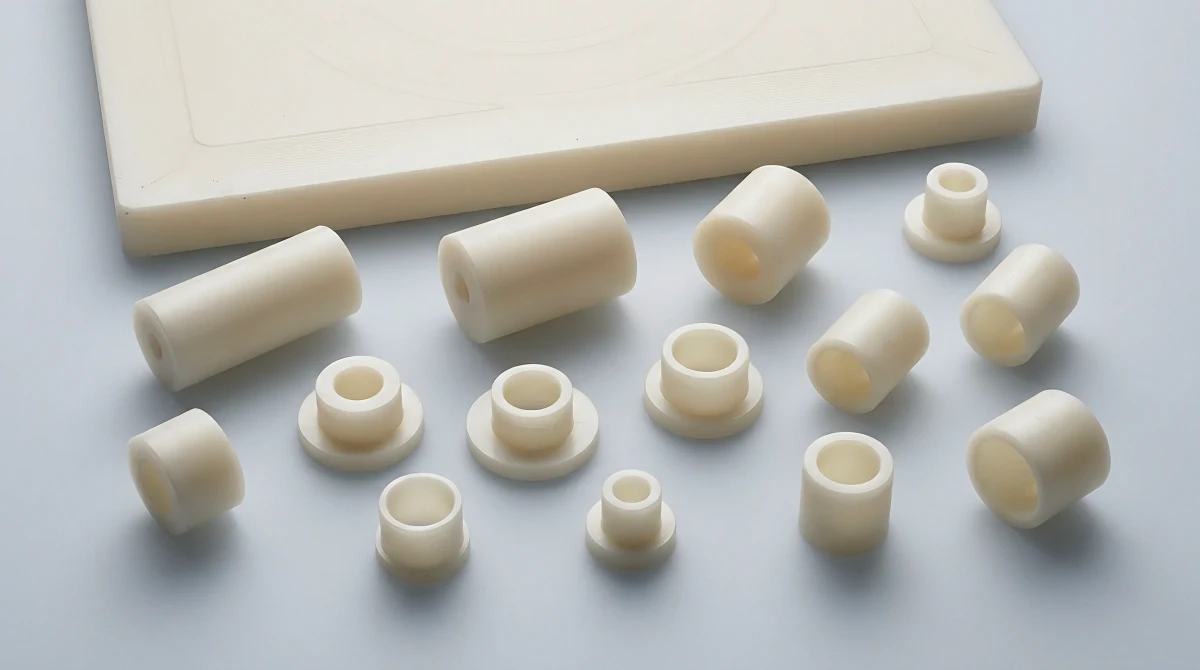
Cast and Extruded Nylon PA6 Stock for Machined Parts

Cast and extruded PA6 share a name but not their stress, crystallinity, chips or moisture behavior, and a machined nylon part keeps changing size after the cut.

Cast or Extruded PA6 for a Machined PartCast PA6 is usually the better machining stock when the part is large, flat, stiff or close-toleranced. Extruded PA6 is the tougher, more elastic choice for smaller parts where impact strength and elongation matter more than the last hundredth of a millimeter.

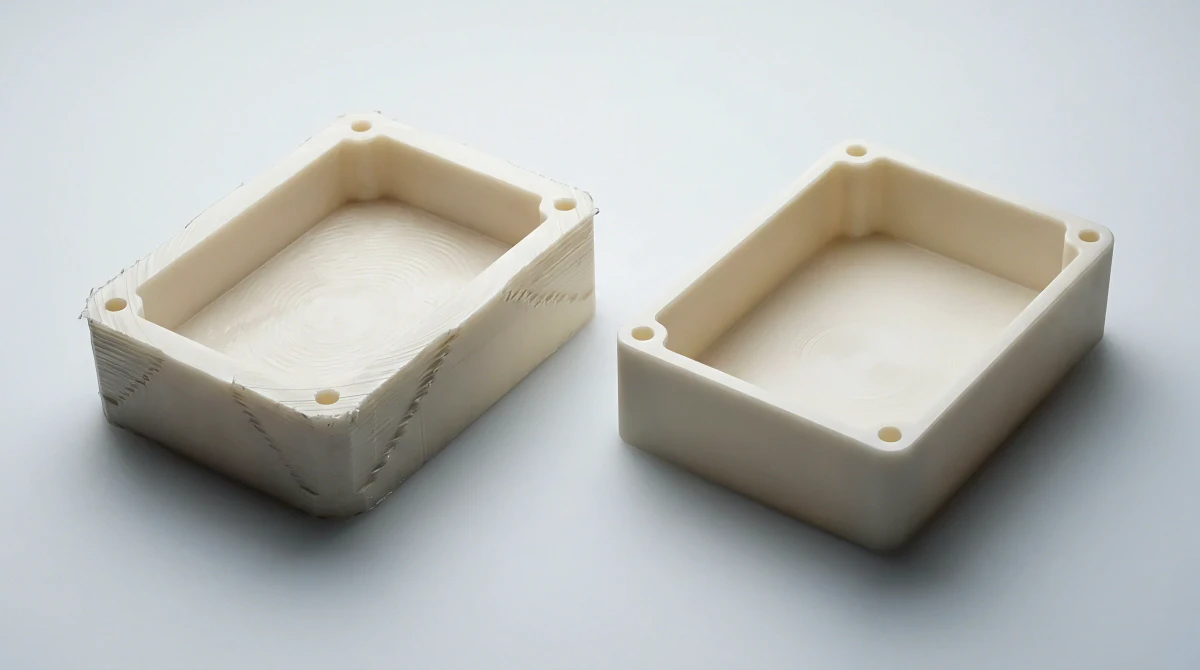
Annealing Machined Plastic Parts Between Roughing and Finishing

Annealing between roughing and finishing trades oven days for flat, stable parts, and it pays only when stress, shape or tolerance demand it.

When a Machined Plastic Part Needs AnnealingA machined plastic part needs an intermediate anneal when it has tight tolerances, an asymmetric shape, or a large share of its blank removed, and when it does not need one the stock maker has already done the work. Ensinger states the starting condition: its semi-finished products are always annealed after production, which is why a first cut can start without a stress-relief step.

Thermal Expansion of Machined Plastic Parts by Material and Size

Every machined plastic dimension has a temperature, and the material decides how many degrees of drift a given tolerance can absorb.

Thermal Expansion of Machined Plastic Parts per 10 DegreesThe coefficient of linear thermal expansion, CTE, is the fractional length change per degree. Plastic sheets print it in 10⁻⁶ per kelvin or in inches per inch per degree Fahrenheit, and the two convert by a factor of 1.8: one in/in/°F is 1.8 per °C.

Machining Tolerances by Part Size for Engineering Plastics

Published plastic tolerances widen with feature size and split by polymer group, so a drawing has to state size, grade, temperature and rest.

Published Machining Tolerances by Feature Size and Material GroupTable 1 reproduces the Mitsubishi table for nine of its sizes, with inches beside each figure. The five groups are the guide's own: HDPE; the group that holds PET-P, PC, PEEK, PTFE 500, PPS, PEI, PPSU and PSU; the group that holds PA, POM and PTFE 207; PEEK with fillers; and PAI with PBI.

Acetal Homopolymer and Copolymer Stock for CNC Machined Parts

Homopolymer is stiffer and harder, copolymer is sold porosity-free with less water uptake and less thermal growth, and the stock a part is cut from decides which it inherits.

Acetal Homopolymer and Copolymer Differences in Machined PartsAcetal, the polyoxymethylene or POM family, reaches a machine shop as two chemistries. Homopolymer chains repeat one unit; copolymer chains carry two.

Request a Plastic CNC Quote

Send the 2D drawing and the 3D file, with the quantity and the stage of the project. An engineer replies within 1 working day.

The quote form, the mutual NDA and the private folder for your files are on Protolis Atelier, with Plastic CNC chosen.

Request a Quote