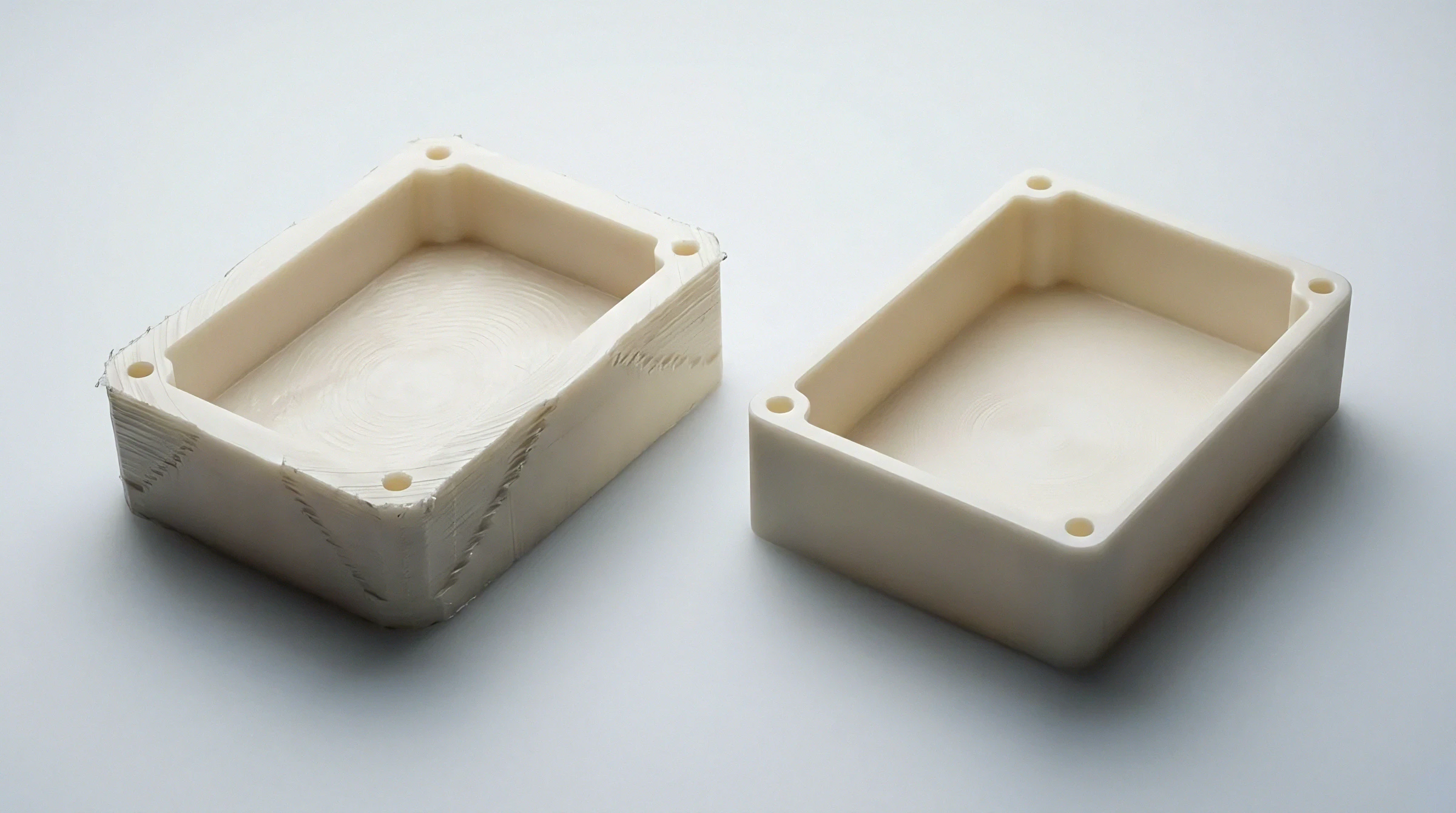
The cool-down is the long part. For a polyacetal part annealed at 155 °C (311 °F), Mitsubishi Chemical Advanced Materials (MCAM) prints a cooling rate of 5 to 10 °C per hour, which puts the oven at roughly 13 to 27 hours between the end of the hold and room temperature. The hold itself, at 10 minutes per millimeter of wall, takes under two hours for a 10 mm (0.39 in) section. A buyer who asks for an annealed part has asked for a calendar day or two of oven time that is invisible on the drawing.
The step earns that time only for certain parts, and not for all of them. What follows takes the decision in order: whether the part needs it, what the alternative is, how the cycle is built, which temperatures the stock-shape makers print, and where the step sits between the rough cut and the finishing pass.
When a Machined Plastic Part Needs Annealing
A machined plastic part needs an intermediate anneal when it has tight tolerances, an asymmetric shape, or a large share of its blank removed, and when it does not need one the stock maker has already done the work. Ensinger states the starting condition: its semi-finished products are always annealed after production, which is why a first cut can start without a stress-relief step.
Both makers then describe the cases in which a second anneal is worthwhile. Ensinger lists them under intermediate annealing:
- narrow tolerances are required;
- the shape has a strong tendency to warp, with asymmetric or narrowed cross sections, pockets and grooves;
- the material is fiber reinforced or filled, because fiber orientation can enhance warping.
MCAM words the trigger as tight-tolerance components, large or asymmetrical parts, components with substantial material removal and parts exposed to elevated service temperatures, and it names extremely close-tolerance parts with precision flatness and a non-symmetrical contour as the ones that sometimes need an intermediate anneal between machining steps.
The reverse is just as plain. The makers treat the intermediate anneal as an exception for demanding parts, and a bracket cut symmetrically from stock with generous tolerances does not need it.
The anneal is not a routine step in plastic CNC. It is a response to a part that will lose a lot of material unevenly, or that has to hold a size through a temperature change later.
Where the Stress in a Plastic Blank Comes From
Stress comes into a plastic part from its making, from the cut and from its use. Ensinger describes the first source: extrusion melts the material and pushes it through a die, and the result is a stock shape with internal stress in the center. Annealing at the maker reduces it, but not to zero, and any cut through the stressed region lets the remainder move.
Röhm, writing about acrylic, lists the sources of tensile stress more broadly. Machining operations such as sawing, milling, turning and sanding appear on the list, together with thermoforming, irregular heating, shrinkage of adhesives, deformation during fastening by clamping or drilling, shrinkage after local overheating from a badly ground tool, impeded thermal expansion and external load. The shape of the list says that the machine shop adds stress as well as removing material.
The material’s own history is the other half of the picture, and heat input is the part a shop controls. Mitsubishi’s guide states that extrusion, molding and machining can all leave residual stresses, and that removing material or exposing the part to elevated temperature lets those stresses redistribute and warp it. Ensinger’s dimensional stability factors are moisture uptake, stress relaxation and heat input, and it names machining among the processes that develop heat in the material, together with annealing, use at high temperature and sterilization. It also notes post-shrinkage of up to about 1.0 to 2.5 percent for semi-crystalline thermoplastics and about 0.3 to 0.7 percent for amorphous ones.
Those percentages are the reason for the oversize rule below, and they explain why two parts cut from the same bar can anneal differently when one was roughed from a thin plate and the other from a thick one. A part pre-machined to final size and then annealed will end up smaller than the drawing in some directions and bigger in others.
Resting the Part as the Cheaper Alternative
Time at room temperature is the simplest stress relief. MCAM’s turning tips say to rough out large sections and leave them for 24 hours for improved tolerances.
A rest costs no oven and no fixture, but it needs shelf space and a part in a safe, flat position, and it gives only the relaxation the part can do at room temperature. The method fits parts whose stress is moderate and whose relaxation is mainly the elastic recovery of a clamped blank. Parts that will see service temperatures higher than room temperature are a poorer fit, because the stress that a rest leaves in the part can relax suddenly later.
Ensinger states that risk directly: use at elevated temperatures is particularly critical, since frozen-in stress can reduce suddenly, giving a change of shape, warping or, in the worst case, stress cracking in service. The anneal moves that relaxation into the shop, where it is measured and cut away.
The decision between rest and oven can be written as a short question for the drawing. A part that will never go above room temperature and carries a moderate tolerance gets by with a rest. When the part is asymmetric, tight, or used at temperature, the oven is the answer, and the times in the next section apply.
The Four Times of an Annealing Cycle
Both makers define the cycle by four periods. T1 is the heat-up, at 10 to 20 °C per hour. T2 is the hold, which depends on the wall thickness at 10 minutes per millimeter. T3 is the cool-down at 5 to 10 °C per hour, and T4 is the additional time for the center of the part to reach room temperature, at 3 minutes per millimeter.
Everywhere in the oven or the oil bath, the temperature has to stay within plus or minus 3 °C at all times. The rates are the surprising part: a hold of 10 minutes per millimeter is about as long as one expects, but a ramp of 10 to 20 °C per hour means a part destined for 155 °C is in the oven for most of a working day before it begins to hold. Table 1 works the arithmetic for four polymers from the MCAM 2026 hold temperatures, assuming a room temperature of 20 °C.
| Polymer | Hold temperature, °C (°F) | Heat-up T1 | Cool-down T3 | Hold and equalization, T2 plus T4, 10 mm (25 mm) wall | Total, 10 mm wall | Total, 25 mm wall |
|---|---|---|---|---|---|---|
| Polycarbonate | 130 (266) | 5.5 to 11 | 11 to 22 | 2.2 (5.4) | 19 to 35 | 22 to 38 |
| Acetal, POM-C and POM-H | 155 (311) | 6.8 to 13.5 | 13.5 to 27 | 2.2 (5.4) | 22 to 43 | 26 to 46 |
| Polyamide | 160 (320) | 7 to 14 | 14 to 28 | 2.2 (5.4) | 23 to 44 | 26 to 47 |
| PEEK | 250 (482) | 11.5 to 23 | 23 to 46 | 2.2 (5.4) | 37 to 71 | 40 to 74 |
The rows show that the wall thickness matters much less than the temperature. Going from 10 mm to 25 mm adds about three hours in every row, because T2 and T4 are small beside the ramps. PEEK takes about three days of oven time, and the long tail is the cool-down at 5 to 10 °C per hour.
The aim of those rates is uniform heating and cooling, because a part that cools unevenly carries new stress back out of the oven.
Hold Temperatures by Polymer in Two Editions
The hold temperature depends on the polymer. Table 2 gives MCAM’s 2026 values, all held for 10 minutes per millimeter of wall.
| Polymer | MCAM 2026 hold temperature | Annealing environment |
|---|---|---|
| Acetal (POM-C, POM-H) | 155 (311) | Air, nitrogen or oil |
| Polyamide, unfilled | 160 (320) | Air, nitrogen or oil |
| Polyamide 66, 30 percent glass-filled | 170 (338) | Air, nitrogen or oil |
| PET-P | 155 (311) | Air, nitrogen or oil |
| Polycarbonate | 130 (266) | Air or nitrogen |
| PE-(U)HMW | 130 (266) | Air, nitrogen or oil |
| PEEK | 250 (482) | Air or nitrogen |
| PPS | 200 (392) | Air or nitrogen |
| PPSU, PEI | 200 (392) | Air or nitrogen |
| PSU | 170 (338) | Air or nitrogen |
Most rows agree, and four differ by 5 to 50 °C. Polyethylene shows the largest difference, which is a reminder that the guides group their grades differently, so the tables are read for the exact trade name. The safe use of both editions is to take the current document of the maker for the grade in hand, and to treat a number from another maker’s table as a ceiling for comparison.
Some shop practice follows from the temperature. MCAM lists air, nitrogen or oil for polyamide, acetal, PET-P and polyethylene, and air or nitrogen for polycarbonate and the high-temperature grades. A part heated in air can show a thin oxidized skin, which the finishing pass removes along with the stock left for it.
Oversize, Fixtures and Oven Uniformity
The anneal changes the shape of the part, and the program has to expect it. MCAM advises leaving enough oversize when pre-machining to allow machining to final sizes after annealing, and a shop finds out how much the heat treatment moves by running the procedure on one or a few parts first. Ensinger agrees that the roughing leaves an approximate safety margin, because annealing can shrink the components, and the final dimensions are cut afterwards.
Three practices keep the anneal from adding a new problem:
- Fixture the parts that tend to bow. MCAM finds fixturing to the desired shape or flatness during the entire cycle often proves advantageous, and the part stays fixtured until it has cooled slowly to the touch.
- Hold the temperature uniform. MCAM asks for plus or minus 3 °C throughout the oven or oil bath, at all times in the cycle.
- Rough, anneal, then finish. MCAM gets better flatness by rough machining, annealing and finish machining with a very light cut.
A fixture that distorts the part is no better than none, and the fixture itself expands and contracts as the oven ramps through a span of more than 100 °C. Plates of steel and polymer move at different rates, which is another reason to check one part before a batch goes in. The pieces by the stock-shape makers do not print fixture designs, so the rule is a general one: use something flat and supportive, with a material that does not pinch the part as it shrinks.
The finishing pass after an anneal is a light one. MCAM describes the sequence as rough machining, annealing and finish machining with a very light cut, which gives better flatness.
Annealing Acrylic and Other Parts That Craze
Acrylic follows a different logic because its concern is crazing. Röhm explains that plastics withstand considerable tensile stress as long as they are not exposed to corrosive media at the same time. If solvents, thinners from bonding, printing or painting, monomer vapors, plasticizers from PVC insulation, sealants or aggressive cleaners are present, the stressed part crazes, and a part that would survive in a stress-free state becomes unfit for use.
The remedy is annealing below the softening point. Röhm prints its conditions. PLEXIGLAS GS is annealed at 80 °C (176 °F), unformed parts up to 100 °C (212 °F). XT is annealed at 70 to 80 °C (158 to 176 °F), unformed parts up to 85 °C (185 °F).
The annealing time in hours is the thickness in millimeters divided by 3, with a minimum of 2 hours. Oven cooling time in hours is the thickness divided by 4, at a cooling rate not above 15 °C per hour, and the part leaves the oven at no more than 60 °C. Cooling too fast gives a cold, stiff skin and creates tensile stress, because the material continues to shrink inside.
For a 3 mm (0.12 in) sheet that gives the 2 hour minimum and 0.75 hours of oven cooling. A 10 mm (0.39 in) sheet takes 3.3 hours at temperature and 2.5 hours of cooling, and a 25 mm (0.98 in) sheet takes 8.3 hours and 6.3 hours. The times are short beside engineering plastics because the hold temperatures are low and the cooling is bounded by the 15 °C per hour limit and the 60 °C exit temperature.
Röhm adds one more reason to anneal: if only one surface of a sheet is mechanically treated, the workpiece can distort slightly, and annealing reverses it. MCAM’s guide covers the amorphous engineering plastics in a different part of its text, in the coolant discussion, where it warns that mineral-oil cutting fluids may contribute to stress cracking of PC, PPSU, PEI and PSU. Washing in isopropyl alcohol and pure water after machining with coolant is a separate protection against the same cracking, and it does not replace an anneal.
A Shorter Shop Cycle From a Distributor Handbook
The cycle sets the calendar as much as the oven does. MCAM’s 2026 guide prints its rates as ranges: a heat-up of 10 to 20 °C (18 to 36 °F) per hour, a hold of 10 minutes per millimeter of wall and a cool-down of 5 to 10 °C (9 to 18 °F) per hour, with the part fixtured through the whole cycle and left in the fixture until it has cooled slowly to the touch.
Table 3 turns those rates into total oven time for a 10 mm wall, starting at 20 °C (68 °F), with the hold temperature the guide prints for each polymer.
| Material | MCAM hold, °C (°F) | Heat-up, hours | Hold, hours | Cool-down, hours | Total, hours |
|---|---|---|---|---|---|
| Acetal copolymer (POM-C) | 155 (311) | 6.8 to 13.5 | 1.7 | 13.5 to 27 | 22 to 42 |
| Nylon 6 | 160 (320) | 7 to 14 | 1.7 | 14 to 28 | 23 to 44 |
| PET-P | 155 (311) | 6.8 to 13.5 | 1.7 | 13.5 to 27 | 22 to 42 |
| Polycarbonate | 130 (266) | 5.5 to 11 | 1.7 | 11 to 22 | 18 to 35 |
The cool-down is the longest leg in every row, and it is the one a shop is most tempted to shorten. A buyer who sees a quoted annealing time of a few hours against one of two days is looking at two different cycles, and the shorter one trades cooling time for a higher risk of stress built in by uneven cooling, which is the point the MCAM and Röhm guides make about slow, uniform cooling.
In practice a buyer asks the supplier which cycle it follows and why it suits the part. The handbook itself asks for care: it warns against shortcuts, and it places finish machining of critical dimensions after the anneal.
Post Cure and Parts That Skip the Oven
One group of stock shapes asks for a heat treatment of a different kind. Polyamide-imide, sold by Mitsubishi as Duratron PAI, typically does not require annealing, according to MCAM, because of its dimensional stability. It can, however, be post-cured to improve wear and chemical resistance. MCAM separates the two terms: annealing makes the part dimensionally predictable, and post-curing develops the material’s final performance.
The post-cure cycle printed by MCAM is stepped: 150 °C (302 °F) for 1 day, 215 °C (419 °F) for 1 day, 245 °C (473 °F) for 2 days and 260 °C (500 °F) for 6 days. Heating and cooling run at 10 to 20 °C per hour, and the cycle is given for parts up to 12 mm (0.47 in) in wall thickness. Ten days of holds is the minimum calendar the cycle asks for.
In air the surface turns dark brown from minor oxidation, and the oxidized layer is what gives the wear resistance. Finishing after the post-cure removes no more than 0.5 mm (0.020 in) of it. For tight tolerances, MCAM recommends doing the post-cure before final precision machining.
For a buyer, these two cases show that “heat treated” on a drawing can mean three different things: a relief of stress, a post-cure for properties, or a drying step. A drawing that names the purpose and the stage lets a supplier schedule the oven days and the finishing pass correctly. Teams planning low-volume plastic CNC work that grows into bridge production can fix that wording once, so the first parts and the later runs follow the same sequence.
Sources and Further Reading
- Mitsubishi Chemical Group, Mitsubishi Chemical Advanced Materials, Guide to machining plastic parts, metric edition, 2026
- Ensinger, Frequently asked questions, machinable plastics
- Ensinger, Stock Shapes catalog, 2024, stock shapes annealed after production
- Röhm, Guidelines for workshop practice, Machining PLEXIGLAS