Test Method

A test method is the standard procedure behind a data sheet figure.

Every Test Method article of the Plastic CNC Resources, newest first, each written from published standards, research and makers’ data.

Meaning

A test method is the standard procedure behind a data sheet figure. It fixes the specimen, its conditioning, the load or speed and the reading. A number without its method is not comparable with another number. The four standards treated in these resources each say, in their own notes, how far their figures can be used.

Fixed Conditions

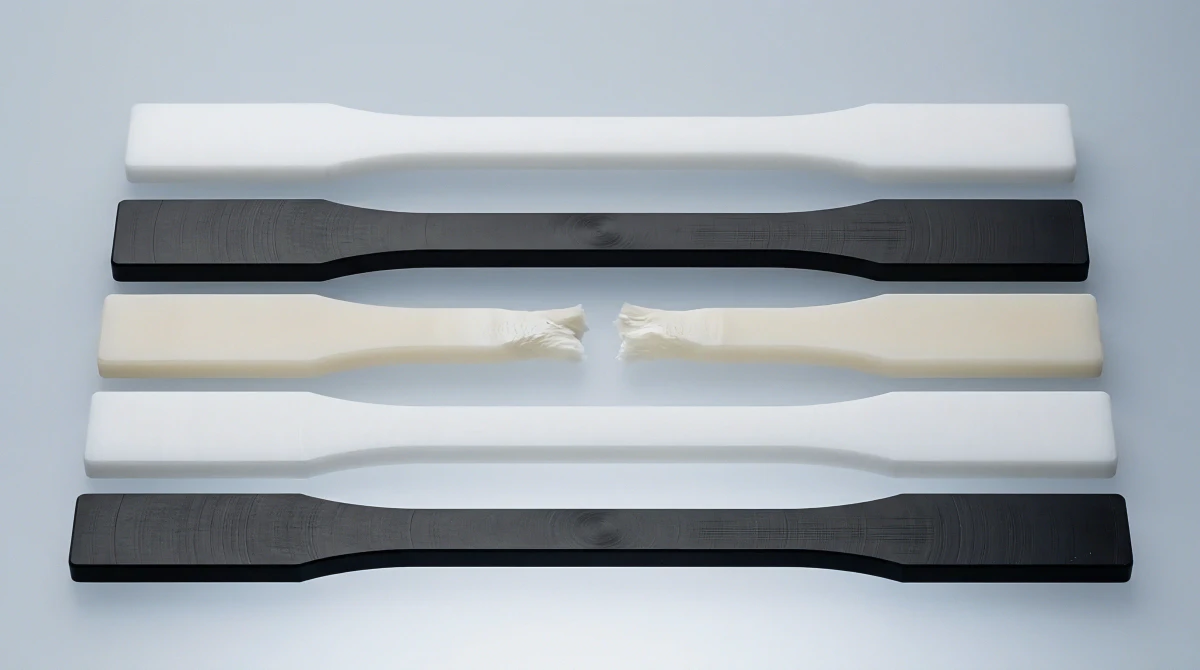
ASTM D638 fixes a dumbbell specimen, its pretreatment, temperature, humidity and testing speed. ASTM D648 fixes a bar loaded edgewise, a fiber stress, a heating rate and a deflection of 0.25 mm (0.010 in). ASTM D696 fixes a temperature range of −30 to 30 °C (−22 to 86 °F) and a silica dilatometer. UL 94 fixes bar sizes, flame size, flame time and a cotton indicator.
Read More

ISO Relation

The ASTM methods name their ISO cousins and warn against mixing them. D638 and ISO 527-1 address the same subject but differ in technical content. D648-18 says results shall not be compared with ISO 75-1 and 75-2. D696 notes that there is no known ISO equivalent. A sheet that prints ISO values and one that prints ASTM values describe different tests.

IEC Equivalent

UL names IEC 60695-11-10 methods A and B and IEC 60695-11-20 as equivalents of its flame tests. It lists them as equivalent on request, not as identical. A buyer who needs UL recognition asks for the UL record itself.

Sheet Citation

Printed method numbers are claims to check. One Delrin sheet prints D639 for tensile modulus, a slip for D638. ASTM D648 adds that a material specification may modify the procedure and take precedence. A call-out therefore names the method, its edition and the conditions that matter.
Shore D and Rockwell Hardness on Plastic Stock Data Sheets

Shore D and Rockwell values on plastic stock sheets rank surface hardness under named methods, cannot be converted into each other, and bind a supplier only when agreed.

What Shore D and Rockwell Numbers Mean on a Plastic Stock Data SheetBoth numbers rank how strongly a plastic resists a hard indenter pressed into its surface at room temperature. Neither is a strength, a wear rating or a design value.

Cast and Extruded Nylon PA6 Stock for Machined Parts

Cast and extruded PA6 share a name but not their stress, crystallinity, chips or moisture behavior, and a machined nylon part keeps changing size after the cut.

Cast or Extruded PA6 for a Machined PartCast PA6 is usually the better machining stock when the part is large, flat, stiff or close-toleranced. Extruded PA6 is the tougher, more elastic choice for smaller parts where impact strength and elongation matter more than the last hundredth of a millimeter.

Thermal Expansion of Machined Plastic Parts by Material and Size

Every machined plastic dimension has a temperature, and the material decides how many degrees of drift a given tolerance can absorb.

Thermal Expansion of Machined Plastic Parts per 10 DegreesThe coefficient of linear thermal expansion, CTE, is the fractional length change per degree. Plastic sheets print it in 10⁻⁶ per kelvin or in inches per inch per degree Fahrenheit, and the two convert by a factor of 1.8: one in/in/°F is 1.8 per °C.

UL 94 Flammability Ratings for Machined Plastic Parts

A flame rating belongs to a material, a color and a thickness, so the call-out has to name all three and the machined wall has to stay inside them.

What UL 94 Covers and What It Leaves OutThe UL standards catalog lists UL 94 as Tests for Flammability of Plastic Materials for Parts in Devices and Appliances, in its seventh edition. Its scope states that the requirements cover tests for flammability of polymeric materials used for parts in devices and appliances, and that they serve as a preliminary indication of acceptability with respect to flammability for a particular application.

ASTM D638 Tensile Strength on Plastic Stock Data Sheets

A tensile figure on a data sheet belongs to one bar, one speed and one reading, so the sheet has to name all three before the number guides a design.

What ASTM D638 CoversThe scope of ASTM D638, Standard Test Method for Tensile Properties of Plastics, is the determination of the tensile properties of unreinforced and reinforced plastics in the form of standard dumbbell-shaped specimens, tested under defined conditions of pretreatment, temperature, humidity and testing machine speed. On astm.org the 2022 edition is listed as active.

Request a Plastic CNC Quote

Send the 2D drawing and the 3D file, with the quantity and the stage of the project. An engineer replies within 1 working day.

The quote form, the mutual NDA and the private folder for your files are on Protolis Atelier, with Plastic CNC chosen.

Request a Quote