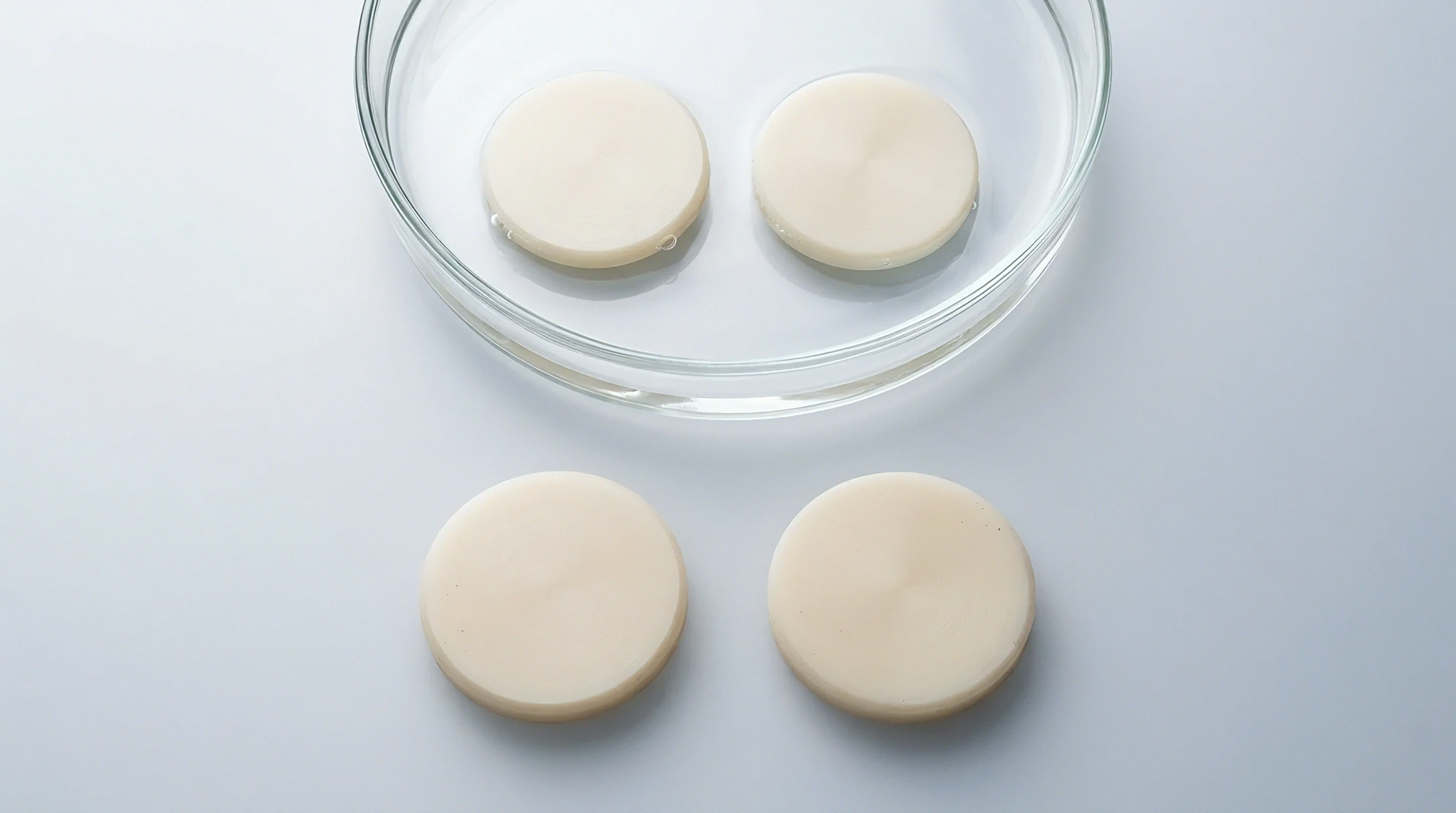
Röchling’s ASTM data sheet for its cast nylon Sustamid 6G prints two water absorption figures to ASTM D570: 1 % after 24 hours and 8.5 % in a second row with no condition beside it. The first is what a nylon bar takes up in a day under water. That second figure is closer to what it can hold. Between them sits the problem every machined nylon part carries: the material keeps taking up water long after it has been cut, measured and shipped, and it grows as it does.
ASTM D570 is the test behind those rows, and ISO 62 is its international counterpart. It is often read as a ranking of how “wet” a plastic gets. For a buyer of machined parts, it is more useful as a warning about time, thickness and size. This article reads the public scope of D570, sets the values the stock makers print beside each other, and follows the weight gain through to the dimensional change that reaches the gauge.
What ASTM D570 Measures and Why Nylon Parts Care
The method determines the relative rate at which plastics absorb water when immersed. ASTM gives the test two jobs.
One is to guide how much water a material takes up and, where the link to other properties is known, what exposure to water or humidity does to electrical, mechanical, dimensional or appearance properties. The other is to serve as a control test on the uniformity of a product, which ASTM says applies particularly to sheet, rod and tube when the test is made on the finished product.
The second job matters for machining stock. Rod, tube and sheet are the stock shapes a machined part is cut from, and the standard explicitly covers them.
Nylon cares more than most plastics because of how much water it holds. Plastics Technology, the trade journal, explains that most hygroscopic plastics absorb about 0.1 to 0.2 % water over time under normal air, while unfilled nylon, because of hydrogen bonding, reaches about 1.5 to 2 % at room temperature in 35 to 65 % relative humidity and 5 to 8 % when continuously immersed. Those levels change both properties and size.
D570 measures weight gain under water, not growth in service air. For nylon, the gap between the two is where a machined dimension drifts.
The Scope of ASTM D570 and Its Link to ISO 62
ASTM’s public scope sets out what the method covers. It applies to all types of plastics, including cast, hot-molded and cold-molded resinous products, homogeneous and laminated materials, and rod and tube as well as sheet of 0.13 mm (0.005 in) thickness or more. Values in SI units are the standard. ASTM states that D570 and ISO 62 are technically equivalent when the test specimen described in the standard is used.
The same page carries the observations that explain why one number is never the whole story.
- Water diffuses into polymers as a function of the square root of immersion time, so the uptake slows as the test goes on.
- Time to saturation depends strongly on specimen thickness; the standard itself illustrates this with nylon 6.
- The moisture content of a plastic is closely tied to electrical insulation resistance, dielectric losses, mechanical strength, appearance and dimensions.
- The effect of absorbed water depends on whether the exposure is immersion or high humidity, on the shape of the part and on the plastic itself.
- Absorption is sometimes slightly greater through cut edges than through molded surfaces, even in homogeneous materials.
- For materials of very different density, absorption should be considered on a volume basis as well as by weight.
The cut-edge note deserves attention from anyone buying machined parts. A molded part has a molded skin. Machining leaves almost no molded surface; every face is a cut face. The standard does not quantify the difference, but it names the direction.
Immersion Conditions Printed on Stock Data Sheets
Data sheets do not reproduce the standard’s procedures. They print a condition beside each value, and those conditions are the practical classes a buyer meets. Table 1 lists the conditions found on the stock sheets used in this article.
| Condition printed | Standard | Where it appears | What it describes |
|---|---|---|---|
| 24 hours at 23 °C (73 °F) | ASTM D570 | Ensinger US sheets for PEEK and acetal | Short-term uptake under immersion |
| 24 hours, temperature not printed | ASTM D570 | Röchling Sustamid 6G ASTM sheet | Short-term uptake under immersion |
| Saturation at 23 °C (73 °F) | ASTM D570 | Ensinger US sheet for acetal | Uptake when no more water enters |
| Saturation at 23 °C (73 °F) | DIN EN ISO 62 | Ensinger US sheet for PEEK | Uptake at saturation under the ISO method |
| 24 hours and 96 hours at 23 °C (73 °F) | DIN EN ISO 62 | Ensinger European sheets for PA6 and PEEK | Two short-term points on the uptake curve |
| No condition printed | ASTM D570 or DIN EN ISO 62 | Röchling Sustamid 6G ASTM and ISO sheets | A value that cannot be placed on the curve |
The last row is the one to question. A water absorption figure without its time or its saturation note could describe a day under water or a part soaked to its limit.
Water Absorption Values for Nylon, Acetal and PEEK Stock
Table 2 sets the printed values side by side. The method and condition columns are copied from each sheet.
| Grade (maker) | Method | Condition | Value |
|---|---|---|---|
| Sustamid 6G, cast PA6 (Röchling, ASTM sheet) | ASTM D570 | 24 hours | 1 % |
| Sustamid 6G, cast PA6 (Röchling, ASTM sheet) | ASTM D570 | not printed | 8.5 % |
| Sustamid 6G natural, cast PA6 (Röchling, ISO sheet) | DIN EN ISO 62 | not printed | 2.5 % |
| TECAMID 6 natural, extruded PA6 (Ensinger) | DIN EN ISO 62 | 24 h / 96 h at 23 °C | 0.3 % / 0.6 % |
| TECAFORM AH natural, acetal copolymer (Ensinger, US) | ASTM D570 | 24 hours at 73 °F | 0.18 % |
| TECAFORM AH natural, acetal copolymer (Ensinger, US) | ASTM D570 | saturation at 73 °F | 0.80 % |
| TECAPEEK natural, PEEK (Ensinger, US) | ASTM D570 | 24 hours at 73 °F | 0.03 % |
| TECAPEEK natural, PEEK (Ensinger, US) | DIN EN ISO 62 | saturation at 73 °F | 0.45 % |
Two observations follow. Nylon sits an order of magnitude above acetal and PEEK at every printed condition, which is the reason acetal is so often chosen where size has to hold. And the two nylon makers print 24-hour values that differ by more than a factor of three, 1 % against 0.3 %, under methods that ASTM calls equivalent only when the same specimen is used. Specimen size, conditioning before the test and the exact grade are the likely sources; the sheets do not say which.
Ensinger groups its materials the same way in words. Its lower-uptake group, which it calls generally much more dimensionally stable, includes its acetal, PET, PPS and PEEK. The high-uptake group, whose dimensions are markedly affected, is its extruded and cast nylons.
From Weight Gain to Dimensional Change
D570 reports weight. The drawing reports length. Two sources connect them for nylon and acetal.
Ensinger gives a rule of thumb for its polyamides: 3 % moisture uptake causes a dimensional change of about 0.5 %, and thin-walled parts up to about 10 mm (0.39 in) can absorb up to 3 %. Plastics Technology gives a similar figure for parts molded from unfilled nylon 6 or 6/6: growth of about 0.5 to 0.6 % from moisture at room temperature, more at higher temperature, and still about 0.1 % for a highly filled nylon. For unfilled acetal at room temperature and 50 % relative humidity, the same article gives about 0.2 % uptake and about 0.2 % growth, rising to almost 0.8 % uptake and 0.7 % growth at 100 % relative humidity.
Table 3 turns those percentages into length on a 50 mm (1.97 in) feature, a common size for a machined bushing or housing.
| Material and exposure | Published growth | Change on 50 mm, mm (in) |
|---|---|---|
| Unfilled nylon, 3 % uptake (Ensinger rule) | about 0.5 % | 0.25 (0.010) |
| Unfilled nylon 6 or 6/6, room temperature (Plastics Technology) | 0.5 to 0.6 % | 0.25 to 0.30 (0.010 to 0.012) |
| Highly filled nylon (Plastics Technology) | about 0.1 % | 0.05 (0.002) |
| Unfilled acetal, 50 % RH (Plastics Technology) | about 0.2 % | 0.10 (0.004) |
| Unfilled acetal, 100 % RH (Plastics Technology) | 0.7 % | 0.35 (0.014) |
A quarter of a millimeter on 50 mm is far wider than the tolerance most machined bores are drawn to. The acetal rows are a useful corrective too. Acetal is the usual answer to nylon’s moisture problem, and at normal humidity it is, but Plastics Technology records a case where acetal pistons grew about 0.10 mm (0.004 in) on a 15.2 mm (0.600 in) diameter after long conditioning at 85 °C (185 °F) and 95 % relative humidity, which used up the smallest clearance in the assembly’s tolerance stack of 0.10 to 0.25 mm (0.004 to 0.010 in).
Weight gain becomes size gain. For unfilled nylon the published conversion is about half a percent of length for a few percent of water, which is more than most machined tolerances allow.
Thickness, Cut Surfaces and Time to Equilibrium
The square-root law in D570’s scope has a practical meaning: a thin part reaches equilibrium in days to weeks, a thick one in months, and a large bar may never reach it through its whole section. Ensinger describes the result in polyamide stock. In small sections the water content is almost uniform across the cross-section. Rods and plates from about 100 mm (3.94 in) behave differently: the moisture content falls from the outside inward, and in the worst case the core stays brittle and hard.
Machining exposes that gradient. A part cut from the middle of a large, dry-cored bar starts drier than a part cut near its skin, and both then take up water from the air at their new, fully cut surfaces. Ensinger notes that moisture uptake and release cause swelling and shrinkage, and that conditioning may be recommended before processing.
Plastics Technology adds the molding view of the same process. Nylon is dried before molding, so a part leaves the mold at below about 0.2 % moisture, the dry-as-molded state, and then climbs toward about 2 % in normal air. Many molders condition parts deliberately to shorten the time to equilibrium from weeks or months to a couple of days. Water also lowers the glass transition of nylon 6 and 6/6, from 65 to 70 °C (149 to 158 °F) down to about 10 °C (50 °F), which is why dry nylon feels brittle in a cold winter and conditioned nylon feels tough.
The same physics applies to machined nylon, even though the stock is not molded by the shop. A bar stored in a dry warehouse and cut into thin parts will absorb water after machining, and the parts will grow toward their service size over the following weeks.
Moisture and the Other Rows of a Nylon Data Sheet
D570’s scope ties moisture to electrical insulation resistance, dielectric losses, mechanical strength and appearance as well as to size. The nylon data sheets show that link in the conditions they print, or fail to print, beside their other rows.
Ensinger’s TECAMID 6 sheet is explicit on its electrical rows. Surface and volume resistivity, both 10¹⁴, are measured at 23 °C (73 °F) and 12 % relative humidity. Dielectric strength, 31 kV/mm, and tracking resistance, CTI 600 V, are measured at 23 °C and 50 % relative humidity. A buyer comparing nylon grades for an insulating part therefore needs the humidity behind each number, because the same bar at a different moisture content will not give the same reading.
Röchling’s ISO sheet for Sustamid 6G natural prints its electrical rows, a volume resistivity of 10¹⁵ Ω·cm and a dielectric strength of 20 kV/mm, without a humidity condition. It does print a general note on the mechanical side: under the influence of moisture absorption the properties of polyamides change, the material becomes tougher and more impact resistant, and its modulus of elasticity declines. In thick-walled parts only a surface layer is affected, to a certain depth, and the center keeps its original properties.
Ensinger states the same trade in reverse. Polyamides are naturally rather brittle in the freshly made, dry state, and the moisture they take up is what gives them their balance of toughness and strength. A dry nylon part is stiffer and more brittle than the same part a month later; a conditioned one is tougher and slightly larger.
On a nylon data sheet, every mechanical and electrical value belongs to a moisture state. Where the sheet prints the humidity, the value can be compared; where it does not, the comparison is open.
What a Supplier Signs and What D570 Leaves Open
A data-sheet water absorption value is a typical result, not a lot guarantee. Röchling’s ASTM sheet states that its values are averages from regular statistical tests, provided for information and not binding unless agreed in a contract of sale. Ensinger issues confirmations only with an actual order and the material supplied, and lists tests in its own laboratories that can be included in a works test certificate of type 3.1. ASTM’s own description of D570 as a control test on finished sheet, rod and tube makes it a reasonable lot test when moisture behavior matters to the part.
What the standard leaves open is everything between the bath and the application.
- Equilibrium moisture in service air, which depends on humidity and temperature rather than immersion.
- The dimensional change that follows, which D570 does not measure.
- The rate of uptake in a specific part, which depends on its thickness and its cut surfaces.
- The moisture state of the stock when it was machined.
The drawing and the purchase order can close those gaps with a few lines.
- State the moisture condition at which dimensions are inspected: as machined, after conditioning at a stated temperature and relative humidity, or after drying.
- Ask how the stock is stored before cutting; Ensinger’s guidance is flat, in closed rooms at 23 °C (73 °F) and 50 % relative humidity where possible.
- Where moisture matters to function, name D570 or ISO 62 with the condition required, and the certificate type.
- Allow for moisture growth on fits and clearances in nylon, or specify a lower-absorbing grade such as acetal or PEEK.
Plastics Technology makes the same point from the molding side: the processor and the end user need to agree the conditions under which parts are measured for first-article approval. The same is true for a machined nylon part, and it costs one line on the drawing.
For nylon parts that are inspected and shipped in batches, low-volume plastic CNC with bridge production keeps the stock storage, the conditioning state and the inspection condition the same for every lot.
Sources and Further Reading
- ASTM D570, Standard Test Method for Water Absorption of Plastics, ASTM International
- Dimensional Stability After Molding, Part 4, Plastics Technology
- Technical Data Sheet, Sustamid 6G, ASTM, version 2.0, 2024, Röchling
- Technical Data Sheet, Sustamid 6G natural, version 4.0, 2023, Röchling
- PA 6, TECAMID 6 natural, Ensinger
- POM-C unfilled, TECAFORM AH natural, Ensinger
- PEEK unfilled, TECAPEEK natural (US data), Ensinger
- Frequently asked questions, machinable plastics, Ensinger