Meaning
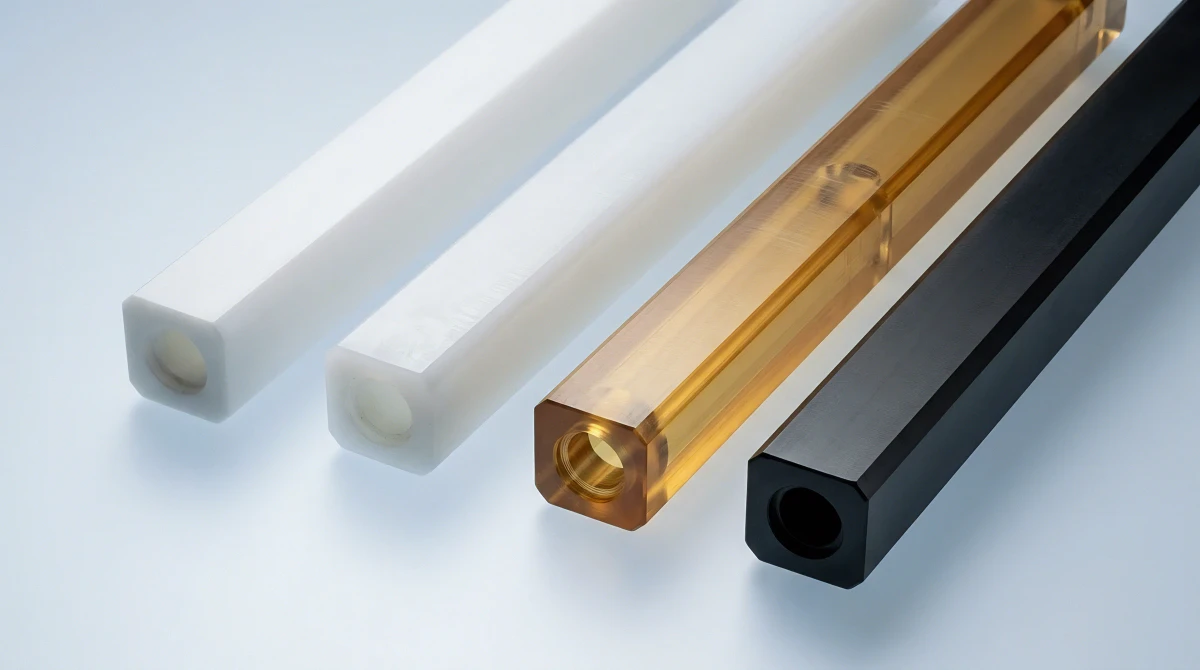
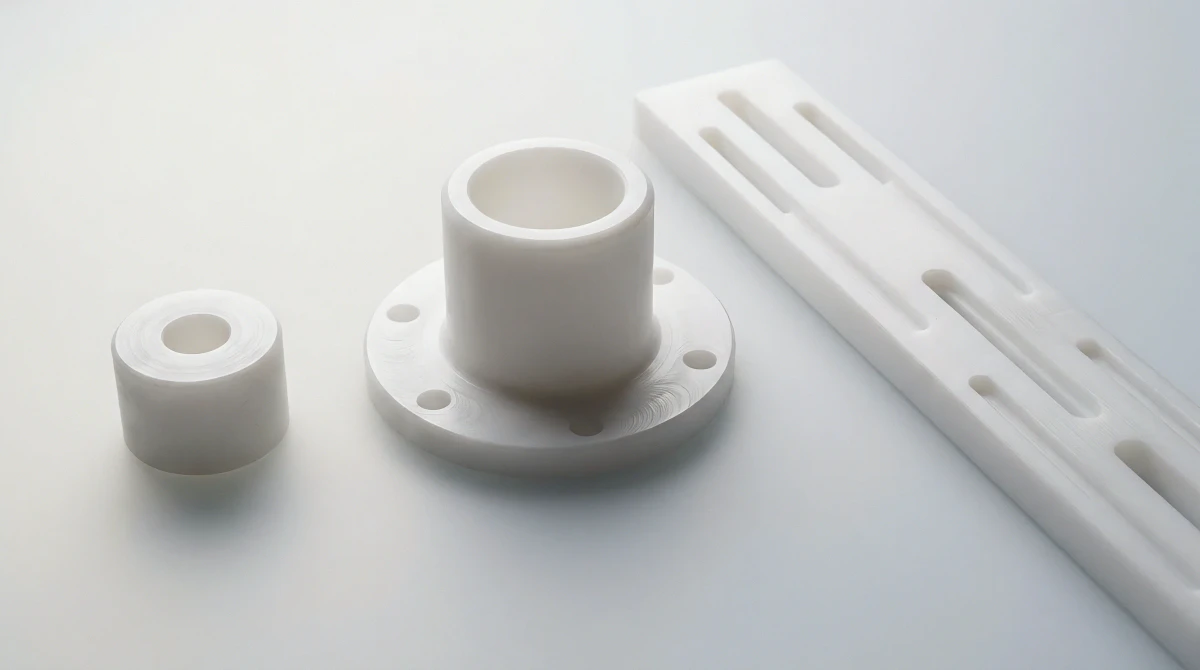
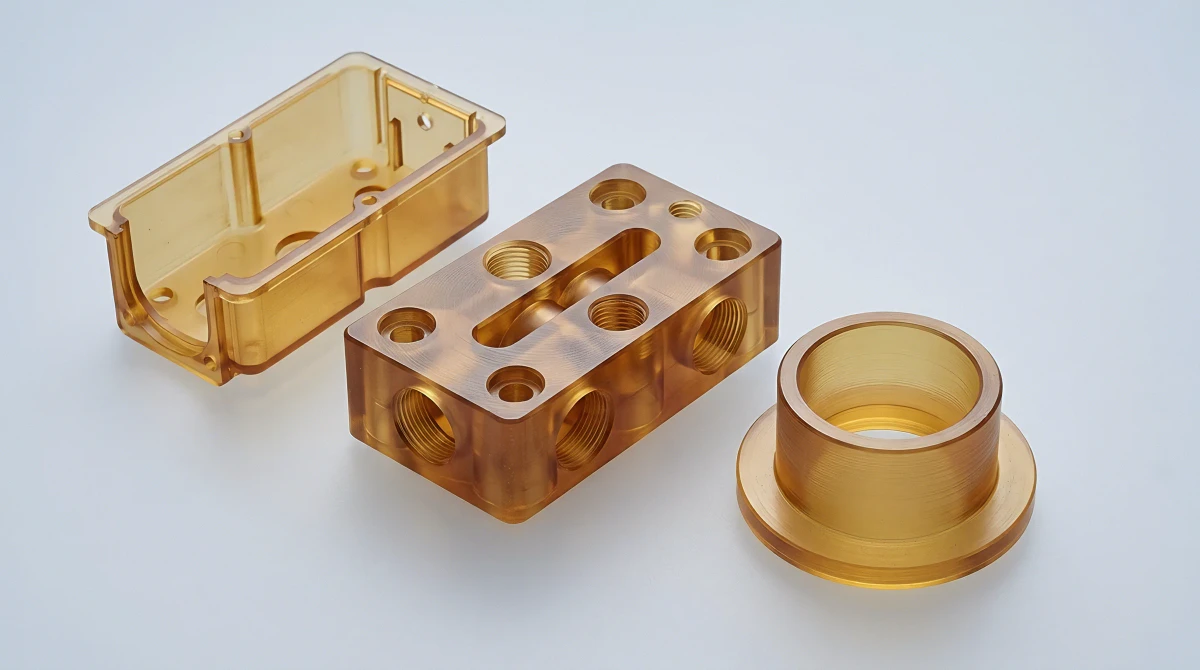
PEI, polyetherimide, is an amorphous high-temperature thermoplastic machined from rod and plate sold as Ultem or Duratron U1000. Ensinger calls PEI inherently flame retardant with low smoke emission. On the stock sheets it is stiff, holds shape at heat and carries a UL 94 rating of V-0. In the shop it is sensitive to cutting fluids, to stress and to heat held at the edge.Amorphous Structure
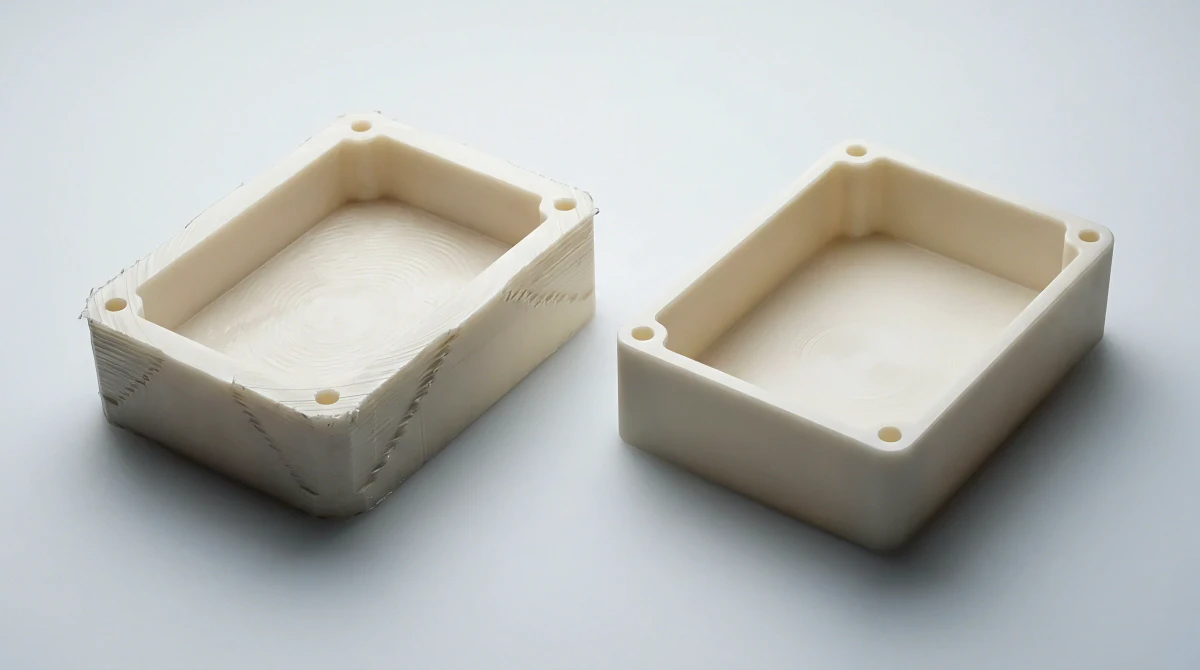
PEI has no crystalline melting point to stay below. Heat in the cut shows up as a surface that smears and as stress that stays in the part. Tangram Technology places amorphous thermoplastics among the materials more sensitive to stress and to cooling fluids than semicrystalline ones such as acetal. Thermal conductivity adds to it. Ensinger lists 1.5 to 1.56 BTU·in/(h·ft²·°F), about 0.22 W/m·K, for its PEI stock. Heat stays where the cutter put it.Read More
Property Data
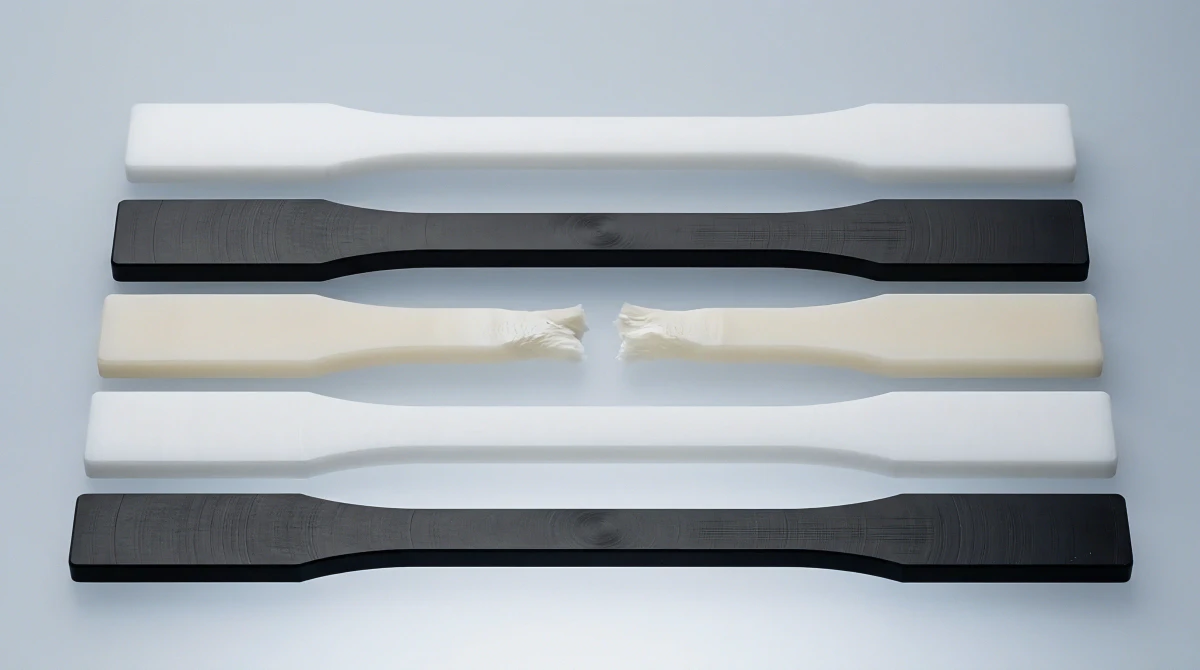
Ensinger lists unfilled PEI beside a 30 percent glass grade. At 30 percent glass, tensile modulus rises from 2.96 to 8.96 GPa (430,000 to 1,300,000 psi). Linear thermal expansion falls from 56 to 20 x 10⁻⁶ per K. Heat deflection at 1.82 MPa (264 psi) rises from 200 to 210 °C (392 to 410 °F). Elongation at break falls from 60 percent to between 3 and 13 percent. Water absorption at equilibrium drops from 1.25 to 0.90 percent. Tangram notes that glass, carbon and graphite filled grades are more abrasive, which is the cost of the stiffness. Heat deflection near 200 °C (392 °F) is a short test on a loaded bar. Ensinger gives the unfilled grade a long-term service temperature of 170 °C (338 °F). A bracket at 80 °C (176 °F) sits far inside both figures, where acetal has little room and polyethylene none.Fluid Sensitivity
Mitsubishi’s machining guide warns that mineral-oil cutting fluids may contribute to stress cracking of amorphous plastics, and names Duratron U1000 PEI. It recommends cutting dry with air or a mist where the geometry allows. Deep holes take a nonaromatic, water-soluble coolant. The part is then washed in isopropyl alcohol and pure water. The damage is delayed, so a clean first article proves little. A later wipe with a solvent meets the same stress the cutter left.Cutting Data
Mitsubishi gives unfilled PEI turning at 200 to 400 m/min (655 to 1,310 ft/min) and 0.05 to 0.4 mm/rev (0.002 to 0.016 in/rev) with carbide. Milling runs at the same speed with up to 0.4 mm (0.016 in) per tooth. Drilling runs at 50 to 100 m/min (165 to 330 ft/min). The filled line drops to 100 to 200 m/min (330 to 655 ft/min) for turning. For glass or carbon filled PEI, the guide calls polycrystalline or CVD diamond tooling essential.Stress Relief Cycle
PEI, like polycarbonate and polysulfone, may be annealed to limit stress crazing, and Mitsubishi holds it at 200 °C (392 °F). Its cycle holds unfilled PEI at 199 °C (390 °F) and the glass grades at 204 °C (400 °F). It heats for 4 hours, holds 30 minutes per 6.35 mm (1/4 in) and cools at 28 °C (50 °F) per hour. Mitsubishi holds at 200 °C (392 °F). It heats at 10 to 20 °C (18 to 36 °F) per hour. It cools at 5 to 10 °C (9 to 18 °F) per hour. Both makers call their figures guidelines, so a shop names the cycle it follows.Tolerance and Drawing Notes
Mitsubishi places PEI in one group with PC, PEEK, PPS, PET-P, PPSU and PSU. The group’s best published figure is 0.02 mm (0.0008 in) at 10 mm (0.39 in) and 0.06 mm (0.0024 in) at 100 mm (3.94 in). The guide does not state whether these are bands or plus-and-minus values. Water uptake of 1.25 percent at equilibrium means a size checked fresh and again after weeks in humid air may differ. A PEI drawing names the maker’s grade and any glass content with its percentage. It gives the cleaning method or fluid the part will meet, so a wipe-down does not undo the machining. It says whether the part is annealed, by which cycle and before or after the finish cut. Any dimension under about 0.1 mm (0.004 in) carries a measurement temperature and humidity condition. Corners that cannot take a chamfer are flagged.