Meaning
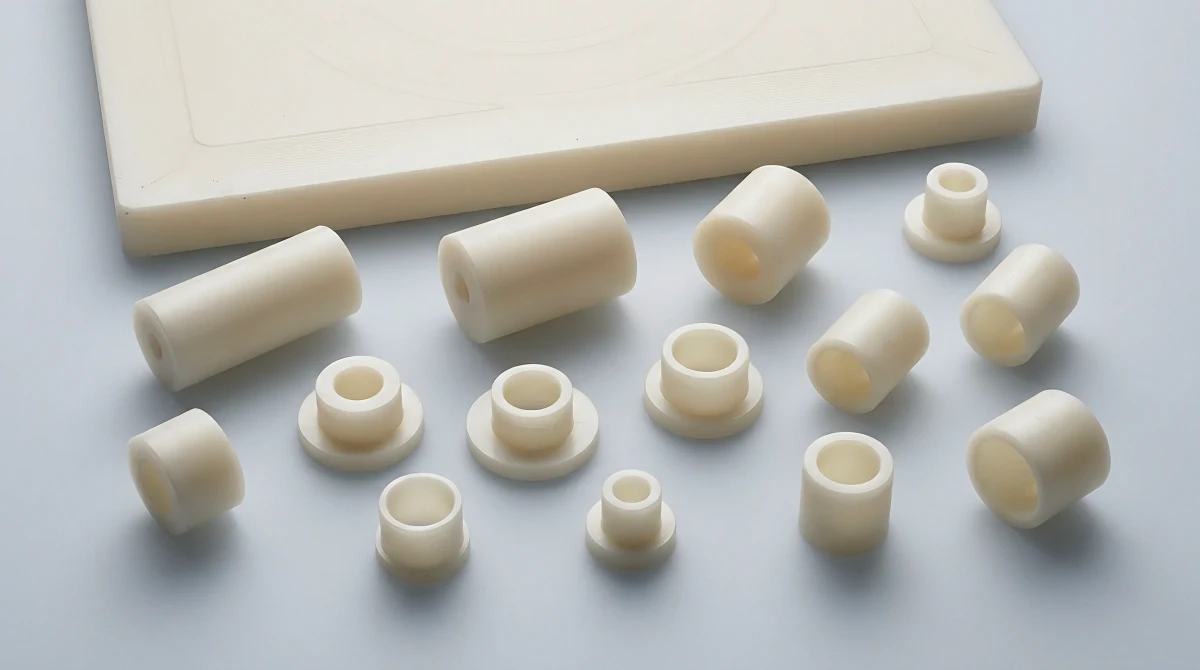
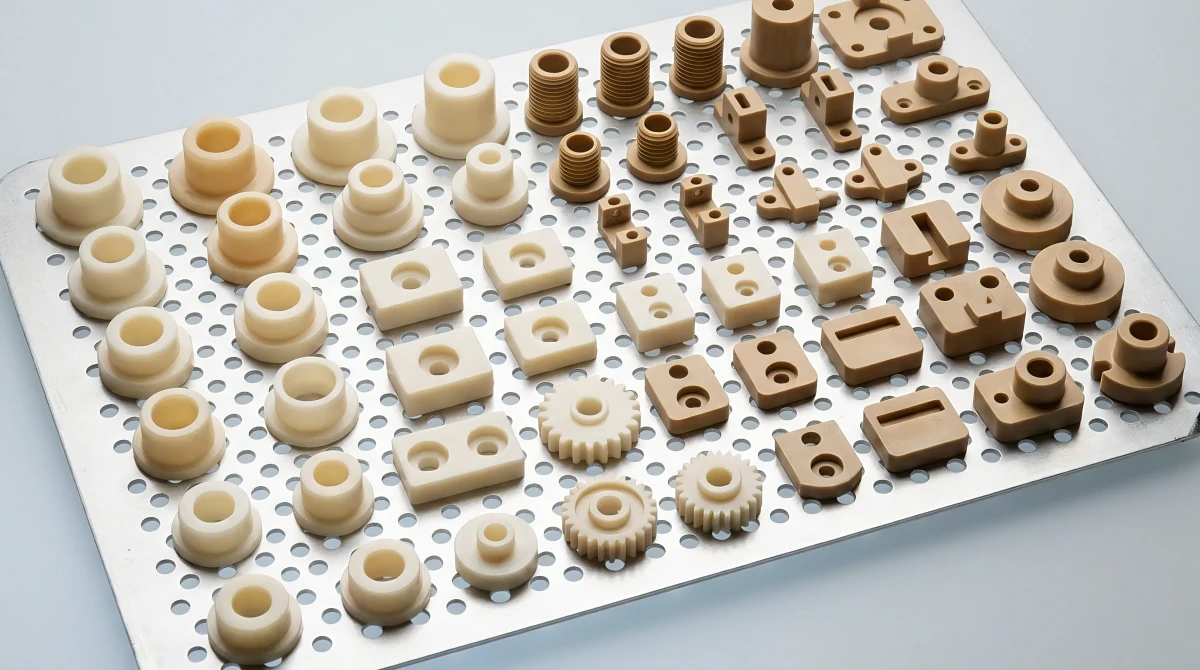
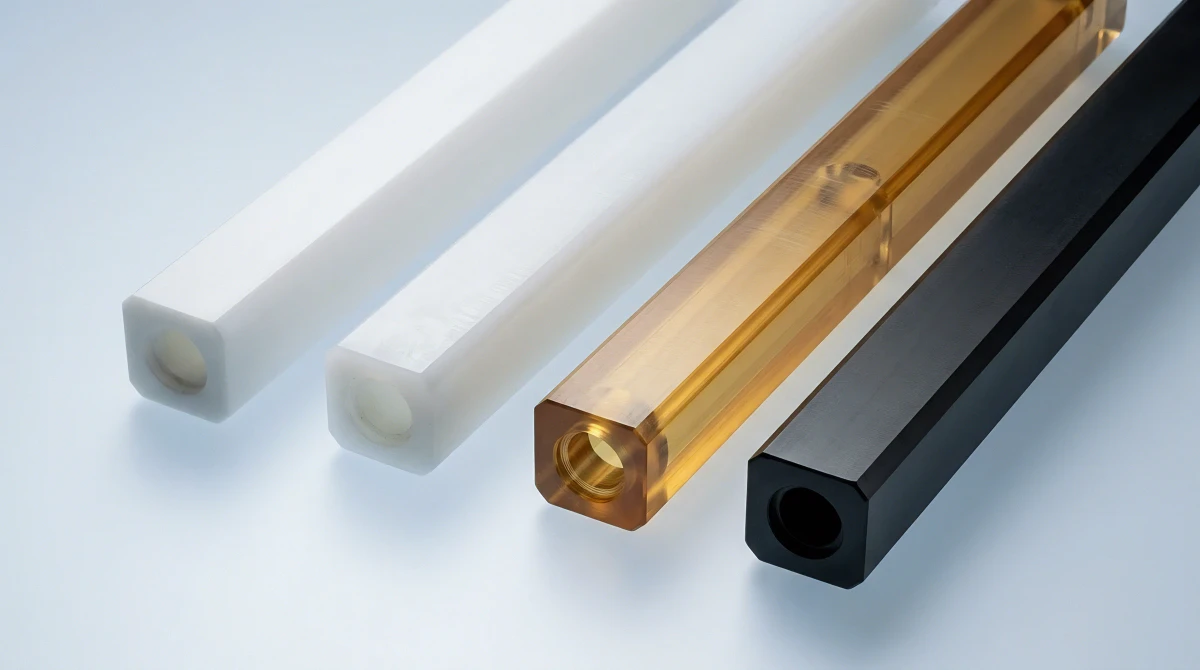
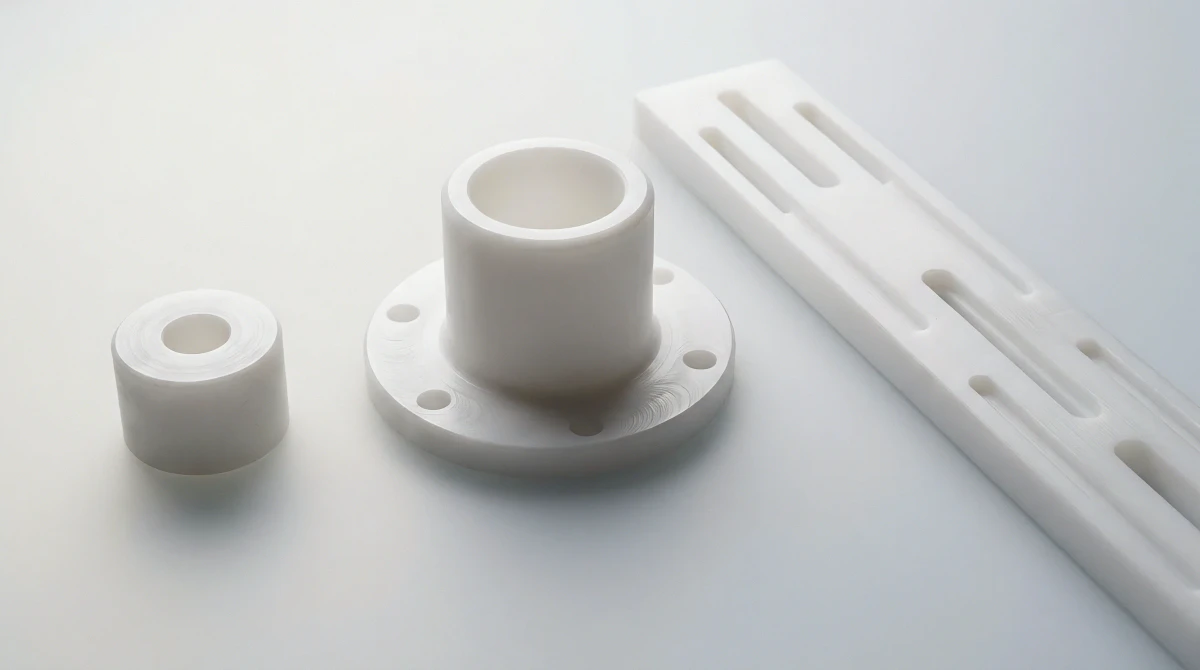
Acetal is the polyoxymethylene (POM) family of engineering plastics, sold as homopolymer (POM-H) and copolymer (POM-C) rod, plate and tube for machined parts. The two chemistries cut alike and cost nearly the same, and they differ in the finished part. Tangram Technology rates POM as excellent to machine. Density sits at 1.41 to 1.42 g/cm³ (about 0.051 lb/in³) on every sheet in these resources.Chemistry Choice
Homopolymer chains repeat one unit, and copolymer chains carry two. Ensinger sums up the result for unfilled grades: homopolymer has a slightly higher density, hardness and strength because of its higher crystallinity. Homopolymer is about 10 to 15 percent stronger and stiffer, and copolymer resists hot water and chlorine-bearing cleaners better. Ensinger rates the copolymer for 91 °C (195 °F) long term and the homopolymer for 85 °C (185 °F), with wear factors of 65 and 55 on its stock pages. Homopolymer shows the higher heat deflection temperature. Copolymer is reported to resist thermal degradation better at higher temperature. Its stock also carries far less porosity along the centerline of rod and plate, which matters for any part that holds a fluid.Read More
Stock Grades
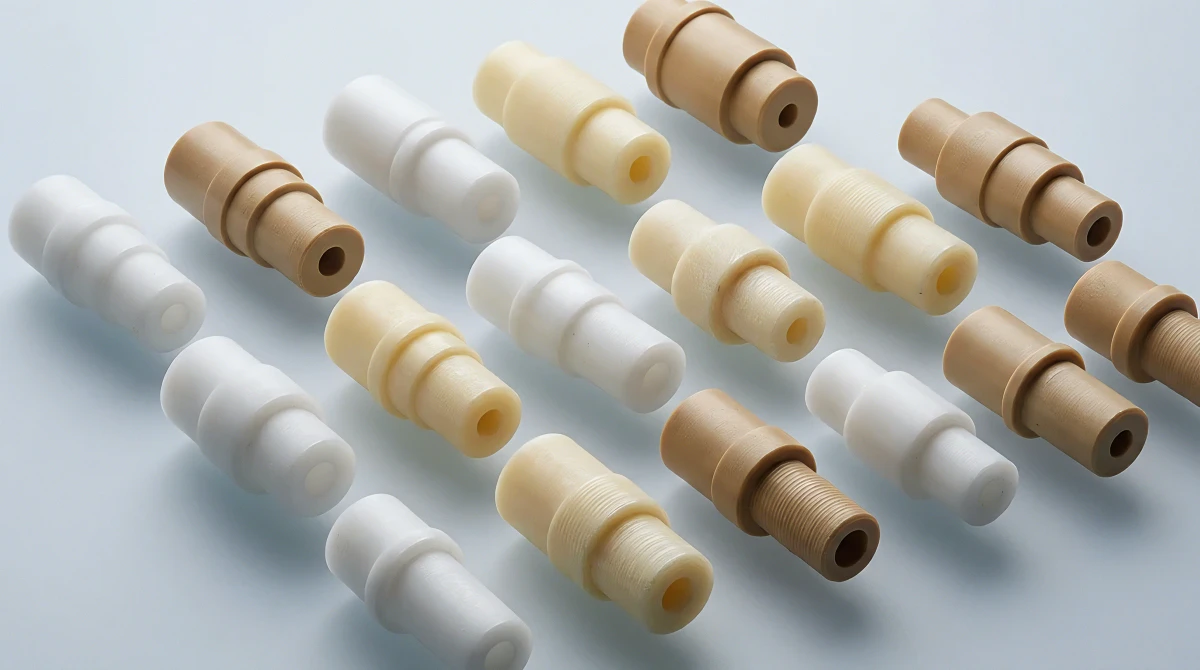
Few resins reach stock form. Ensinger makes its homopolymer stock, TECAFORM AD, from Delrin resin of the 150 series. Delrin 527UV is the UV-stabilized grade most suited to extrusion, and Delrin 100AF is the only low-friction grade designed for it. Converters also extrude 100AF as a blend with Delrin 100, known as AF Blend. Enhanced-crystallinity, toughened, low-emission and glass-filled Delrin resins are listed as injection molding grades. On the copolymer side, Ensinger’s TECAFORM AH and Mitsubishi’s Acetron GP are sold on low centerline porosity. A grade outside this short list means a made-to-order bar.Published Properties
Four stock sheets in these resources give tensile strength from 60.7 to 76.5 MPa (8,800 to 11,100 psi). Tensile modulus runs from 2.62 to 3.10 GPa (380,000 to 450,000 psi), and homopolymer sits above copolymer in every pairing. Heat deflection at 1.8 MPa (264 psi) runs from 104 °C (220 °F) to 125 °C (257 °F). The copolymer sheets sit at the low end of that range. Water absorption is 0.22 to 0.25 percent after 24 hours and 0.80 to 0.9 percent at saturation. The Delrin 150 and TECAFORM AH sheets both print a UL 94 rating of HB. All of these are typical values for comparing materials, and the sheets say so. A worked reading in the ASTM D648 article places an acetal copolymer bracket at 80 °C (176 °F). That sits 11 K (20 °F) below the TECAFORM AH long-term service figure and 30 K (54 °F) below its heat deflection temperature. The margin is thin for a part that will creep. The annealing hold of 155 °C (311 °F) sits under the light-load deflection figures. Those run 158 to 169 °C (316 to 336 °F).Machining Behavior
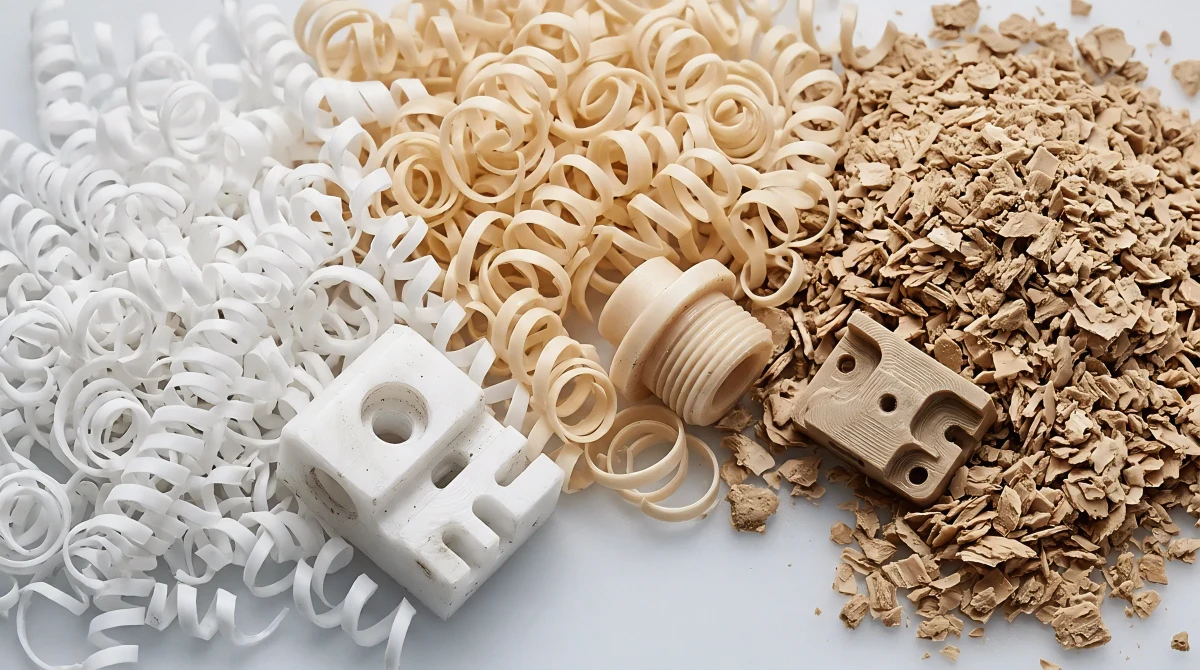
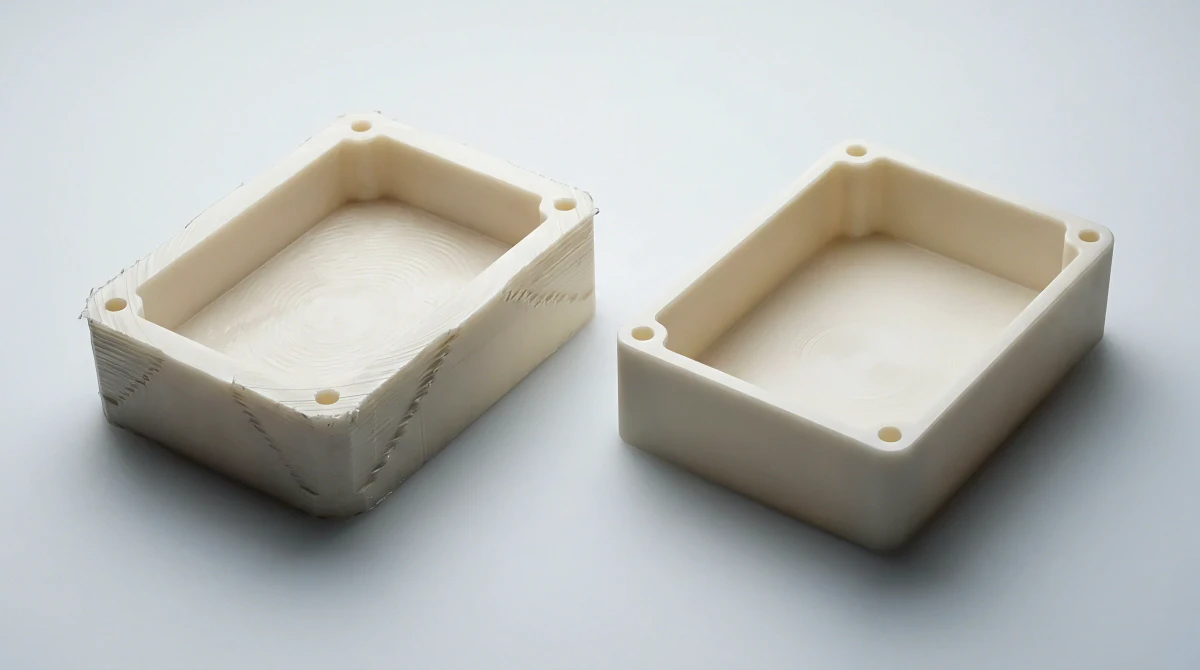
Tangram lists three faults for POM: burrs when the tool is dull, heat when the cut rubs, and undersized holes. Holes come out small unless the cutter is given enough to bite. The guide recommends single or low-flute cutters with sharp edges and generous chip clearance. Its indicative milling data give 200 to 400 m/min (655 to 1,310 ft/min) and up to about 0.5 mm (0.020 in) per tooth. Turning runs at 200 to 500 m/min (655 to 1,640 ft/min). Ensinger lists good machinability and high stiffness among the homopolymer’s features. The same holds for diameters under 25 mm (1 in) on high-speed CNC lathes.Size Control
Mitsubishi Chemical Advanced Materials places acetal in one tolerance group with polyamide and PTFE 207. Its best published figure for that group is 0.03 mm (0.0012 in) at a 10 mm (0.39 in) size. At 100 mm (3.94 in) the figure widens to 0.09 mm (0.0035 in). The guide does not say whether these are total bands or plus-and-minus values. Ensinger states that its stock shapes are annealed after production to reduce internal tension. A pocketed or ribbed part can still move as the remaining stress is released. Where a second anneal is needed, Mitsubishi’s 2026 guide prints a hold of 155 °C (311 °F) for both chemistries.Drawing Callout
A drawing that names only POM or Delrin leaves homopolymer, copolymer and every filled variant open. Naming the chemistry, the maker’s grade and the shapes standard, ASTM D6100, makes the stock a controlled input. The drawing should also state the measurement temperature. A 100 mm (3.94 in) acetal feature grows about 0.12 mm (0.005 in) over 10 K (18 °F), more than many plastic tolerances. Parts that hold a fluid or a gas call for a pressure or leak test on the first article, whichever chemistry is bought.