Meaning
A data sheet is the maker’s printed table of a material grade’s typical properties, each with its test method and conditions. For machined plastic it is the main source of strength, stiffness, heat and expansion figures. The sheets in these articles come from stock makers, Ensinger and Mitsubishi, and a sheet maker, Spartech. They are written for comparing materials, and most of them say so.Typical Basis
Mitsubishi states that its values are mainly for comparison, are not guaranteed and are not to be used as specification limits. Ensinger calls its figures guidelines, not minimum or maximum values. Ensinger calls its values guidelines, not minimum or maximum values. A buyer who needs a minimum asks for one in writing, as a lot result tied to the standard that governs the shape.Read More
Units and Conditions
Most stock sheets in these resources publish inch-pound units, so metric values are conversions. Each 1,000 psi converts to 6.895 MPa, and a coefficient per °F is multiplied by 1.8 to give one per kelvin. Where two sheets differ by less than the rounding of a conversion, about 0.1 MPa (15 psi), they agree. Mitsubishi states that its tests are done at 23 °C (73 °F). Industrial lengths, by contrast, are defined at 20 °C (68 °F).Label Gap
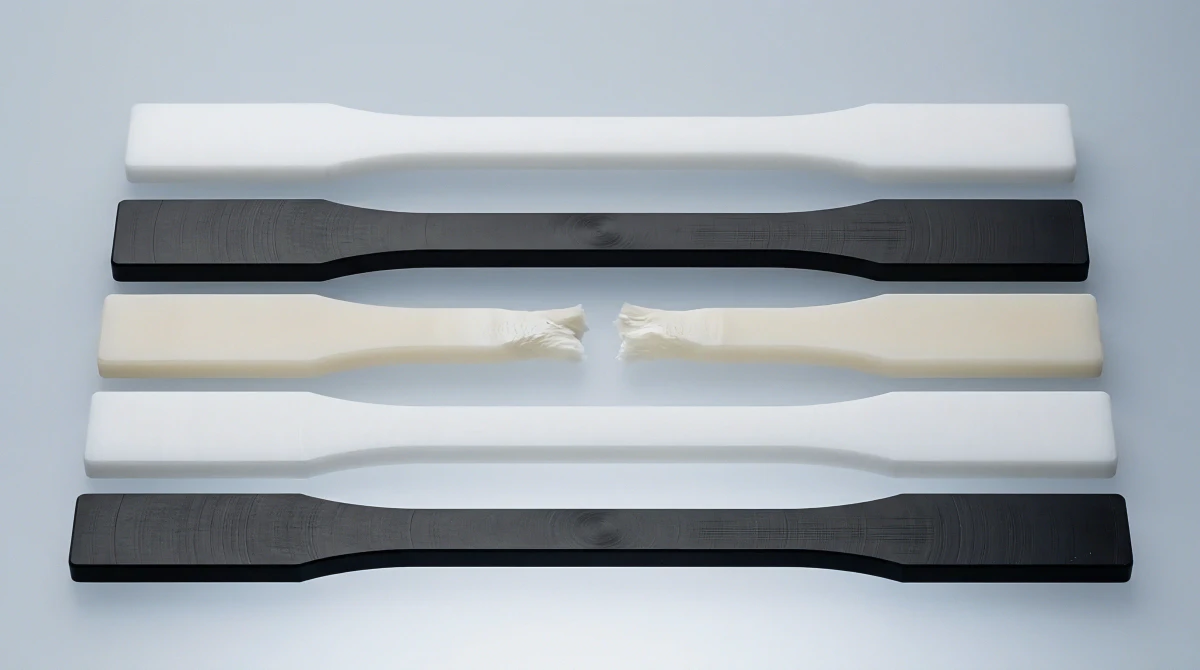
A tensile strength printed without a label may be the strength at yield or at break, as Mitsubishi’s note says. Mitsubishi’s sheet prints the specimen type and the pull speed, and says where its bars are cut from. The Spartech HDPE sheet prints heat deflection at one load only. A Delrin 150 sheet prints the method for tensile modulus as D639, a slip for D638. The lesson is that printed method numbers are claims to check. Some lines only make sense beside their neighbors. The sheets print a heat deflection temperature and a service temperature side by side, and the two differ. For acetal, long-term service sits 20 to 40 °C (36 to 72 °F) below heat deflection. For PEI the gap is about 30 °C (54 °F). Flexural modulus sits near tensile modulus on most sheets but not on all. The two HDPE sheets give flexural values of 1.15 and 1.55 GPa (167,000 and 225,000 psi). Their tensile values are 1.55 and 1.34 GPa (225,000 and 195,000 psi). One cannot replace the other without a note.Resin and Stock Source
A resin sheet comes from the maker of the pellet. A stock sheet comes from the maker or seller of the shape. Ensinger states that its data come from extruded shapes material unless otherwise noted. One PEI stock sheet gives break at 104.8 MPa (15,200 psi), below that yield. None of the sheets tested the same bar, speed or lot. Several sheets also cite the specification of the shape and of the resin. The Delrin 150 sheet cites ASTM D6100 S-POM0111 for the shape and ASTM D4181 for the resin. TECAFORM AH cites D6100-11 S-POM211 and D6778-06. A shapes claim and a resin claim cover different things.Spread Between Sheets
Read across a row and the same chemistry gives different numbers. Two homopolymer acetal sheets agree within 1 MPa (145 psi) in strength and 4 °C (7 °F) in heat deflection. Two copolymer sheets differ by 5 MPa (725 psi) and 6 °C (11 °F). That spread is the size of the noise a buyer should expect when one sheet is swapped for another. The rows that move least are the useful ones. Density sits at 1.41 to 1.42 g/cm³ (0.051 lb/in³) on every acetal sheet, and the stiffness ranking holds in every pairing. No sheet says whether its bar was cut from rod or plate, at what size, or from which lot. None says where in a thick section the test bar came from. That matters for acetal, whose weakest line is the porous centerline of the plate. No sheet includes creep, time at temperature or the effect of a machined corner.Reading Order
A usable reading starts with the label beside every strength, yield or break. It then looks for the specimen type, the speed and the standard, ASTM or ISO, without mixing the two. Modulus and elongation are read beside strength, since together they say how far a part moves before it yields. A missing condition turns a figure into a typical value for ranking only.