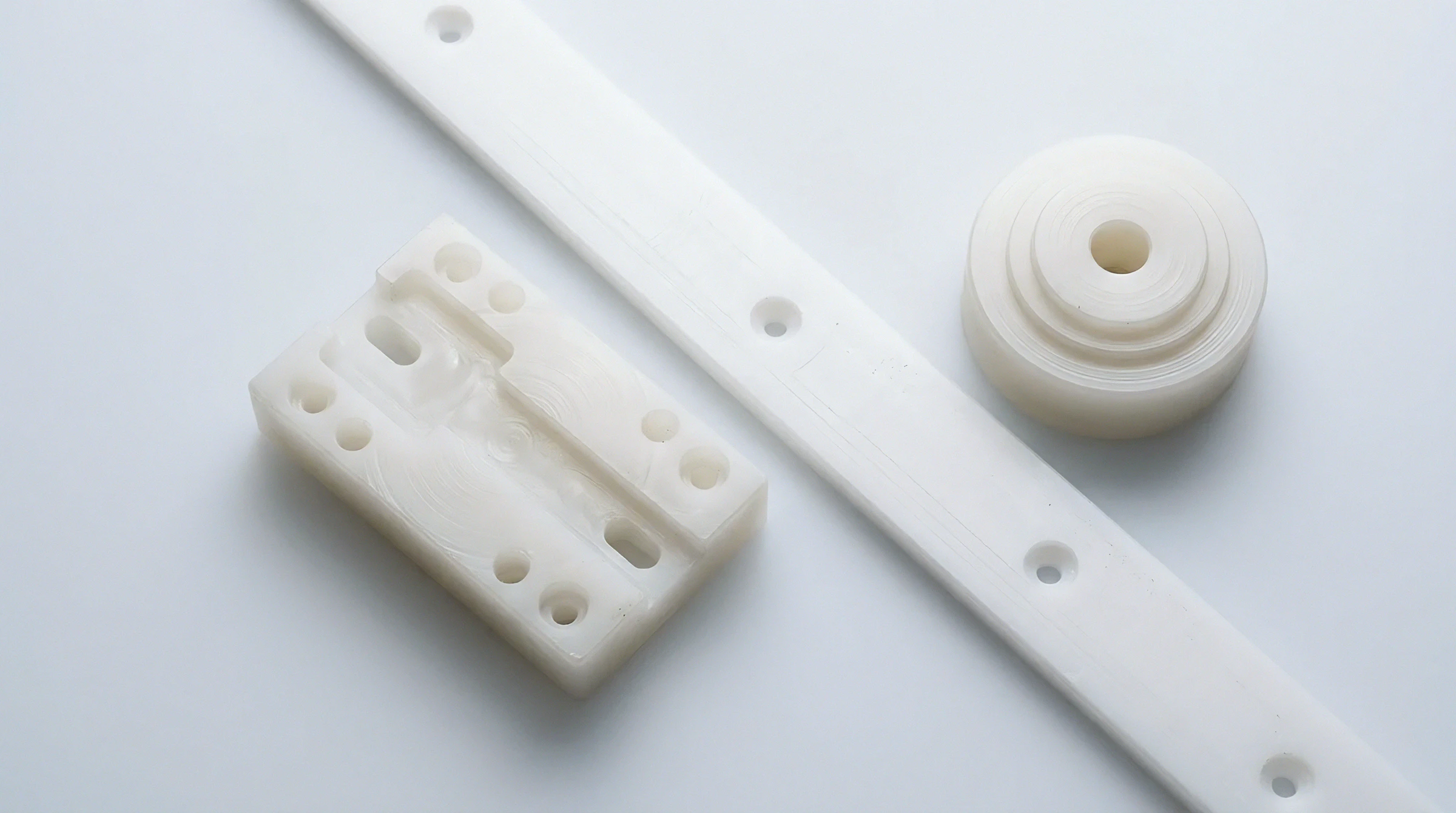
Mitsubishi’s data sheet for its ultra-high molecular weight polyethylene lists an elongation at break of 300 percent. Spartech’s sheet for plain HDPE lists 800. Both numbers say the same thing about a cutting edge: the material does not snap clean, it stretches, folds over and lets the tool slide past. A bar that behaves like that is a different job from acetal, and the shop that treats it as one gets burrs the length of the part.
Polyethylene stock is also among the most useful plastics a machine shop cuts. It is light, slick, and takes almost no water. The two grades below, UHMW-PE and HDPE, share a chemistry and almost nothing else on the machine.
UHMW-PE and HDPE Differences for Machined Parts
Both are polyethylene, and the difference starts with chain length. Mitsubishi describes its TIVAR 1000 Virgin UHMW-PE as setting the standard for ultra high molecular weight polyethylene shapes, with a combination of wear and corrosion resistance, a low-friction surface and excellent impact strength. Ensinger’s PE 1000 stock is the same polymer class, designated PE-UHMW. HDPE stock is the shorter-chain sheet that Spartech sells for stiffness and easy fabrication.
On the machine the two feel different. Tangram Technology’s guide to machining plastics rates polyolefins as fair and PE-UHMW as difficult, describing the latter as very tough and stringy. It also notes that some materials are naturally better suited to machining than to conventional extrusion and molding, with PTFE and PE-UHMW as its examples. For a complex UHMW-PE part, a machined one is often the practical shape.
Stiffness separates them as well, and it is the property that shows up in tolerances. The UHMW-PE sheets give a tensile modulus of 552 to 750 MPa (80,000 to 109,000 psi), depending on the test method. The HDPE sheet gives 1,344 MPa (195,000 psi). A UHMW-PE web or flange therefore flexes away from a cutter noticeably more than the same shape in HDPE.
UHMW-PE is the tougher, more wear-resistant and less stiff of the two. HDPE is stiffer, easier to cut cleanly and still burr-prone. Neither takes a tight tolerance without attention to heat and clamping.
UHMW-PE and HDPE Properties in Metric and Inch Units
Table 1 sets two UHMW-PE stocks against one HDPE sheet, all from their makers. Mitsubishi prints its TIVAR 1000 sheet with both ISO and ASTM values, Ensinger prints ISO values for its PE 1000, and Spartech prints ASTM values for SP-1010 HDPE, so each column carries the test method it came with; the conversions are rounded.
| Property | UHMW-PE, TIVAR 1000 Virgin (Mitsubishi) | UHMW-PE, PE 1000 (Ensinger) | HDPE, SP-1010 (Spartech) |
|---|---|---|---|
| Density | 0.93 g/cm³ (ISO 1183-1) | 0.93 g/cm³ | 0.96 (specific gravity) |
| Tensile strength | 40.0 MPa (5,800 psi), ASTM D638; 19 MPa, ISO 527 | 19 MPa at yield, ISO 527 | 31.0 MPa (4,500 psi) |
| Elongation at break | 300 %, ASTM D638 | more than 200 %, ISO 527 | 800 % |
| Tensile modulus | 552 MPa (80,000 psi), ASTM D638; 750 MPa, ISO 527 | 680 MPa, ISO 527 | 1,344 MPa (195,000 psi) |
| Flexural modulus | 600 MPa (87,000 psi), ASTM D790 | not listed | 1,551 MPa (225,000 psi) |
| Hardness | Shore D 66 (ASTM D2240), 60 (ISO 868) | ball indentation 30 MPa | Shore D 66 |
| Melting temperature | 135 °C (275 °F) | 135 °C | not listed |
| Heat deflection at 1.8 MPa (264 psi) | 42 °C (ISO 75), 116 °F (ASTM D648) | not listed | not listed |
| Heat deflection at 0.45 MPa (66 psi) | not listed | not listed | 80 °C (176 °F) |
| Linear thermal expansion | 200 x 10⁻⁶ per K (23 to 100 °C); 110 µin/in/°F (ASTM E831) | 180 x 10⁻⁶ per K (23 to 60 °C) | 108 x 10⁻⁶ per K (6.0 x 10⁻⁵ in/in/°F) |
| Long-term service temperature in air | 80 °C (180 °F), 20,000 h | 80 °C | not listed |
| Water absorption, 24 h | 0.1 % (ISO 62) | below 0.01 % | not listed |
| Dynamic friction | 0.12 (QTM 55007) | not listed | not listed |
Note how differently the columns are built. The same TIVAR bar prints 40 MPa of tensile strength by ASTM D638 and 19 MPa by ISO 527, because the two methods use different specimens and speeds and the ISO figure is the yield. A buyer comparing two sheets compares the same method, or the comparison says nothing. Mitsubishi says its values are for comparison and are not to be used as specification limits or alone as a basis of design, and Ensinger says the same of its guideline values.
Two figures matter more than the rest for machining. The first is thermal expansion. At 200 x 10⁻⁶ per kelvin, a 100 mm (3.94 in) feature of UHMW-PE grows 0.20 mm (0.008 in) over 10 °C, and the HDPE figure of 108 x 10⁻⁶ per kelvin gives 0.11 mm (0.004 in). Both exceed the tolerance most drawings ask for, so the temperature at which a part is measured is part of the tolerance.
Water is the second. The UHMW-PE sheet gives water absorption as nil and the HDPE sheet as slight, so humidity does not move these stocks the way it moves nylon, and heat is the movement to plan for.
Hardness is no help in telling them apart. Shore D reads 68, 67 and 66 across the three columns, and a durometer cannot sort one bar from the other at the receiving dock. The grade comes from the supplier’s certificate and the bar’s marking, so a purchase order should name it.
Why Polyethylene Burrs and Wraps Chips
Tangram’s table of common faults lists the problem for each material. For polyolefins it names heavy burrs, “gumming” and chip welding, and marks left by work holding. PE-UHMW draws severe burrs, chip wrap, part deflection and heat from recutting swarf. Those are the failure modes to look for on a first article.
A burr on polyethylene is the material that was pushed, not cut. Two things make it: a cutting edge that is not sharp enough to part the chain, and a cut so light that the tool rubs. Tangram makes the second point as a general rule, writing that slow and gentle is not automatically safer, since excessive light cuts create rubbing and rubbing creates heat. For polyolefins the guide asks for aggressive chip evacuation and larger chip thickness.
Chips are the other half. Soft, tough chips come off a lathe as a continuous ribbon that wraps the part, the tool and the chuck. Tangram says effective chip extraction is needed, and for UHMW-PE it recommends an air blast or vacuum to move the swarf away. A ribbon trapped between tool and part gets cut again, and the heat from that second cut is what the guide blames for deflection and size drift.
Mitsubishi’s guide gives the same instructions for the softest stocks in its own words. For polyamides, UHMW-PE and other soft materials it advises maximum feed and speed to get swarf away from the tool, tools with large clearance, milling cutters with two or three flutes and a higher helix, and an air blast or vacuum venturi. It adds that high-speed steel works well on these stocks while solid carbide is stiffer. For its flame-retardant UHMW-PE grade, the guide says liquid coolants are not suitable and that dry machining with compressed air is recommended, a reminder that a grade name decides the coolant as well.
A few habits follow from this:
- Use cutters sharp enough to shear the chain, with positive geometry and polished flutes, and replace them before they dull. Tangram says tooling should have positive geometry, polished surfaces and generous chip clearance.
- Keep the chip load up. A feed that is too small turns a cut into a rub.
- Use fewer flutes. Low flute counts leave room for chips and reduce recutting, which Tangram repeats across materials.
- Clear chips with an air blast or vacuum, which Tangram lists for UHMW-PE, and use a liquid coolant only after it is confirmed compatible with the grade.
- Deburring becomes a normal step, since burrs head Tangram’s list of faults for both materials.
Cutting Data for UHMW-PE and HDPE
Tangram prints indicative cutting data for polyolefins and for UHMW-PE. Table 2 sets them side by side with the conditions the guide gives.
| Operation | Polyolefins (PE and PP) | PE-UHMW |
|---|---|---|
| Drilling speed Vc | 50 to 150 m/min (165 to 490 ft/min) | 50 to 100 m/min (165 to 330 ft/min) |
| Drilling feed | 0.1 to 0.3 mm/rev (0.004 to 0.012 in/rev) | 0.1 to 0.3 mm/rev (0.004 to 0.012 in/rev) |
| Turning speed Vc | 250 to 500 m/min (820 to 1,640 ft/min) | 200 to 500 m/min (655 to 1,640 ft/min) |
| Turning feed | 0.1 to 0.5 mm/rev (0.004 to 0.020 in/rev) | 0.05 to 0.5 mm/rev (0.002 to 0.020 in/rev) |
| Milling speed Vc | 250 to 500 m/min (820 to 1,640 ft/min) | 200 to 500 m/min (655 to 1,640 ft/min) |
| Milling feed per tooth | higher chip load than hard plastics; increase feed if rewelding occurs | up to about 0.5 mm (0.020 in), control burrs |
| Note in the guide | soft and tough: prioritize swarf evacuation and real chip thickness | wrap-around swarf is common; air blast or vacuum helps |
The two columns are almost identical, which is the point. Numbers do not separate the two materials. Chip control does.
The guide also gives the formulas to turn a surface speed into spindle speed and a feed per tooth into a table feed, and they are worth keeping at the machine: spindle speed in rev/min is 1,000 times Vc divided by the product of pi and the tool diameter in millimeters, and table feed is feed per tooth times the number of flutes times spindle speed.
Holding and Measuring Soft Stock
A polyethylene part moves under three loads, and a tolerance has to survive all three. The first is the clamp. Tangram warns that plastics deform far more easily under clamp pressure than metals do, and advises that flat parts and thin sections be carefully supported. A UHMW-PE plate clamped hard in a vise springs back out of flat when the jaws open, and the machined face follows it.
The second is the cutter’s heat. UHMW-PE is a poor conductor and the guide names heat as the root of most failures: smearing, residual stress and dimensional drift. A part that leaves the machine warm and is measured warm reads large and shrinks back to a smaller size on the bench.
Stored stress is the third. The guide says parts can move after machining through stress relaxation, and it recommends annealing only where it adds value. For thick UHMW-PE plate with deep pockets, a rest between roughing and finishing is a cheaper first move than annealing.
What a buyer can do:
- Specify the measurement temperature, usually 23 °C (73 °F), on the drawing for any feature under about 0.2 mm (0.008 in).
- Let the part reach the measurement temperature before it is checked, because a 10 °C difference moves a 100 mm UHMW-PE feature by about 0.2 mm.
- Request roughing, rest and finishing on parts with large pockets or thin walls.
- Plan on a wider tolerance than the machine could hold on aluminum, and ask the supplier for the tolerance it can hold on the grade in question.
Parts that come off the machine in UHMW-PE keep a record of how they were held. Marks from work holding are on Tangram’s list of polyolefin faults, and Mitsubishi’s guide suggests fixed pressure jaws on newer machines and vacuum plates for plate parts. A buyer reading a first article should look at the clamped faces as well as the cut ones.
Fixtures matter as much as tolerances. Parts made of soft stock are best held on vacuum tables, soft jaws bored to the part, or fixtures that spread the load, with tool paths that cut the thin features last. That is a shop’s habit rather than a published rule, and the first article is where it shows.
UHMW-PE for Wear Parts and What the Datasheet Shows
Mitsubishi’s sheet lists the applications where UHMW-PE earns its place: bearings, bushings, chain guides, sprockets, gears, rollers, paddles and scrapers. Behind that list sit the properties in Table 1 and a few more on the same sheet: a relative volume loss in the sand-slurry test of 10 against 100 for 1018 steel (ASTM D4020 index), a dynamic coefficient of friction of 0.12, a limiting PV of 3,000 ft·lb/(in²·min) at 100 ft/min with a safety factor of 4, and a double-notched Izod impact of 47.6 ft·lb/in.
The limits are on the same page. Compressive stress at 1, 2 and 5 percent nominal strain is 6.5, 10.5 and 17 MPa (ISO 604), so a UHMW-PE pad under load gives way measurably, and the continuous service temperature in air of 80 °C (180 °F) is the level at which the material keeps half its tensile strength after 20,000 hours, which keeps the part away from hot service. Impact is the strength: the unnotched Charpy specimen does not break.
HDPE is rarely the wear choice. Its stiffness is the reason to choose it: Spartech’s SP-1010 prints a tensile modulus more than twice that of the TIVAR bar and a flexural modulus about two and a half times as high. HDPE stock is chosen when a part needs a cheap, stiff, low-friction body and does not need UHMW-PE’s abrasion resistance. The two also part ways at volume. HDPE is a common molding resin, so an HDPE part that runs into thousands can move to an injection mold once its design settles, while the UHMW-PE grades on these sheets are sold as sheet and rod for machining and a UHMW wear part stays a machined part.
The wear numbers belong to UHMW-PE. When a drawing asks for abrasion resistance and the stock is called out as polyethylene, name the grade.
Choosing UHMW-PE or HDPE for a Part
Table 3 pairs part features with the grade the sources favor, and names the source behind each.
| Part feature | Leans toward | Reason as published |
|---|---|---|
| Sliding or abrasive contact | UHMW-PE | sand-slurry loss 10 against 100 for steel, friction 0.12 (TIVAR 1000 sheet) |
| Thin walls and tall features | HDPE | tensile modulus 1,344 MPa against 552 to 750 MPa |
| Parts that need to hold flat under load | HDPE | higher modulus and lower expansion (108 against 180 to 200 x 10⁻⁶ per K) |
| Complex machined shape in a tough stock | UHMW-PE, with expected burr work | machining is the practical process (Tangram) |
| Heat above about 80 °C | neither | UHMW-PE continuous service 80 °C, HDPE heat deflection 80 °C at 0.45 MPa |
| Tight tolerance, small features | neither | both rated fair or difficult to machine (Tangram) |
A purchase order for polyethylene stock names four things: the polymer, the grade or maker designation, the color if it matters, and the shape and size. The two UHMW-PE columns of Table 1 show why the maker’s name belongs on the list: the same polymer class prints different moduli, expansions and water uptake from two makers. A second maker’s UHMW-PE will be close, and it will not be the same bar.
None of the sheets rates either grade for a tight tolerance, and the guide’s summary says to treat tolerances as a stability problem. The honest brief for a polyethylene part states the grade, the measurement temperature and the features that carry the function, then lets the supplier say what the stock can hold.
For one to a few hundred polyethylene parts that need to be checked before a molded or fabricated version exists, low-volume plastic CNC followed by bridge production lets the first article and the tooling decision use the same stock.
Sources and Further Reading
- Mitsubishi Chemical Group, TIVAR 1000 Virgin UHMW-PE, product data sheet, 2026
- Ensinger, Polyethylene 1000, stock shapes data sheet, 2014
- Spartech, SP-1010 HDPE technical data sheet
- Tangram Technology, Plastics Topics, Machining of plastics