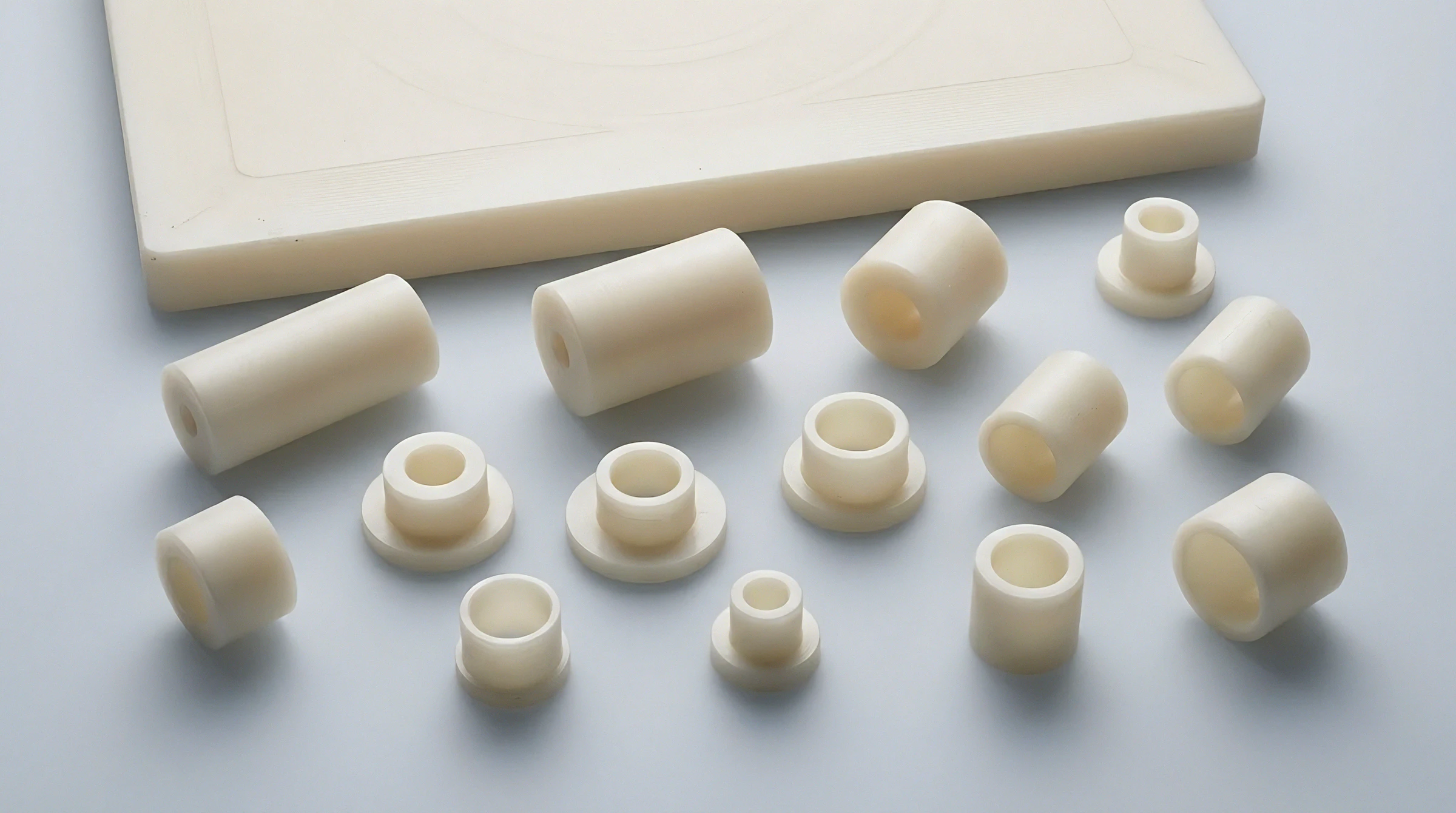
Three percent water by weight makes a nylon part about half a percent larger. Ensinger gives that rule of thumb for its polyamide stock shapes, and on a 100 mm (3.94 in) feature it means roughly 0.5 mm (0.020 in) of growth, several times the closest tolerance a machine shop would promise on the same size. The cut can be perfect and the part still out of tolerance a month later.
That single fact shapes the choice between the two common forms of PA6 stock. Cast PA6, also written PA6G or PA 6 C, is polymerized directly in a mold. Extruded PA6 is melted and pushed through a die. They share a chemistry and a name on the drawing, but they arrive at the machine with different stress, crystallinity, moisture behavior and chip form.
Cast or Extruded PA6 for a Machined Part
Cast PA6 is usually the better machining stock when the part is large, flat, stiff or close-toleranced. Extruded PA6 is the tougher, more elastic choice for smaller parts where impact strength and elongation matter more than the last hundredth of a millimeter. Ensinger states the comparison on its extruded TECAMID 6 page: against cast PA 6 C, extruded nylon 6 absorbs more moisture, wears more and is slightly less dimensionally stable, and the extrusion process limits the size and weight of the stock.
The machining guide of Mitsubishi Chemical Advanced Materials (MCAM) makes the same point in practical terms. Among its solutions for a plate part that bows after one-sided machining, the first listed is to use cast polyamide plate.
Many buyers search for the best plastic for machining and expect one answer. For nylon, the useful answer is a pair of questions: how large is the part, and how tight is the tolerance once the part has taken up moisture in service?
Cast PA6 is the stable, large-format, short-chip stock. Extruded PA6 is the tougher, more elastic one. Both absorb water, and both change size when they do.
How Each Stock Is Made
Cast nylon, sold as cast polyamide PA6G or PA 6 C, starts as a liquid. Ensinger describes the process as pouring activated caprolactam into heated molds, where an exothermic polymerization forms the solid polymer. The result is a high molecular weight, highly crystalline PA6, made with little waste and short production times. Ensinger’s automated casting produces plates from 0.25 mm (0.010 in) to 127 mm (5.0 in) thick and rods from 50 mm (1.97 in) to 500 mm (19.7 in) in diameter, and it credits the process with very low stress and high dimensional stability in the stock.
Extruded nylon starts as a melt. Ensinger explains that in extrusion the material is melted and compressed by a screw, forced through a die and calibrated by cooling. The outer layer solidifies first, while the core is still molten, and the shrinking core is then held by a rigid skin. Internal stress in the center is the consequence, along with a higher risk of cracking during machining.
Additives multiply the cast family. Ensinger’s TECAST range includes unfilled cast PA6, molybdenum disulfide filled, oil-filled, solid-lubricant filled and elastomer-modified versions. A drawing that says only “cast nylon” therefore leaves open whether the part is lubricated, colored or toughened. A third way sits beside them once quantities grow: the same polyamide injection molded into the part’s shape, which gives up the large sections of cast stock for walls of even thickness and no machining at all.
PA6 Stock Properties in Metric and Inch Units
Table 1 compares a cast and an extruded PA6 from two makers, both measured mostly to ISO methods. Röchling publishes Sustamid 6G natural as cast PA6 and states that its values follow DIN EN 15860, the European standard for thermoplastic semi-finished products for machining. Ensinger publishes TECAMID 6 natural as extruded PA6.
| Property, method | Sustamid 6G natural, cast PA6 (Röchling) | TECAMID 6 natural, extruded PA6 (Ensinger) |
|---|---|---|
| Density, g/cm³ (lb/in³) | 1.15 (0.0415) | 1.14 (0.0412) |
| Yield stress, ISO 527, MPa (ksi) | 75 (10.9) | 78 (11.3) |
| Elongation at break, ISO 527, % | 45 | 130 |
| Tensile modulus, ISO 527, MPa (ksi) | 3,400 (493) | 3,300 (479) |
| Notched impact, ISO 179, kJ/m² | 3 | 7 |
| Shore hardness D, ISO 868 | 83 | 79 |
| Melting temperature, ISO 11357, °C (°F) | 216 (421) | 221 (430) |
| Thermal conductivity, W/(m·K) | 0.25 | 0.37 |
| Linear thermal expansion, 10⁻⁵/K (10⁻⁵/°F) | 8 (4.4), DIN 53752 | 12 (6.7) at 23 to 60 °C and 13 (7.2) at 23 to 100 °C, ISO 11359 |
| Long-term service temperature, °C (°F) | up to 110 (230) | 100 (212) |
| Heat deflection temperature, ISO 75 method A, °C (°F) | 95 (203) | not listed |
| Water absorption, ISO 62, % | 2.5, condition not printed | 0.3 after 24 h, 0.6 after 96 h, 23 °C |
| UL 94 | HB at 3 mm and 6 mm | HB |
The table supports the makers’ descriptions. Cast PA6 is slightly harder and stiffer, with a lower expansion coefficient. Extruded PA6 stretches almost three times as far before breaking and carries more than twice the notched impact energy.
Two rows need care. The expansion values come from different test standards and temperature ranges, so the comparison is indicative only. Water absorption is not comparable at all: Röchling prints 2.5 % with no exposure time or condition, while Ensinger prints short-term immersion values. Neither figure is the equilibrium moisture content of a part in service.
What the Service Temperature Rows Mean
Röchling defines its long-term service temperature in a note under the table. It is based on thermal ageing by oxidation, and it marks the temperature at which at least 5,000 hours of exposure cost 50 % of the original tensile strength, measured at room temperature. The note adds that the value says nothing about strength at the high temperature itself, and that on thick-walled parts only the surface layer is affected by the oxidation. Its short-term maximum of 170 °C (338 °F) applies only to very low mechanical stress for a few hours.
The same note carries a caution about every row in Table 1. Röchling states that properties depend on the dimension of the semi-finished product and on its degree of crystallization, which pigments can change, so a particular bar may differ from the typical value. Ensinger frames extruded PA6 in similar terms: a universal mechanical material for tough environments, as long as dimensional tolerances are not critically tight.
A data-sheet value for nylon is a typical value for a standard specimen. The bar on the saw, its size, its color and its moisture all move the number.
The Same Grade on an ASTM Sheet
Röchling also publishes Sustamid 6G on an ASTM basis, and Table 2 shows why a buyer compares numbers only within one method family.
| Property, method | Value as printed | Metric conversion |
|---|---|---|
| Tensile strength at yield, ASTM D638, 73 °F | 12,000 psi | 82.7 MPa |
| Tensile modulus, ASTM D638 | 550,000 psi | 3,792 MPa |
| Elongation at break, ASTM D638 | 25 % | 25 % |
| Flexural strength, ASTM D790 | 15,000 psi | 103 MPa |
| Hardness, ASTM D2240 | Shore D 78 | Shore D 78 |
| Rockwell hardness, ASTM D785 | R 115; a second value of 85 with no scale printed | as printed |
| Water absorption, ASTM D570, 24 hours | 1 % | 1 % |
| Water absorption, ASTM D570, condition not printed | 8.5 % | 8.5 % |
| Deflection temperature, ASTM D648, 264 psi | 195 °F | 91 °C at 1.82 MPa |
| Deflection temperature, ASTM D648, 66 psi | 370 °F | 188 °C at 0.45 MPa |
| Linear thermal expansion, ASTM D696 | 4.5 × 10⁻⁵ in/in/°F | 8.1 × 10⁻⁵/K |
| Melting point, ASTM D3418 | 450 °F | 232 °C |
The ASTM sheet prints a Shore D of 78 and a melting point of 232 °C (450 °F) for the same cast grade that the ISO sheet lists at Shore D 83 and 216 °C (421 °F). Nothing about the material changed. The test methods, specimens and conditioning did. A supplier substitution judged by mixing these two sheets would compare the methods, not the plastics.
Moisture, Size and the Order of Machining
Water is the property that most separates nylon from acetal or PEEK on a machined part. Ensinger explains that polyamides take up moisture through the surface, and that this uptake gives them their balance of toughness and strength.
In small sections the water spreads almost evenly through the cross-section. Large sections, which Ensinger defines as rods and plates from about 100 mm (3.94 in), behave differently. Their moisture content falls from the outside inward, and in the worst case the center stays brittle and hard.
For thin parts the figures are specific. Ensinger says walls up to about 10 mm (0.39 in) can absorb up to 3 % moisture, and its rule of thumb ties 3 % uptake to about 0.5 % dimensional change. Table 3 applies that rule to common feature sizes.
| Feature size, mm (in) | Approximate growth, mm (in) |
|---|---|
| 10 (0.39) | 0.05 (0.002) |
| 25 (0.98) | 0.13 (0.005) |
| 50 (1.97) | 0.25 (0.010) |
| 100 (3.94) | 0.50 (0.020) |
| 200 (7.87) | 1.00 (0.039) |
Röchling’s sheet adds the mechanical side of the same change. As a polyamide absorbs moisture it becomes tougher and more impact resistant while its modulus falls. On thick-walled parts only a surface layer is affected to a certain depth, and the center stays as it was.
The cast grade is not immune. Mustafa Bozdemir of Kırıkkale University, in a 2018 milling study, describes PA6G as vulnerable to humidity up to 7 %, and he kept his test plates in humid and dry storage as a deliberate variable. For a buyer, the practical rules are these.
- Specify the conditioning state at which dimensions are checked: as machined, after a stated time at 23 °C and 50 % relative humidity, or after drying.
- Ask how the stock is stored before cutting; Ensinger stores semi-finished products flat, in closed rooms at 23 °C (73 °F) and 50 % relative humidity where possible.
- Leave tolerance for service moisture on fits and clearances, or choose a lower-absorbing material where that is not possible.
Nylon stock is measured at one moisture content and used at another. The tolerance that matters is the one that still holds after the part has reached equilibrium with its service air.
Cutting Behavior of Cast and Extruded Nylon
The two stocks leave the tool differently. Ensinger reports that cast TECAST T natural tends to form short chips and machines well, while extruded TECAMID 6 and TECAMID 66 form a continuous flow of chips that may need clearing from the tool and the part more often. Tangram Technology, a UK plastics consultancy, lists the same tendency for nylon in general: stringy chips, wrap-around and burrs, with dimensional change from moisture as a separate issue.
Cutting data for both forms come from one band in MCAM’s guide, which groups unfilled polyamide with UHMW-PE. Turning runs at 200 to 500 m/min (656 to 1,640 ft/min) with HSS or carbide and a feed of 0.05 to 0.5 mm/rev (0.002 to 0.020 in/rev). Milling uses the same speed band with up to 0.5 mm (0.020 in) per tooth, and drilling drops to 50 to 100 m/min (164 to 328 ft/min) at 0.1 to 0.3 mm/rev.
Sawing the blank follows the same logic. For polyamide, MCAM’s sawing data give a band saw tooth pitch of 4 to 10 mm (0.16 to 0.39 in) at 50 to 500 m/min (164 to 1,640 ft/min), and a carbide-tipped circular saw pitch of 8 to 45 mm (0.31 to 1.77 in) at 1,000 to 3,000 m/min (3,281 to 9,843 ft/min), with as much tooth set as possible so the cut does not close on the blade.
MCAM adds the habit that suits nylon: go for maximum feed and speed to move swarf away from the tool, choose cutters with large clearance and two or three flutes with a high helix, and use an air blast or vacuum to clear chips.
Large blanks need one extra step. Ensinger recommends pre-heating large polyamide stock, round rods above 100 mm (3.94 in) and plates above 80 mm (3.15 in) thick, to 80 to 120 °C (176 to 248 °F), and machining close to the center, to avoid tension cracks that come from the dry, hard core and the extrusion stress together.
Surface Finish on Cast PA6
Bozdemir’s study gives a rare look at measured roughness on cast PA6.
He end milled 46 mm (1.81 in) thick PA6G plates with HSS and carbide cutters of 10, 14 and 18 mm (0.39, 0.55 and 0.71 in), at cutting speeds of 100 to 160 m/min and feeds of 100 to 175 mm/min (3.9 to 6.9 in/min), with humid and dry plates. In the sample rows the paper prints, average roughness Ra ranges from about 0.9 µm (35 µin) to just under 5 µm (197 µin). At one setting, 1 mm depth, 100 m/min, a 10 mm cutter and 100 mm/min, the dry plate cut with HSS gave 0.927 µm while the humid plate gave 2.184 µm. The same cut, the same tool and a different moisture state produced more than twice the roughness.
Warping, Annealing and Flat Parts in PA6
Plate parts in nylon warp for the same reasons as in other semi-crystalline plastics: stress released unevenly as material is removed. MCAM’s general rules give five remedies for a plate that bows after machining on one side.
- Use cast polyamide plate.
- Cut the part symmetrically about the centerline of the extrusion.
- Start from the thickest plate and move the extrusion centerline away from machined features.
- Machine slots or grooves in the opposite face.
- Balance the removal on both sides of the centerline.
When those are not enough, MCAM prints an annealing cycle for polyamide: heat at 10 to 20 °C (18 to 36 °F) per hour to a hold of 160 °C (320 °F), hold 10 minutes per millimeter of wall thickness, and cool at 5 to 10 °C (9 to 18 °F) per hour in air, nitrogen or oil. Ensinger recommends the same order for critical parts: rough with a margin, anneal with the part supported, then finish.
Writing a PA6 Call-Out a Shop Can Quote
A good nylon call-out names the form, the grade and the moisture condition. Each line below closes a question that would otherwise be answered by whichever bar is on the shelf.
- Cast or extruded PA6, and the maker’s grade where it matters.
- Any modification: lubricated, oil-filled, molybdenum disulfide filled, heat stabilized or elastomer modified.
- The condition at which dimensions are inspected, including temperature and moisture state.
- Whether an intermediate anneal is allowed or required for flat or asymmetric parts.
- The data-sheet basis for any property requirement, ISO or ASTM, so values are compared within one method.
- The flammability class if one is needed; both sheets here print UL 94 HB.
For nylon parts that move from a first article into batches of tens or hundreds, low-volume plastic CNC with bridge production behind it holds the stock form, the conditioning and the inspection state constant from batch to batch.
Sources and Further Reading
- Technical Data Sheet, Sustamid 6G natural, version 4.0, 2023, Röchling
- Technical Data Sheet, Sustamid 6G, ASTM, version 2.0, 2024, Röchling
- PA 6, TECAMID 6 natural, Ensinger
- Cast nylon, Ensinger
- Cast Nylon plate, Ensinger
- Frequently asked questions, machinable plastics, Ensinger
- Guide to machining plastic parts, metric system, 2026, Mitsubishi Chemical Advanced Materials
- Plastics Topics, Machining of plastics, 2026, Tangram Technology
- Prediction of Surface Roughness considering Cutting Parameters and Humidity Condition in End Milling of Polyamide Materials, Computational Intelligence and Neuroscience, 2018, Mustafa Bozdemir, Kırıkkale University