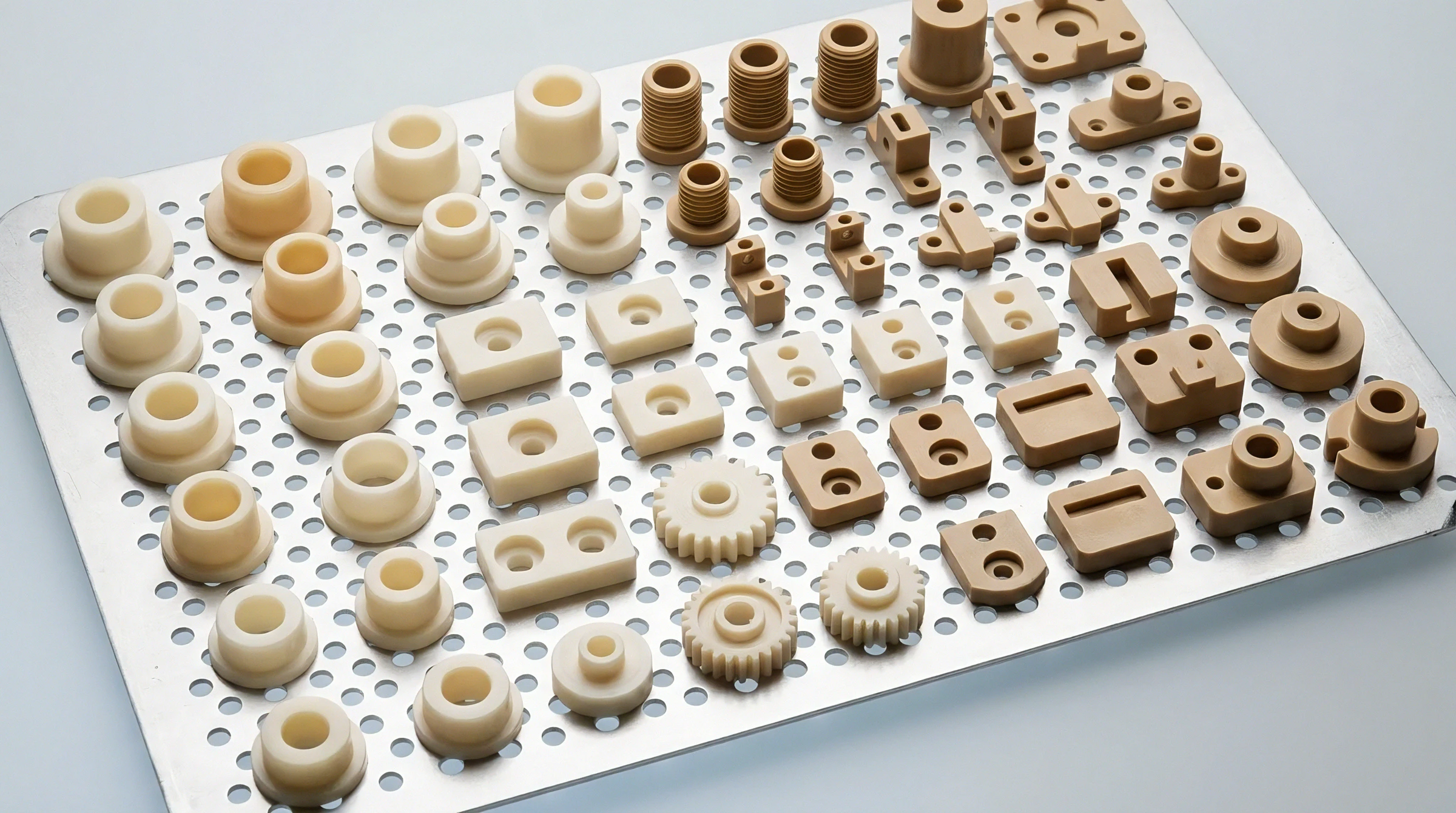
A 50 mm (2 in) acetal rod turned for 100 mm (3.9 in) at 300 m/min and 0.2 mm per revolution takes about 16 seconds per pass. Those values sit in the middle of the acetal turning ranges that Mitsubishi Chemical Advanced Materials (MCAM) prints in its 2026 machining guide. If the drawing carries tight tolerances and a lot of unevenly removed material, that same part can then spend a day or two in an annealing oven. The cut is the short part of a machined plastic order, and the calendar is made of everything around it.
This piece takes the calendar apart in the order a part meets it. It uses the makers’ published rates for resting, drying and heat treatment, adds arithmetic where a rate has to be turned into hours, and leaves out capacity, queues and prices, which belong to individual suppliers.
Where the Calendar Goes in a Machined Plastic Order
Most of the elapsed time in a machined plastic order is spent on stock preparation, resting, heat treatment, drying and measurement at a controlled temperature, and the cutting is a small fraction. When a part needs none of those steps, it goes from blank to finished in the machine time plus setup and deburring. Parts that need one or more gain hours or days that no spindle speed can recover.
The drawing decides which steps apply, and the makers’ documents give the rules. Tight tolerance, asymmetric shape or a high share of material removed triggers a rest or an anneal, while a moisture-sensitive grade triggers drying and sealed packaging. Grades with a post-cure requirement add days in an oven. Each of those is a line a buyer can ask a supplier to state, which is also the quickest way to compare lead times that look different on paper.
Four questions cover most of the difference between suppliers that run the same machines:
- Does the part rest between roughing and finishing, and for how long?
- Is it annealed, and at what hold temperature and wall thickness?
- Is the stock or the finished part dried or conditioned before it is measured and packed?
- At what temperature is it measured, and after how long in the measuring room?
The cut takes seconds or minutes. Heat, rest and drying take hours or days, and they decide the lead time.
Minutes at the Machine
Machine time is easy to compute from the published data, and it is small. Table 1 uses the MCAM acetal turning range, speed 200 to 500 m/min and feed 0.05 to 0.5 mm per revolution, on the 50 mm by 100 mm example, for one pass along the length.
| Case | Cutting speed, m/min | Feed, mm/rev | Spindle speed, rpm | Time per pass |
|---|---|---|---|---|
| Finishing, low end of range | 200 | 0.05 | 1,273 | 94 seconds |
| Typical, middle of range | 300 | 0.2 | 1,910 | 16 seconds |
| Roughing, high end of range | 500 | 0.5 | 3,183 | 4 seconds |
Spindle speed is the surface speed divided by the circumference, and time per pass is the length divided by the product of feed and spindle speed. A simple turned part needs a handful of passes, a bore and a parting cut, so a few minutes of machine time per part is plausible. Milled parts take longer, since their feed per tooth is limited to 0.5 mm or less and their pockets are many.
Setup and program proving are the other machine-side times. They depend on the supplier and the part, and the published sources do not give them, so they remain a question for the buyer to ask. Climb milling, sharp tools and an open chip path, as the makers recommend, keep the machine time short and the surface good enough that rework does not add to it.
Stock, Blanks and Acclimatizing
A machined part starts as a blank cut from a stock shape. The stock side is rarely the long pole. Ensinger’s stock catalog lists its acetal copolymer, TECAFORM AH, in rods from 3 to 300 mm (0.12 to 11.8 in) in diameter, plates from 0.5 to 150 mm (0.02 to 5.9 in) thick and tubes from 20 to 435 mm (0.8 to 17.1 in), so common grades and sizes are made to stock. A less common grade, a custom color or an unusual size takes longer, and the buyer finds out by asking.
One condition of the stock does take time. Ensinger writes that products stored in cold conditions should be allowed sufficient time to acclimatize to room temperature before processing. Röhm gives the reason in its figure for acrylic: 0.07 mm per meter per kelvin, which makes a 1,000 mm part 1.4 mm longer between 10 °C and 30 °C. A cold blank cut and measured while it warms is a part that changes size on the table.
The makers also state what the stock has already had. Ensinger writes that its stock shapes are annealed after production, which is why a first cut can start without a stress-relief step. The first cut then releases whatever stress remains, and the later steps depend on how much material comes away.
Resting Between Roughing and Finishing
A rest is the least expensive delay. In the MCAM turning tips, large sections are roughed out and left for 24 hours to improve tolerances. The rest takes the place of an anneal where the tolerance allows it, at the cost of a day on the calendar.
A rest adds one or two calendar days and no equipment. It applies to the batch: all the roughed parts sit on a shelf together, and they are finished together. A buyer who orders 10 parts and one who orders 400 therefore wait about the same time for the rest, and the difference between them is the setup and cutting time on each side of it.
The condition that goes with the rest is flatness. A part that bowed during the rest needs a fixture that takes it in its relaxed shape, and a finishing pass at light depth, as the earlier piece on workholding in these resources describes. That adds machine time on the second side, but not calendar time.
Rest and anneal are alternatives for the same job, and a buyer can ask which one a supplier uses. Ensinger recommends an intermediate anneal for narrow tolerances, warp-prone shapes and fiber-filled materials, and says that in the case of higher machining volumes it may be advisable to introduce one. The rest suits the lighter cases, and the anneal suits the cases where a part has to hold its size when it later sees heat. Either choice moves the lead time by about a day, so it is worth settling on the drawing and not on the shop floor.
Oven Days for Annealing and Post Cure
Heat treatment dominates the calendar when it is used. Table 2 sets out the times for two cases from the makers’ published cycles. Its annealing row uses the MCAM 2026 rates for acetal at a hold of 155 °C (311 °F) and a 10 mm wall, starting from 20 °C. The post-cure row uses the stepped cycle printed by MCAM for polyamide-imide, with heating and cooling at 10 to 20 °C per hour.
| Treatment | Heating | Holds | Cooling | Total |
|---|---|---|---|---|
| Anneal, acetal, 155 °C, 10 mm wall | 7 to 14 hours at 10 to 20 °C/h | 1.7 hours at 10 min/mm, plus 0.5 hours equalization at 3 min/mm | 14 to 27 hours at 5 to 10 °C/h | about 22 to 43 hours |
| Post-cure, polyamide-imide, up to 12 mm wall | 12 to 24 hours for the 240 K climb at 10 to 20 °C/h, in stages | 10 days: 1 day at 150 °C, 1 at 215 °C, 2 at 245 °C, 6 at 260 °C | 12 to 24 hours for the descent at 10 to 20 °C/h | about 11 to 12 days |
Both rows come from printed rates and are not promises from any supplier. The time is per load, not per part: an oven that takes the whole batch at once treats it in one cycle, and a smaller one needs several. Shorter cycles are also possible where the part is thin and the polymer does not need a high hold temperature: Röhm’s acrylic rule of the thickness in millimeters divided by 3 hours, with a minimum of 2 hours, gives 3.3 hours for a 10 mm sheet, followed by cooling of the thickness divided by 4 hours.
A shop that quotes a much shorter cycle for the same wall is running faster heat-up and cooling rates than the maker prints, and a buyer comparing quotes can ask which cycle each one follows, since the cooling rate is what keeps new stress out of the part.
The cycle has a fixed floor. Both makers specify an oven within plus or minus 3 °C throughout, and a slow, steady ramp, which is the reason that the ramp is not shortened to save a day. A shop that offers an annealing step with a much shorter total than these rates would need to say how it protects against stress built in by cooling too fast.
An anneal can also come between the first cuts. MCAM gets better flatness by rough machining, annealing and finish machining with a very light cut. That adds an oven load early in the order, which a supplier schedules ahead of the first setup, so a buyer who needs a short lead time asks whether the parts are annealed between cuts and, if they are, when.
Amorphous grades add a post-machining case. Polycarbonate, polysulfone and PEI are the grades most often annealed after machining, to limit stress crazing, and the more material a part loses to the cutter the stronger the case for it. The oven time is then at the end of the order, after the finishing pass, and it comes with a final measurement.
Drying Nylon and Other Parts That Absorb Moisture
Moisture adds a different calendar item. Nylon parts take up moisture and swell, so tight-tolerance nylon parts are kept dry and packed against moisture until installed. The swelling is reversible: a machined part that has grown can be dried back toward its original size in an oven until its weight stops changing.
Drying time depends on the moisture content and the wall thickness, and water leaves a thick wall slowly, so drying a thick nylon part can take days. A supplier who has to dry parts says so at the quote, because those days sit at the end of the order.
The consequence is that the order of operations affects the calendar. A nylon part machined from wet stock and then dried can end up smaller than drawn, so a careful supplier dries or conditions the stock first or accounts for the shift. In a 2018 study, Mustafa Bozdemir of Kırıkkale University on end milling of cast polyamide PA6G used plates held in humid and dry conditions as an input variable, and describes the material as vulnerable to humidity up to 7 percent, which indicates how much the starting state can vary. Asking whether stock is dried before cutting adds a line to the quote request and removes a source of surprise.
Deburring and Finishing Before the Measuring Room
Deburring is the last step on the machine side and it has its own time.
MCAM names sharp knives and rotating hooks as the common tools, with countersink tools that do not cut too deep or chatter, wet and dry abrading for hard plastics, rotary stones for some and hot air for complex profiles in general engineering plastics. The guide stresses tool sharpness above all. A part is deburred by hand or by a tool, one at a time, so this step grows with the number of parts and with the number of edges, unlike the heat steps, which belong to the batch. The sources print no times for it, which makes it a line to ask about when comparing two quotes with the same drawing.
Inspection at 20 °C and the Loop on the First Part
Measurement is a calendar item because plastic changes size with temperature. The reference temperature for dimensional measurement is 20 °C (68 °F), adopted by the International Committee for Weights and Measures in 1931 and described by Ted Doiron of NIST in a 2007 journal paper. A part brought from a warm shop or a cold truck to the measuring room has to reach 20 °C first, and Röhm’s advice is to compare parts only at the same ambient and material temperatures.
The first part adds a loop. A first part is cut and measured, and if a dimension is off, the program or the offset is corrected and a second part is cut. MCAM advises aiming at the lowest dimension when setting a turned diameter, since most diameters grow, and suggests capability studies on the machine. A loop of this kind costs hours of machine and measuring time, and it is the reason the first parts of a new program arrive later than the repeat parts of an existing one.
Batches, Deliveries and the Rest Clock
Order size changes the calendar in a different way from each step above. The rest, the anneal and the drying clock run per batch, and the machine time runs per part, so a larger order stretches the machine side while the heat side stays about the same, provided the batch fits the oven and the shelf.
That structure suggests how to stage a delivery. The first batch carries the first-part loop and the longest waiting steps, and a second batch started later follows the same path with the lessons applied. A buyer who needs a few parts early for fit checks can ask for a small first batch to be released while the rest of the order rests, with the understanding that the early parts carry the same measured conditions as the later ones.
Resting, annealing and drying belong to the batch. Cutting belongs to the part. Order size moves the second far more than the first.
The reverse risk is a batch split that repeats the heat cycle for no reason. Two half batches annealed in sequence take twice the oven time of one batch, so a buyer who knows the full quantity does well to say so at the start, and to ask whether the supplier loads the oven once.
Five Order Types Side by Side
Table 3 puts five kinds of order next to the steps they trigger, with the added calendar time computed from the rates above. Setup, programming and shipping are not in the table, since they depend on the supplier.
| Order type | Steps triggered | Added calendar time |
|---|---|---|
| Symmetric acetal part, moderate tolerance | Deburr and measure at 20 °C | hours |
| Asymmetric plate part, tighter tolerance | Rest between roughing and finishing | 1 to 2 days |
| Acetal part, 10 mm wall, tight tolerance, annealed | Rough, anneal, finish | about 1 to 2 days of oven, plus second setup |
| Nylon part, 10 mm wall, high tolerance | Dry before packing, sealed bag | at least 3.3 days of drying |
| Polyamide-imide part with post-cure | Rough, post-cure, finish | about 11 to 12 days of oven |
The table also shows where a drawing can save time. Three choices remove rows from the calendar without lowering the quality of the part:
- a symmetrical stock layout, with pockets balanced by grooves on the opposite face, which can replace an anneal with a rest;
- generous tolerances on features that do not carry fit or function, which can remove the finishing loop for those features;
- a grade that does not need drying or a post-cure, when the application allows the choice.
Each choice has a cost in design freedom, and the drawing is where the buyer and the supplier settle it. Setting the order out this way helps whoever plans low-volume plastic CNC parts that are meant to grow into bridge production, because the rows a part really needs are fixed once, in the first order, and repeat in every later one.
The measuring row deserves a last word. A supplier that states the temperature and the soak time at which it measures gives the buyer a number that can be compared with the incoming inspection on the other side, so that a disagreement of a few hundredths of a millimeter is traced to the room and not to the part.
Sources and Further Reading
- Ensinger, Stock Shapes catalog, 2024
- Mitsubishi Chemical Group, Mitsubishi Chemical Advanced Materials, Guide to machining plastic parts, metric edition, 2026
- Ensinger, Frequently asked questions, machinable plastics
- Röhm, Guidelines for workshop practice, Machining PLEXIGLAS
- Ted Doiron, 20 °C, a short history of the standard reference temperature for industrial dimensional measurements, Journal of Research of NIST 112(1), 2007
- Mustafa Bozdemir, Prediction of surface roughness considering cutting parameters and humidity condition in end milling of polyamide materials, 2018, PMC6046151