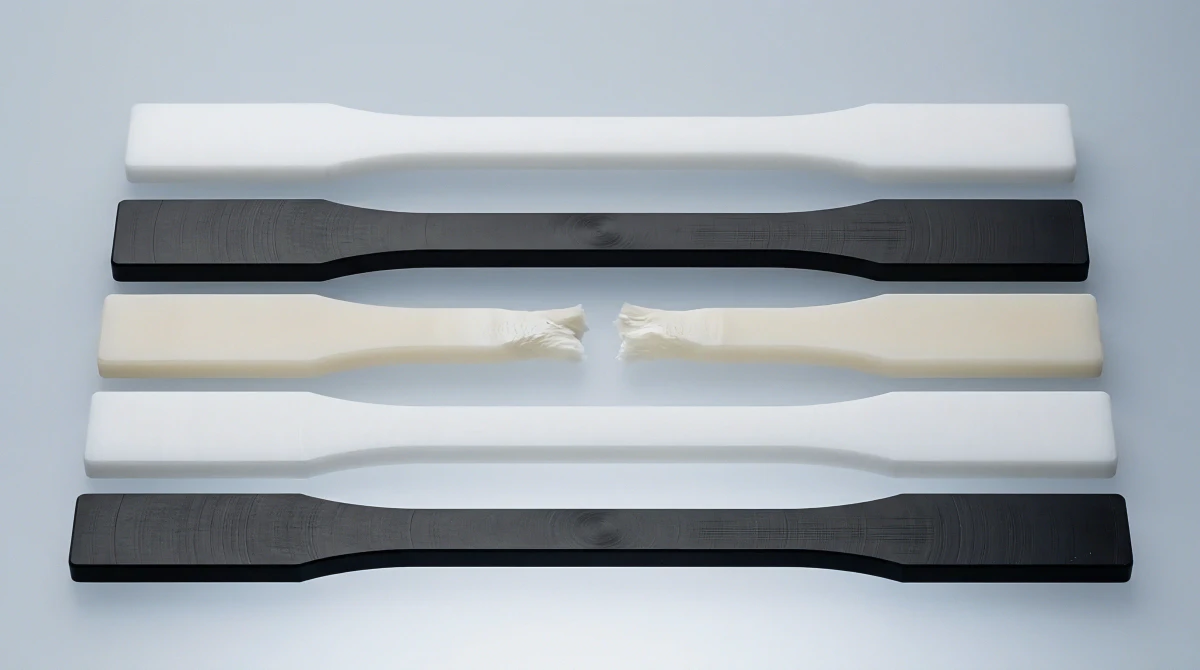
Meaning
A specimen is the standard-shaped test piece a property is measured on, such as a tensile dumbbell, a deflection bar or a flame bar. Every figure on a data sheet belongs to its specimen and its conditions. A machined part has none of those dimensions, so the figure transfers only as far as the record allows.Tensile Bar
ASTM D638 tests dumbbell-shaped specimens under defined pretreatment, temperature, humidity and speed. Material up to 14 mm (0.55 in) thick is tested as is, and thicker stock is machined down. Mitsubishi’s sheet prints its specimen types, Type 1 for ASTM and 1B for ISO, with their speeds.Read More
Deflection Bar
ASTM D648 loads a bar edgewise as a simple beam. It applies to stock 3 mm (1/8 in) thick or more, and thinner sheet is tested as a composite. Ensinger prints a 1/4 in (6.35 mm) specimen for its glass-filled PEI deflection figure.Flame Bar
The UL 94 vertical test uses a bar 12.7 mm (0.5 in) wide and 127 mm (5 in) long, held upright. Two sets of five specimens are conditioned. One spends 48 hours at 23 °C (73 °F) and 50 percent relative humidity, the other seven days at 70 °C (158 °F). Components too small to make standard specimens go to UL 1694, for volumes under 2,500 mm³ (0.15 in³).Difference From a Part
The ASTM D638 article lists what changes from bar to part. A part has sharp corners, holes and threads. Its core may hold the porous centerline, and it may carry residual stress. It sees its own temperature and loads such as clamps and creep. A test bar from thick plate is itself machined from somewhere in the section, and the sheet does not say where.