Oven

An oven, in plastic machining, is the controlled-temperature chamber used to anneal, post-cure or dry parts and blanks, and to condition test specimens.

Every Oven article of the Plastic CNC Resources, newest first, each written from published standards, research and makers’ data.

Meaning

An oven, in plastic machining, is the controlled-temperature chamber used to anneal, post-cure or dry parts and blanks, and to condition test specimens. Its days often decide a machined order’s lead time more than the machine hours do. The sources treat the oven as part of the process, with its own limits on temperature, atmosphere and load.

Atmosphere

Mitsubishi lists air, nitrogen or oil for annealing polyamide, acetal, PET-P and polyethylene. Polycarbonate and the high-temperature grades take air or nitrogen. Quadrant prefers a nitrogen-circulating oven where one is available. In an air oven above 100 °C (212 °F), natural-colored parts, particularly nylon, form an oxidized colored skin. Drying uses a vacuum oven, at 60 to 70 °C (140 to 158 °F) for nylon and 150 °C (302 °F) for PBI and PAI.
Read More

Uniformity

Both stock-shape guides ask for plus or minus 3 °C (5.4 °F) everywhere in the oven or oil bath, at all times. If an oven cannot follow the printed ramp, Quadrant advises changing the setting by hand every hour. A part that heats or cools unevenly carries new stress back out of the oven. A fixture inside the load moves as well, since steel and polymer expand at different rates.

Load Planning

Oven time belongs to the whole load. An oven that takes the whole batch treats it in one cycle, and a smaller one needs several. Two half batches annealed in sequence take twice the oven time of one batch. A buyer who knows the full quantity says so at the start and asks whether the supplier loads the oven once. Annealing blanks right after they are cut adds an oven load before the first setup.

Test Conditioning

Ovens also prepare test specimens. In the UL 94 vertical burn test, one set of five specimens spends seven days in a 70 °C (158 °F) oven. The other set is conditioned for 48 hours at 23 °C (73 °F) and 50 percent relative humidity.
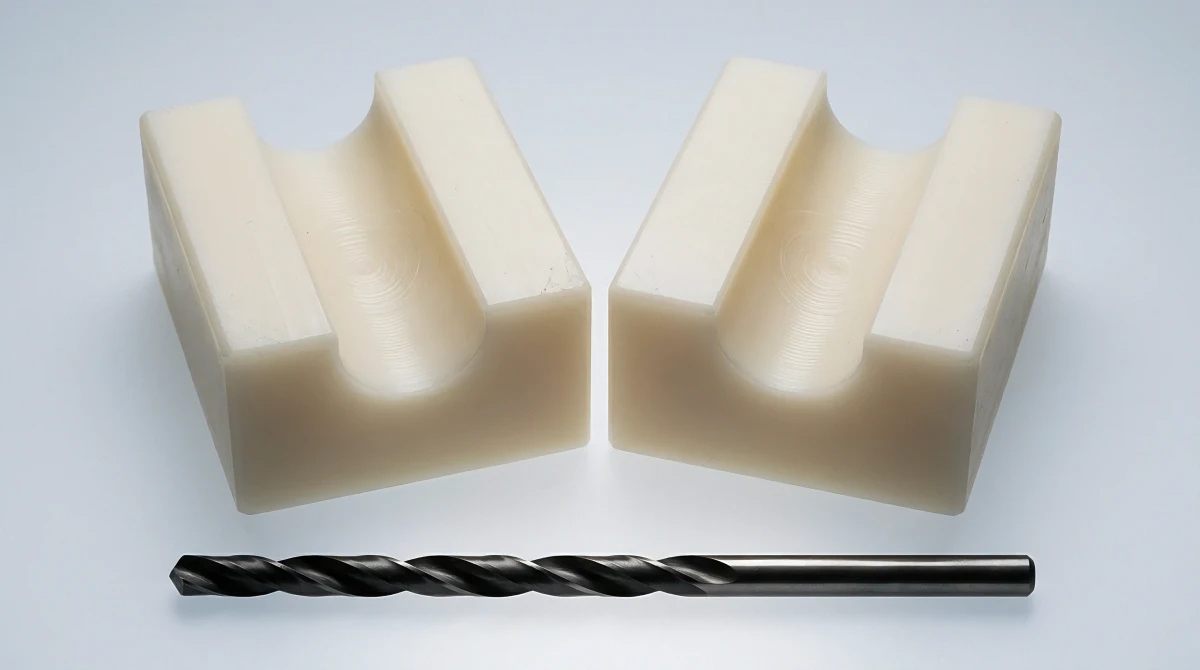
Drilling Deep Holes in Plastic Without Melting or Cracking

Holes deeper than two diameters trap heat in plastic, so drill grind, peck cycle, coolant choice and cool-down decide whether the part cracks or holds its size.

How to Drill a Deep Hole in Plastic Without Melting or CrackingTreat any hole deeper than two diameters as a cooling problem first and a cutting problem second. Both Mitsubishi Chemical Advanced Materials (MCAM) and Ensinger name the same threshold: heat builds very easily once the depth passes twice the diameter.

Flatness and Warp of Thin Machined Plastic Plates

Thin plastic plates bow when stress, heat, clamping or moisture act on one face more than the other, so flatness is planned through stock, sequence, rest and measurement.

Why Thin Machined Plastic Plates Lose FlatnessA thin plate loses flatness when the stresses on its two faces stop balancing. Mitsubishi Chemical Advanced Materials (MCAM) explains the mechanism in its machining guide: extrusion, molding and machining leave residual stresses inside a thermoplastic, and when material is removed or the part meets elevated temperatures, those stresses redistribute and cause warping or dimensional change.

Machining PEEK Unfilled and Carbon-Filled Stock

Unfilled and carbon-filled PEEK share a polymer but differ in stiffness, conductivity, tooling, cutting data and tolerance, so the grade belongs on the drawing.

How Unfilled and Carbon-Filled PEEK Stock Differ for Machined PartsUnfilled PEEK machines like a hard, stiff thermoplastic: short chips, little burr, high feed rates and fine finishes. Carbon-filled PEEK machines like a composite: abrasive to tools, sensitive to fiber direction, and best cut with carbide or diamond at lower speeds.

Sizing a Machined Plastic Run From Blanks to Batches

A machined run is sized from weeks and consumption, converted to plates and batches, and then matched to cutters and fixtures by run length.

How to Size a Machined Plastic RunCount the parts the program will consume until the next process delivers, add a spare for parts lost in testing, convert the total to blanks by nesting, and group the blanks into batches that share a rest, an oven load and a measuring session. Then choose the cutter and the fixture by the length of the run.

How Long Resting, Annealing and Drying Add to Machined Plastic Parts

In a machined plastic order the cutting takes minutes, while resting, drying and heat treatment take days, so the drawing sets the lead time.

Where the Calendar Goes in a Machined Plastic OrderMost of the elapsed time in a machined plastic order is spent on stock preparation, resting, heat treatment, drying and measurement at a controlled temperature, and the cutting is a small fraction. When a part needs none of those steps, it goes from blank to finished in the machine time plus setup and deburring.

Annealing Machined Plastic Parts Between Roughing and Finishing

Annealing between roughing and finishing trades oven days for flat, stable parts, and it pays only when stress, shape or tolerance demand it.

When a Machined Plastic Part Needs AnnealingA machined plastic part needs an intermediate anneal when it has tight tolerances, an asymmetric shape, or a large share of its blank removed, and when it does not need one the stock maker has already done the work. Ensinger states the starting condition: its semi-finished products are always annealed after production, which is why a first cut can start without a stress-relief step.

Thermal Expansion of Machined Plastic Parts by Material and Size

Every machined plastic dimension has a temperature, and the material decides how many degrees of drift a given tolerance can absorb.

Thermal Expansion of Machined Plastic Parts per 10 DegreesThe coefficient of linear thermal expansion, CTE, is the fractional length change per degree. Plastic sheets print it in 10⁻⁶ per kelvin or in inches per inch per degree Fahrenheit, and the two convert by a factor of 1.8: one in/in/°F is 1.8 per °C.

UL 94 Flammability Ratings for Machined Plastic Parts

A flame rating belongs to a material, a color and a thickness, so the call-out has to name all three and the machined wall has to stay inside them.

What UL 94 Covers and What It Leaves OutThe UL standards catalog lists UL 94 as Tests for Flammability of Plastic Materials for Parts in Devices and Appliances, in its seventh edition. Its scope states that the requirements cover tests for flammability of polymeric materials used for parts in devices and appliances, and that they serve as a preliminary indication of acceptability with respect to flammability for a particular application.

Request a Plastic CNC Quote

Send the 2D drawing and the 3D file, with the quantity and the stage of the project. An engineer replies within 1 working day.

The quote form, the mutual NDA and the private folder for your files are on Protolis Atelier, with Plastic CNC chosen.

Request a Quote