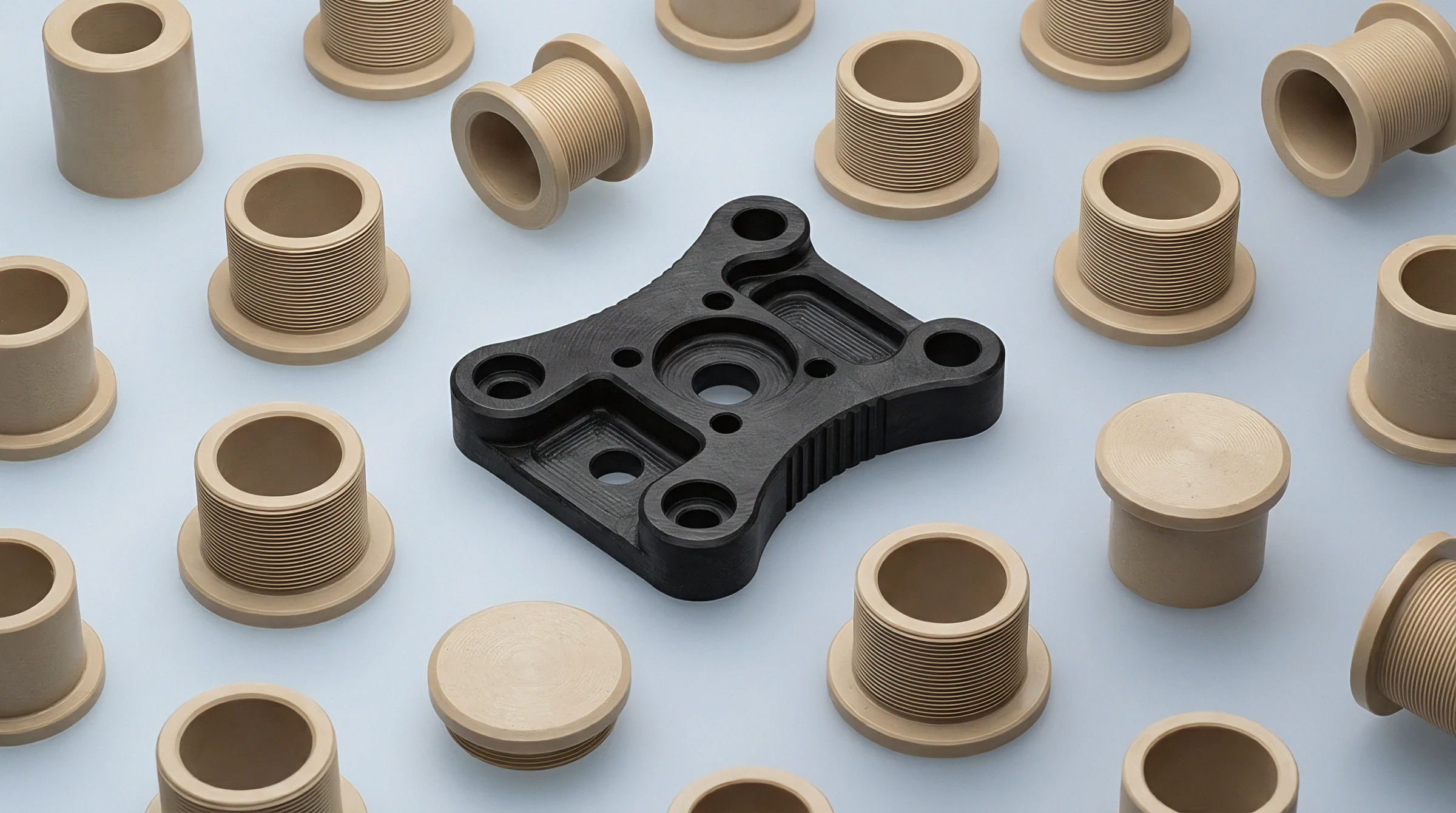
Thirty percent carbon fiber moves the tensile modulus of PEEK stock from 4,200 MPa (609 ksi) to 6,000 MPa (870 ksi) and more than doubles its thermal conductivity, from 0.27 to 0.66 W/(m·K). Ensinger prints both figures for its TECAPEEK natural and TECAPEEK CF30 black stock shapes, measured to the same ISO methods. For the part, that means a stiffer, cooler-running component. At the machine, it means a different tool, a lower cutting speed and a different set of stresses to manage in the blank.
The two grades share a polymer and a melting point of 341 °C (646 °F). Almost everything else that matters at the machine diverges. The sections below set the published properties side by side, then follow each grade through tolerances, cutting data, stress control and the choices a buyer writes on the drawing.
How Unfilled and Carbon-Filled PEEK Stock Differ for Machined Parts
Unfilled PEEK machines like a hard, stiff thermoplastic: short chips, little burr, high feed rates and fine finishes. Carbon-filled PEEK machines like a composite: abrasive to tools, sensitive to fiber direction, and best cut with carbide or diamond at lower speeds. Ensinger describes PEEK in general as highly dimensionally stable with balanced mechanical properties, and says those traits allow high tool infeeds and feed rates. It also states that its machining experience applies to the filled versions, which it treats with optimized parameters of their own.
Mitsubishi Chemical Advanced Materials (MCAM) draws the same line in its machining guide. Unfilled PEEK sits with PET-P and PAI in one group of cutting data, while glass- and carbon-filled PEEK sit with filled PAI, PPS and PEI in another, with lower speeds and harder tool materials.
The choice between them is rarely made at the machine. It follows from the part: stiffness and creep under load point to carbon fiber, while electrical insulation, the lowest burr and the simplest machining point to the unfilled grade.
Unfilled PEEK is a stiff thermoplastic that cuts cleanly at high feeds. Carbon-filled PEEK is a composite that wears tools, follows its fiber direction and conducts both heat and electricity.
PEEK Stock Properties in Metric and Inch Units
Table 1 sets three Ensinger stock grades side by side, all from the company’s European pages, where every value is measured to ISO or DIN EN ISO methods. The third column is a ceramic-filled grade, TECAPEEK CMF white, included because it is the filled PEEK that Ensinger designs specifically for machining fine features.
| Property, method | TECAPEEK natural (unfilled) | TECAPEEK CF30 black (30 % carbon fiber) | TECAPEEK CMF white (ceramic filled) |
|---|---|---|---|
| Density, g/cm³ (lb/in³) | 1.31 (0.0473) | 1.38 (0.0499) | 1.65 (0.0596) |
| Tensile modulus, DIN EN ISO 527-2, 1 mm/min, MPa (ksi) | 4,200 (609) | 6,000 (870) | 5,500 (798) |
| Tensile strength, DIN EN ISO 527-2, 50 mm/min, MPa (ksi) | 116 (16.8) | 112 (16.2) | 105 (15.2) |
| Elongation at break, DIN EN ISO 527-2, % | 15 | 10 | 4 |
| Flexural strength, DIN EN ISO 178, MPa (ksi) | 175 (25.4) | 184 (26.7) | 170 (24.7) |
| Shore hardness D, DIN EN ISO 868 | 89 | 90 | 90 |
| Glass transition, DIN EN ISO 11357, °C (°F) | 150 (302) | 147 (297) | 151 (304) |
| Thermal conductivity, ISO 22007-4, W/(m·K) (BTU·in/(h·ft²·°F)) | 0.27 (1.87) | 0.66 (4.58) | 0.38 (2.63) |
| Linear expansion 23 to 60 °C, 10⁻⁵/K (10⁻⁵/°F) | 5 (2.8) | 4 (2.2) | 5 (2.8) |
| Linear expansion 100 to 150 °C, 10⁻⁵/K (10⁻⁵/°F) | 7 (3.9) | 6 (3.3) | 6 (3.3) |
| Water absorption, DIN EN ISO 62, 24 h / 96 h at 23 °C, % | 0.02 to 0.03 | 0.02 to 0.03 | 0.02 to 0.03 |
| Surface resistivity, Ω | 10¹⁵ | 10³ to 10¹² | 10¹⁴ |
| Long-term service temperature, °C (°F) | 260 (500) | 260 (500) | 260 (500) |
Three rows deserve a second look. Elongation at break falls from 15 % to 10 % with carbon fiber and to 4 % with ceramic, so the filled grades tolerate less deformation in a snap fit or a press fit. Thermal conductivity rises with carbon fiber, which helps a sliding part shed heat and also changes how heat leaves the cutting zone. Surface resistivity drops by orders of magnitude with carbon fiber, so TECAPEEK CF30 black is no longer an insulator.
Water absorption is the same for all three, at 0.02 to 0.03 % over 24 to 96 hours. Ensinger’s US page for TECAPEEK natural adds a figure at saturation: 0.45 % at 23 °C (73 °F) to DIN EN ISO 62, and 0.03 % after 24 hours to ASTM D570. A part machined from either grade therefore changes very little in size with humidity, which is one reason PEEK holds tolerances that nylon cannot.
Machining Tolerances Published for PEEK and Filled PEEK
MCAM prints a table of the best tolerances it achieves on its own machined parts, by feature size and material group. Table 2 extracts the two PEEK columns. The guide adds that these extra-precise tolerances can require special tooling and challenging machining steps, so the values are a ceiling of capability rather than a default.
| Feature size, mm (in) | Unfilled PEEK group, mm (in) | PEEK with fillers, mm (in) |
|---|---|---|
| 1 (0.04) | 0.02 (0.0008) | 0.02 (0.0008) |
| 10 (0.39) | 0.02 (0.0008) | 0.02 (0.0008) |
| 25 (0.98) | 0.03 (0.0012) | 0.03 (0.0012) |
| 50 (1.97) | 0.04 (0.0016) | 0.03 (0.0012) |
| 80 (3.15) | 0.05 (0.0020) | 0.04 (0.0016) |
| 100 (3.94) | 0.06 (0.0024) | 0.05 (0.0020) |
| 150 (5.91) | 0.08 (0.0031) | 0.06 (0.0024) |
| 200 (7.87) | 0.10 (0.0039) | 0.08 (0.0031) |
The guide prints these values without a plus-or-minus sign, and they are read here as printed. Even without that detail, the pattern is clear. Up to about 25 mm (0.98 in) the two groups match. Above that, the filled grades hold a tighter value at every size, reaching 0.08 mm (0.0031 in) at 200 mm (7.87 in) against 0.10 mm (0.0039 in) for unfilled PEEK.
The reason sits in Table 1. Fillers raise stiffness and lower thermal expansion, so a filled part deflects less under the tool and moves less with temperature between the cut and the gauge. A 200 mm (7.87 in) feature in unfilled PEEK grows about 0.05 mm (0.002 in) for each 5 K of temperature difference at the published 5 × 10⁻⁵/K, which is half the tolerance in the table. The measurement temperature therefore belongs on any PEEK drawing with tolerances near these values.
Stock Size Before Machining
A tolerance on the part is only as good as the material left to cut. Ensinger supplies TECAPEEK CF30 black rod and plate oversize, never undersize, as Table 3 shows. The allowance is what the machinist removes to reach clean, stress-balanced material.
| Stock form and nominal size, mm (in) | Tolerance, mm (in) |
|---|---|
| Rod, 10 (0.39) diameter | +0.1 to +0.8 (+0.004 to +0.031) |
| Rod, 20 (0.79) diameter | +0.2 to +0.9 (+0.008 to +0.035) |
| Rod, 50 (1.97) diameter | +0.3 to +2.0 (+0.012 to +0.079) |
| Rod, 100 (3.94) diameter | +0.6 to +3.8 (+0.024 to +0.150) |
| Plate, 5 (0.20) thick | +0.2 to +0.7 (+0.008 to +0.028) |
| Plate, 10 (0.39) thick | +0.2 to +1.1 (+0.008 to +0.043) |
| Plate, 20 (0.79) thick | +0.3 to +1.5 (+0.012 to +0.059) |
| Plate, 50 (1.97) thick | +0.5 to +2.5 (+0.020 to +0.098) |
A buyer who orders a finished thickness of 10 mm (0.39 in) from 10 mm plate is ordering a part that may need no top-surface cut at all, which leaves the extruded skin and its stress in place. Ordering from the next plate size up lets the shop face both sides and balance the removal.
Cutting Unfilled PEEK
Ensinger groups unfilled PEEK with acetal and PET as semi-crystalline, unreinforced materials that are easy to machine, form short chips and accept very high infeeds and feed rates. The same answer gives the main caution: keep heat input low. Ensinger names acetal and PET as the materials with the strongest tendency to post-shrink, by up to about 2.5 %, and says local overheating can cause warping. PEEK sits in the same family, so the habit of moderate heat transfers even where the shrink figure is not stated for it.
MCAM’s cutting data for unfilled PEEK, in the group it shares with PET-P and PAI T4203, give a clear starting window.
- Turning: 200 to 400 m/min (656 to 1,312 ft/min) with carbide, feed 0.05 to 0.5 mm/rev (0.002 to 0.020 in/rev).
- Milling: 150 to 300 m/min (492 to 984 ft/min) with carbide, feed up to 0.4 mm per tooth (0.016 in).
- Drilling: 50 to 80 m/min (164 to 262 ft/min) with carbide, feed 0.1 to 0.3 mm/rev (0.004 to 0.012 in/rev), top angle 90 to 120°.
Coolant is optional for most of these cuts. MCAM says coolants are generally not required apart from drilling and parting off, and suggests nonaromatic, water-soluble fluids when a fine finish or close tolerance calls for them. Ensinger’s list of operations that do need cooling is short: deep drill holes, thread cutting and sawing reinforced materials.
Surface quality is a strength of the unfilled grade. Ensinger says very low roughness can be reached on its semi-crystalline unreinforced materials, including TECAPEEK natural, once the parameters are optimized.
Cutting Carbon-Filled PEEK
Carbon fiber changes the tool before it changes the program. MCAM calls polycrystalline diamond (PCD) or CVD diamond tooling essential for glass-, carbon- or graphite-filled materials, and lists carbide or diamond for every cut on its filled PEEK grades. Ensinger recommends carbide of grade K20 or, ideally, PCD, and asks for regular tool checks because of the abrasive fibers. Hardened steel tools wear too quickly on these materials, in Ensinger’s words, and are not used.
The cutting window narrows accordingly. For its filled PEEK grades, listed with PEEK GF30 and CA30 among others, MCAM gives turning at 100 to 200 m/min (328 to 656 ft/min) with feed 0.05 to 0.3 mm/rev, milling at 75 to 150 m/min (246 to 492 ft/min) with up to 0.3 mm per tooth, and drilling at 50 to 80 m/min with carbide or diamond drills. Sawing changes too: MCAM prefers a band saw with a tooth pitch of 4 to 6 mm (0.16 to 0.24 in) for reinforced PEEK and warns that standard circular saws usually crack it.
Ensinger adds the handling rules that come from the fibers.
- Clamp in the extrusion direction, where compression strength is highest, and with the lowest pressure that holds the part.
- Consider pre-heating the stock before machining.
- Fly-cut both edge zones of the stock evenly, with a cutting depth of at most 0.5 mm (0.020 in) per pass, to spread the stress in the blank more evenly.
- Note where the part lies in the stock, because fiber orientation can increase warping.
The fourth point is easy to miss on a drawing. A plate of carbon-filled PEEK is not the same in all directions, and a long, thin part cut across the extrusion direction will not behave like one cut along it.
Carbon-filled PEEK asks for diamond or K20 carbide tools, lower speeds, light even passes on both faces and a part placed with its fiber direction in mind. Each of these protects the tolerance more than it protects the tool.
Annealing and Stress Before the Finish Cut
Ensinger anneals its semi-finished products after extrusion to lower the internal stress from manufacturing. Machining adds stress back: blunt tools, too much heat from unsuitable speeds and feeds, and large one-sided removal all appear in Ensinger’s list of causes. For critical parts it recommends an intermediate anneal, especially for narrow tolerances, shapes with a strong tendency to warp, and fiber-reinforced or filled grades, where fiber orientation can enhance warping.
MCAM prints the cycle for PEEK: heat at 10 to 20 °C (18 to 36 °F) per hour to a hold of 250 °C (482 °F), hold for 10 minutes per millimeter of wall thickness, and cool at 5 to 10 °C (9 to 18 °F) per hour, in air or nitrogen. The guide asks for temperatures uniform within ±3 °C (±5.4 °F) throughout the oven, for parts fixtured to shape during the whole cycle, and for enough oversize left after roughing to finish to size afterward.
The order of work that follows from these rules is simple: rough, anneal with the part supported, then finish with a light cut. Ensinger’s own sequence matches it, with the reminder that annealing can shrink the part, so the roughing margin has to allow for that change.
Ceramic-Filled PEEK for Fine Features
TECAPEEK CMF white exists because neither unfilled nor carbon-filled PEEK suits the finest machined features. Ensinger developed it for integrated circuit test sockets and fixtures and lists the properties it was built for: a stiffness and elongation balance that allows micro holes smaller than 0.1 mm (0.004 in) with accurate hole positions, low burr formation that avoids secondary deburring, and low moisture absorption.
Ensinger’s comparison with fiber-reinforced PEEK is specific. The ceramic grade deflects the drill less, which improves hole position accuracy, and wears the drill less, which extends tool life. Its comparison with injection-molded plates is just as direct: extruded CMF plate carries less residual stress, so it warps and bends less during machining, which Ensinger calls the key to tight flatness on thin contact plates.
Choosing Between the Grades on a Drawing
A PEEK call-out that says only “PEEK” leaves the shop to choose between materials that differ by a factor of 1.4 in stiffness and by many orders of magnitude in surface resistivity. The drawing or the purchase order settles it with a few lines.
- The grade and maker, for example unfilled, 30 % carbon fiber or ceramic filled, with the stock name when one is required.
- The stock form, rod or plate, and whether the shop may machine from the next size up to clean both faces.
- Whether the part needs to insulate, since carbon fiber makes PEEK conductive.
- The orientation of long features relative to the extrusion direction, for fiber-filled plate.
- Whether an intermediate anneal is required or left to the shop.
- The temperature at which dimensions are measured.
- The certificate the material is delivered with; Ensinger issues confirmations only in connection with an actual order and the material supplied.
Ensinger also points to a hybrid for complex geometries: PEEK injection molded to a near-net blank and then finish-machined to the final shape, which avoids cutting most of a large stock shape into chips. That decision belongs to quantity and geometry rather than to the grade.
The grade, the stock form, the fiber direction and the measuring temperature are the four lines that make a PEEK drawing repeatable. Without them, two shops can machine two different parts to the same print.
For PEEK parts that pass from first articles into repeat batches, low-volume plastic CNC with bridge production keeps the same grade, stock lot and cutting data from the first part to the last.
Sources and Further Reading
- PEEK unfilled, TECAPEEK natural (European data), Ensinger
- PEEK unfilled, TECAPEEK natural (US data), Ensinger
- PEEK carbon fibre reinforced, TECAPEEK CF30 black, Ensinger
- Ceramic filled PEEK, TECAPEEK CMF white, Ensinger
- PEEK machining, Ensinger
- Frequently asked questions, machinable plastics, Ensinger
- Guide to machining plastic parts, metric system, 2026, Mitsubishi Chemical Advanced Materials