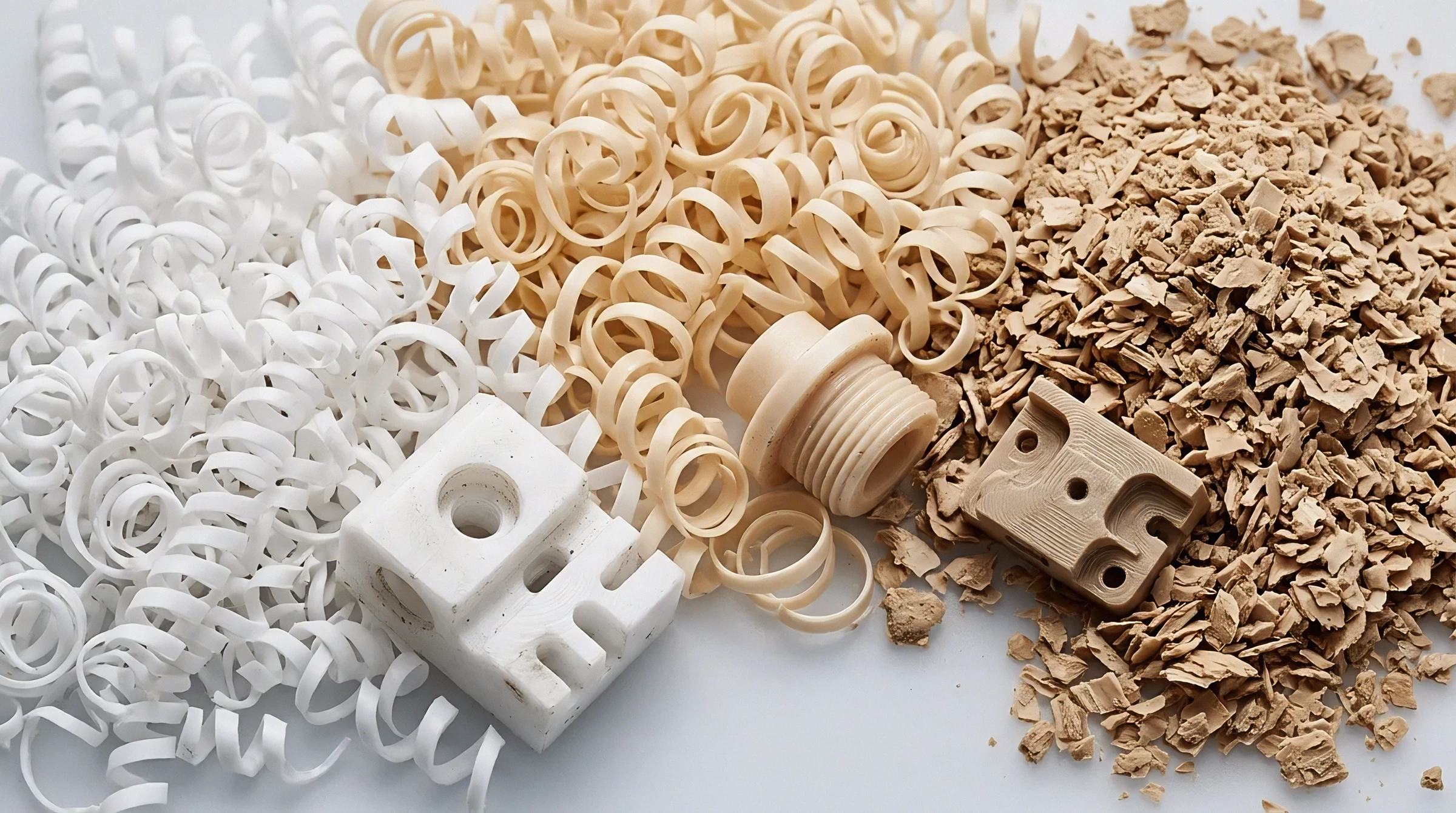
A 10 mm (0.39 in) end mill cutting acetal at 200 m/min (656 ft/min) turns at about 6,400 rpm. The same cutter in steel would run at a fraction of that. That figure comes straight from the published cutting-speed range for acetal in the machining guide of Mitsubishi Chemical Advanced Materials (MCAM), and it surprises machinists who expect a soft material to want a slow, gentle cut. Plastic wants the opposite: high surface speed, a real chip and a feed heavy enough to carry heat away.
Acetal, nylon and PEEK are the three engineering plastics most often machined into precision parts, and they sit close together in the published tables. Their differences show up in the chip, in how heat stays in the part, and in the tool each one tolerates. The sections below follow the process in the order a programmer sets it: choose the published window, convert it to spindle speed, set the feed, check the chip, and adjust.
Speeds and Feeds for Acetal, Nylon and PEEK in One Table
Table 1 sets the published cutting data for the three materials side by side, from MCAM’s 2026 guide and from Tangram Technology, a UK plastics engineering consultancy that publishes indicative values. MCAM groups unfilled PEEK with PET-P and PAI, and filled PEEK with the other reinforced grades; Tangram does not list PEEK.
| Material and operation | MCAM 2026 | Tangram |
|---|---|---|
| Acetal, turning | 200 to 500 m/min (656 to 1,640 ft/min); 0.05 to 0.5 mm/rev; HSS or carbide | 200 to 500 m/min; 0.05 to 0.5 mm/rev |
| Acetal, milling | 200 to 400 m/min (656 to 1,312 ft/min); up to 0.5 mm/tooth | 200 to 400 m/min; up to about 0.5 mm/tooth |
| Acetal, drilling | 50 to 100 m/min (164 to 328 ft/min); 0.1 to 0.3 mm/rev | 50 to 100 m/min; 0.1 to 0.3 mm/rev |
| Nylon, turning | 200 to 500 m/min; 0.05 to 0.5 mm/rev; HSS or carbide | 200 to 500 m/min; 0.05 to 0.5 mm/rev |
| Nylon, milling | 200 to 500 m/min; up to 0.5 mm/tooth | 200 to 500 m/min; up to about 0.5 mm/tooth |
| Nylon, drilling | 50 to 100 m/min; 0.1 to 0.3 mm/rev | 50 to 100 m/min; 0.1 to 0.3 mm/rev |
| Unfilled PEEK, turning | 200 to 400 m/min; 0.05 to 0.5 mm/rev; carbide | not listed |
| Unfilled PEEK, milling | 150 to 300 m/min (492 to 984 ft/min); up to 0.4 mm/tooth; carbide | not listed |
| Unfilled PEEK, drilling | 50 to 80 m/min (164 to 262 ft/min); 0.1 to 0.3 mm/rev; carbide | not listed |
| Filled PEEK, turning | 100 to 200 m/min (328 to 656 ft/min); 0.05 to 0.3 mm/rev; carbide or diamond | not listed |
| Filled PEEK, milling | 75 to 150 m/min (246 to 492 ft/min); up to 0.3 mm/tooth; carbide or diamond | not listed |
| Filled PEEK, drilling | 50 to 80 m/min; 0.1 to 0.3 mm/rev; carbide or diamond | not listed |
Where both sources cover a material, they agree. That is less a coincidence than a sign that the ranges are wide enough to describe a whole family. Inside each window, the machine, the tool and the part decide where the cut actually runs.
Feed converts as follows for readers working in inches: 0.05 mm (0.002 in), 0.1 mm (0.004 in), 0.3 mm (0.012 in), 0.4 mm (0.016 in) and 0.5 mm (0.020 in), per revolution or per tooth as the row states.
Acetal and nylon share one wide window. Unfilled PEEK runs a little slower and on carbide. Filled PEEK halves the speed again and moves to diamond.
Why Plastic Wants Speed and a Real Chip
Plastic conducts heat poorly, softens at low temperature and expands far more than metal. MCAM’s summary page lists all of these and adds that thermal expansion can be up to ten times higher than in metals. The consequence for cutting data is direct: whatever heat stays in the part shows up as melting, smearing or a dimension that moves after the part cools.
Tangram puts the rule in one line, that heat exits with the chip. A properly loaded cut produces a chip thick enough to absorb the cutting energy and leave with it. Very light cuts do the reverse, and Tangram warns that excessively light cuts rub, and rubbing makes heat. Slow and gentle is therefore not automatically safer on plastic.
The makers’ wording follows the same logic. MCAM’s first rules for its stock shapes say feed rates should be as high as possible and tools sharp, with enough clearance that only the cutting edge touches the material. Ensinger, another stock maker, recommends high cutting speeds with medium feed rates for milling, and a high cutting speed with a moderate feed for good surfaces in general. It also names excessive heat from inappropriate speeds and feed rates as one of the ways machining adds stress to a part.
From Cutting Speed to Spindle Speed
A cutting speed is a surface speed. The spindle speed that delivers it depends on the diameter of the cutter or the workpiece. Tangram prints the conversion in its guide.
Spindle speed in rpm equals 1,000 times the cutting speed in m/min, divided by pi times the diameter in mm. In milling, the table feed in mm/min equals the feed per tooth times the number of cutting edges times the spindle speed.
Table 2 applies both at the low end of each material’s milling window, with a two-flute cutter and an example feed of 0.1 mm (0.004 in) per tooth, well inside every published range.
| Material and cutting speed | Cutter, mm (in) | Spindle speed, rpm | Table feed, mm/min (in/min) |
|---|---|---|---|
| Acetal or nylon, 200 m/min (656 ft/min) | 6 (0.24) | 10,610 | 2,122 (83.5) |
| Acetal or nylon, 200 m/min | 10 (0.39) | 6,366 | 1,273 (50.1) |
| Acetal or nylon, 200 m/min | 16 (0.63) | 3,979 | 796 (31.3) |
| Unfilled PEEK, 150 m/min (492 ft/min) | 6 (0.24) | 7,958 | 1,592 (62.7) |
| Unfilled PEEK, 150 m/min | 10 (0.39) | 4,775 | 955 (37.6) |
| Unfilled PEEK, 150 m/min | 16 (0.63) | 2,984 | 597 (23.5) |
| Filled PEEK, 75 m/min (246 ft/min) | 10 (0.39) | 2,387 | 477 (18.8) |
The first row explains a practical limit. A 6 mm (0.24 in) cutter needs more than 10,000 rpm to reach the bottom of the acetal window, and a spindle that tops out below that runs the tool at a lower surface speed than the makers suggest. When that happens, raising the feed per tooth keeps the chip thick enough to carry heat, which is the purpose of the speed in the first place.
The last row shows how far filled PEEK moves. At half the cutting speed of unfilled PEEK and with diamond or carbide tools, a 10 mm cutter runs at half the spindle speed and half the table feed, before any allowance for tool wear.
Feed per Tooth and the Chip to Look For
The published feeds are ceilings: up to 0.5 mm per tooth for acetal and nylon, 0.4 mm for unfilled PEEK and 0.3 mm for filled PEEK in MCAM’s milling table. Tangram uses the same ceilings with “about” in front of them. Neither source sets a lower bound, which leaves the programmer to choose a feed per tooth large enough to cut instead of rub.
The number of cutting edges matters as much as the feed. Each maker leans toward fewer flutes.
- MCAM recommends cutters with fewer teeth, a higher helix and good clearance, and two- or three-flute cutters for polyamides and other soft materials.
- Ensinger advises at most two cutting edges in peripheral milling, to limit vibration and leave enough chip space.
- Tangram notes that single-flute cutters are often preferred for acetal, to reduce frictional heat and improve chip space.
The direction of cut is the last setting. MCAM recommends climb milling and illustrates why: the cutter enters thick and leaves thin, giving a small break, less heat and a better finish, while conventional milling gives the reverse. Tangram also favors climb milling because more heat leaves with the chip.
The chip itself is the check. Ensinger describes acetal, PET and unfilled PEEK as materials that tend to form short chips at high infeed and feed. Extruded nylon forms a continuous flow of chips that may need to be cleared from the tool more often, while cast nylon breaks into shorter chips. A chip that turns from a clean curl into a molten string, or welds back onto the cutter, is a sign that the feed is too light or the speed too high for the heat the setup can remove.
The feed per tooth is chosen to make a chip, not to protect the tool. In plastic, too little feed is the more common fault, and it shows up as heat.
Turning the Three Materials
Turning uses the same windows with the workpiece diameter in the formula. Table 3 shows spindle speed at 200 m/min (656 ft/min), the lower bound that acetal, nylon and unfilled PEEK share in MCAM’s turning data, with the table feed for an example of 0.1 mm/rev (0.004 in/rev).
| Workpiece diameter, mm (in) | Spindle speed, rpm | Feed rate, mm/min (in/min) |
|---|---|---|
| 12 (0.47) | 5,305 | 531 (20.9) |
| 25 (0.98) | 2,546 | 255 (10.0) |
| 50 (1.97) | 1,273 | 127 (5.0) |
| 100 (3.94) | 637 | 64 (2.5) |
| 200 (7.87) | 318 | 32 (1.3) |
On a lathe with constant surface speed, the spindle climbs as the tool moves toward the center, so small diameters reach the spindle limit first.
The makers’ turning advice adds several settings that are not in the speed table. Ensinger asks for a high cutting speed, a cutting depth of at least 0.5 mm (0.020 in), compressed air for cooling and a steady rest where the part lacks rigidity. MCAM recommends inserts designed for nonferrous metals such as aluminum or brass, a nose radius of 0.8 mm (0.031 in) for the best finish, and a compressed-air suction system to carry away the continuous chip from nylon and similar materials so it does not wrap around the chuck or the part.
Two of MCAM’s tips concern size rather than speed. Most diameters grow after turning, so the guide suggests setting to the lowest dimension of the tolerance. For improved tolerances it suggests roughing large sections and leaving them for 24 hours before finishing, so stress released by the roughing cut does not end up in the final size.
Material Notes for Acetal, Nylon and PEEK
The three materials share a speed window but not a temperament. Ensinger ranks their machinability in its guidance on plastics for machining: PEEK is easy to machine because it is stiff and hard and forms few burrs, acetal machines well and accurately, and nylon, being tougher and less stiff, is prone to burrs and warping and needs a tailored process.
Acetal
Tangram rates acetal’s machinability as excellent and lists its faults: burrs from dull tools, heat from rubbing, and undersize holes unless an adequate cut is taken. Ensinger adds a caution that matters for cutting data. Its acetal, TECAFORM, is particularly sensitive to local overheating from friction, which can cause post-shrinkage and severe distortion of the part. A high speed with a light feed is therefore a poor combination on acetal, however clean the first surface looks.
Nylon
MCAM’s advice for polyamides is to go for maximum feed and speed, so swarf leaves the tool before it builds up or wraps around it, and to use an air blast or a vacuum to clear chips. Tangram lists stringy chips, wrap-around and burrs as the common issues, and adds moisture as a separate effect on dimensions. A nylon program therefore pairs aggressive cutting data with chip control and a measurement plan that accounts for moisture.
PEEK, Unfilled and Filled
Ensinger says high tool infeeds and feed rates can be used on PEEK because of its dimensional stability and balanced properties. The filled grades reverse part of that advice. MCAM recommends carbide on glass or carbon fiber, with reduced speed and increased feed, and lists diamond tooling as essential for fiber- and graphite-filled materials. Ensinger notes that machining becomes more complex as the proportion of reinforcement rises, and that fiber orientation affects both the cut and the part.
Adjusting When the Cut Goes Wrong
MCAM’s troubleshooting chart for turning ties the common surface faults to specific settings, and it is a direct way to read a bad part back into the cutting data.
- Melted surface: a dull tool or a rubbing heel, too little side clearance, a feed rate that is too slow, or a spindle speed that is too fast.
- Rough finish: a feed that is too heavy, incorrect clearance angles, a sharp tool point where a slight nose radius is needed, or a tool not on center.
- Chatter: a tool not mounted solidly, a part not supported properly, or a depth of cut that is too heavy, in which case MCAM suggests two cuts.
Ensinger’s guidance on blunt drills completes the picture from the other direction. It lists a feed rate that is too low, a spindle speed that is too low and insufficient lubrication as causes of a drill that dulls quickly or fails to pass through the part.
The adjustment order that follows from these lists starts with the tool, then the feed, then the speed. A sharp, correctly ground tool removes most melting. Most of the rest goes with a heavier feed. Speed is the last lever, and on plastic it is more often lowered to cure heat than raised.
What a Buyer Can Ask About Cutting Data
A buyer does not set speeds and feeds, but a few questions at quoting reveal whether the cutting data suit the material and the part.
- Which grade and stock form the quote assumes, since filled PEEK and unfilled PEEK use different tools and windows.
- Whether the shop uses carbide or diamond tooling for any reinforced grade.
- Whether finishing passes are taken after a rest period on large or asymmetric parts.
- How the shop controls chips on nylon, where wrap-around marks the surface.
- At what temperature and after what delay finished dimensions are measured.
For acetal, nylon and PEEK parts run in batches after the first articles, low-volume plastic CNC with bridge production holds the proven cutting data, tools and rest times constant from one batch to the next.
Sources and Further Reading
- Guide to machining plastic parts, metric system, 2026, Mitsubishi Chemical Advanced Materials
- Plastics Topics, Machining of plastics, 2026, Tangram Technology
- Frequently asked questions, machinable plastics, Ensinger
- CNC milling of plastics at Ensinger, Ensinger
- CNC turning of plastics at Ensinger, Ensinger
- Plastics for machining, Ensinger
- PEEK machining, Ensinger