Heat Deflection Temperature

Heat deflection temperature (HDT) is the bath temperature at which a loaded standard plastic bar deflects 0.25 mm (0.010 in) under ASTM D648.

Every Heat Deflection Temperature article of the Plastic CNC Resources, newest first, each written from published standards, research and makers’ data.

Meaning

Heat deflection temperature (HDT) is the bath temperature at which a loaded standard plastic bar deflects 0.25 mm (0.010 in) under ASTM D648. Sheets also call it deflection temperature under load. ASTM calls the deformation and the test conditions arbitrary. The figure ranks materials, and the standard says it is not for design.

Procedure

The Polymer Innovation Blog summarizes the method. The bar is loaded edgewise as a simple beam, for a fiber stress of 0.455 MPa (66 psi) or 1.82 MPa (264 psi). The bath warms at 2 ± 0.2 °C (3.6 ± 0.4 °F) per minute. It uses mineral oil up to 115 °C (239 °F) or silicone oil up to 260 °C (500 °F). The test applies to stock 3 mm (1/8 in) thick or more. At least two samples are run and averaged, and the stress level is stated with the result.
Read More

Load Pair

The heavier load gives the lower number, because a heavy load moves a hot bar sooner. Delrin 150 reads 125 °C (257 °F) at 1.82 MPa (264 psi) and 169 °C (336 °F) at 0.455 MPa (66 psi). On these sheets acetal reads 44 to 48 °C (79 to 86 °F) apart between the loads, and PEI about 10 °C (18 °F). Glass closes the gap. PEI with 30 percent glass reads 210 and 212 °C (410 and 414 °F).

Published Values

Acetal sheets give 104 to 125 °C (220 to 257 °F) at 1.82 MPa (264 psi), across two chemistries. Unfilled PEI gives 200 to 204 °C (392 to 400 °F). Spartech’s HDPE sheet prints only 80 °C (176 °F) at the light load. A sheet with one load leaves the reader unable to compare it safely. Ensinger prints its glass-filled PEI figure for a 1/4 in (6.35 mm) specimen, and annealing changes the result by relieving residual stress.

Limit of Use

ASTM D648-18 notes that its results shall not be compared with ISO 75. The test lasts tens of minutes, while a part in service sits at heat for months. A requirement that uses heat deflection names the standard and edition, the load, the thickness, the annealed state and the grade.

Shore D and Rockwell Hardness on Plastic Stock Data Sheets

Shore D and Rockwell values on plastic stock sheets rank surface hardness under named methods, cannot be converted into each other, and bind a supplier only when agreed.

What Shore D and Rockwell Numbers Mean on a Plastic Stock Data SheetBoth numbers rank how strongly a plastic resists a hard indenter pressed into its surface at room temperature. Neither is a strength, a wear rating or a design value.
Cast and Extruded Nylon PA6 Stock for Machined Parts

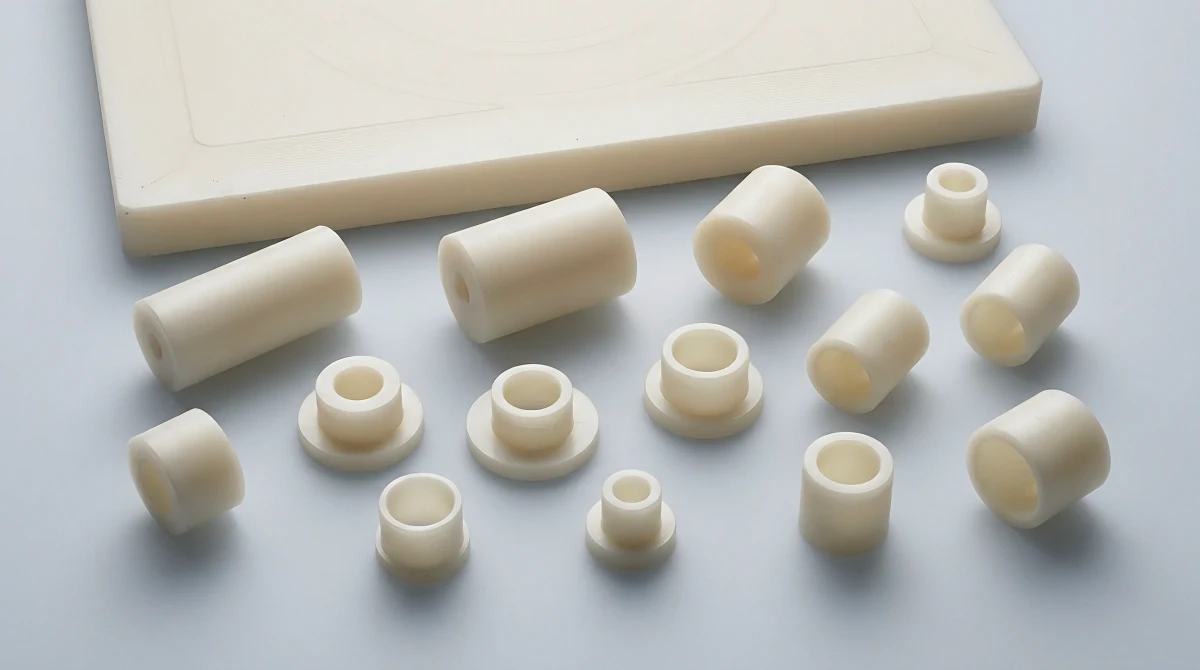
Cast and extruded PA6 share a name but not their stress, crystallinity, chips or moisture behavior, and a machined nylon part keeps changing size after the cut.

Cast or Extruded PA6 for a Machined PartCast PA6 is usually the better machining stock when the part is large, flat, stiff or close-toleranced. Extruded PA6 is the tougher, more elastic choice for smaller parts where impact strength and elongation matter more than the last hundredth of a millimeter.

UL 94 Flammability Ratings for Machined Plastic Parts

A flame rating belongs to a material, a color and a thickness, so the call-out has to name all three and the machined wall has to stay inside them.

What UL 94 Covers and What It Leaves OutThe UL standards catalog lists UL 94 as Tests for Flammability of Plastic Materials for Parts in Devices and Appliances, in its seventh edition. Its scope states that the requirements cover tests for flammability of polymeric materials used for parts in devices and appliances, and that they serve as a preliminary indication of acceptability with respect to flammability for a particular application.

PEI Ultem Stock for CNC Machined Parts

PEI holds stiffness and shape at heat, and it asks for dry cutting, careful fluids and an annealing decision before the first part is cut.

PEI Ultem Properties for Machined PartsPolyetherimide, PEI for short, is an amorphous thermoplastic, and Ensinger, which extrudes it into rod and plate, notes that it is commonly referred to as ULTEM plastic after the resin's trade name. Ensinger describes the material as having high mechanical strength and rigidity, exceptional creep resistance over a wide temperature range and very good hydrolysis resistance, and as inherently flame retardant with low smoke emission, which makes it a preferred material for aircraft interiors.

Request a Plastic CNC Quote

Send the 2D drawing and the 3D file, with the quantity and the stage of the project. An engineer replies within 1 working day.

The quote form, the mutual NDA and the private folder for your files are on Protolis Atelier, with Plastic CNC chosen.

Request a Quote