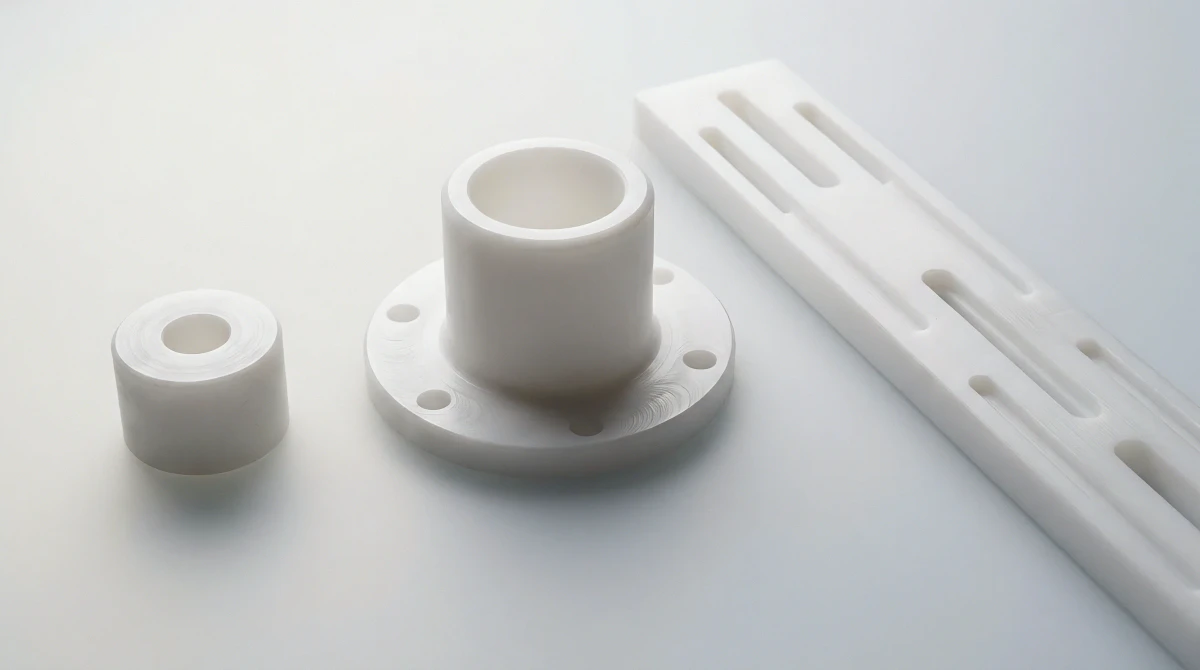
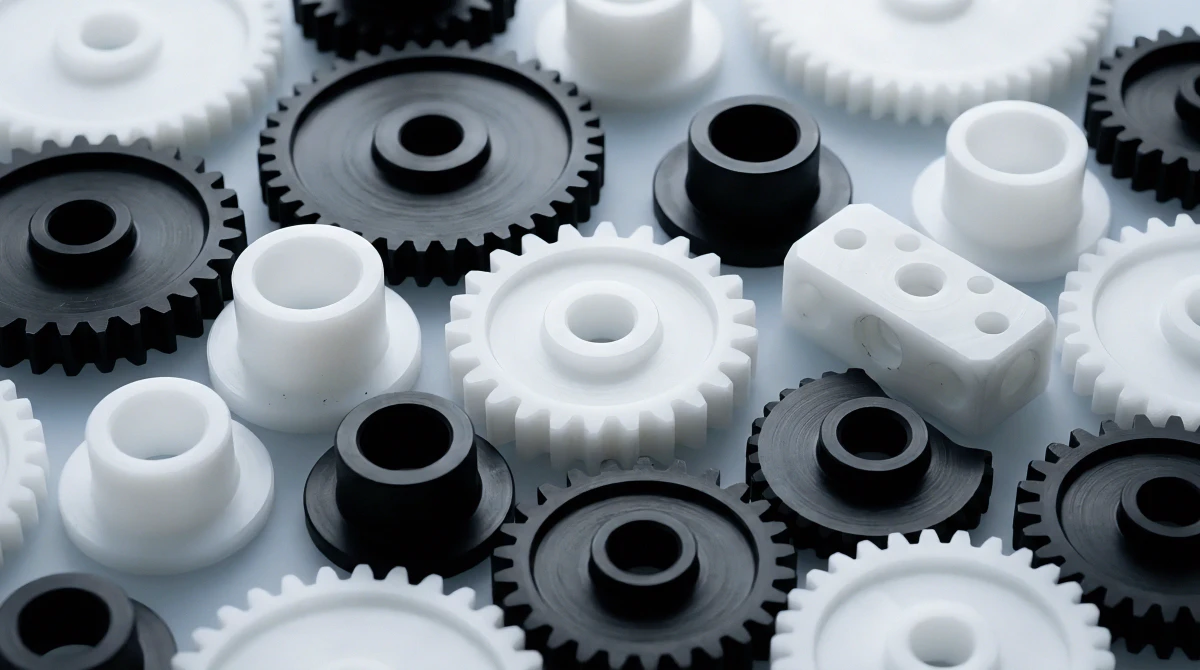
Carbon Fiber

Carbon fiber is a reinforcement added to engineering plastics such as PEEK, as in the 30 % carbon-filled PEEK grades, to raise stiffness, creep strength and thermal conductivity.

Every Carbon Fiber article of the Plastic CNC Resources, newest first, each written from published standards, research and makers’ data.

Meaning

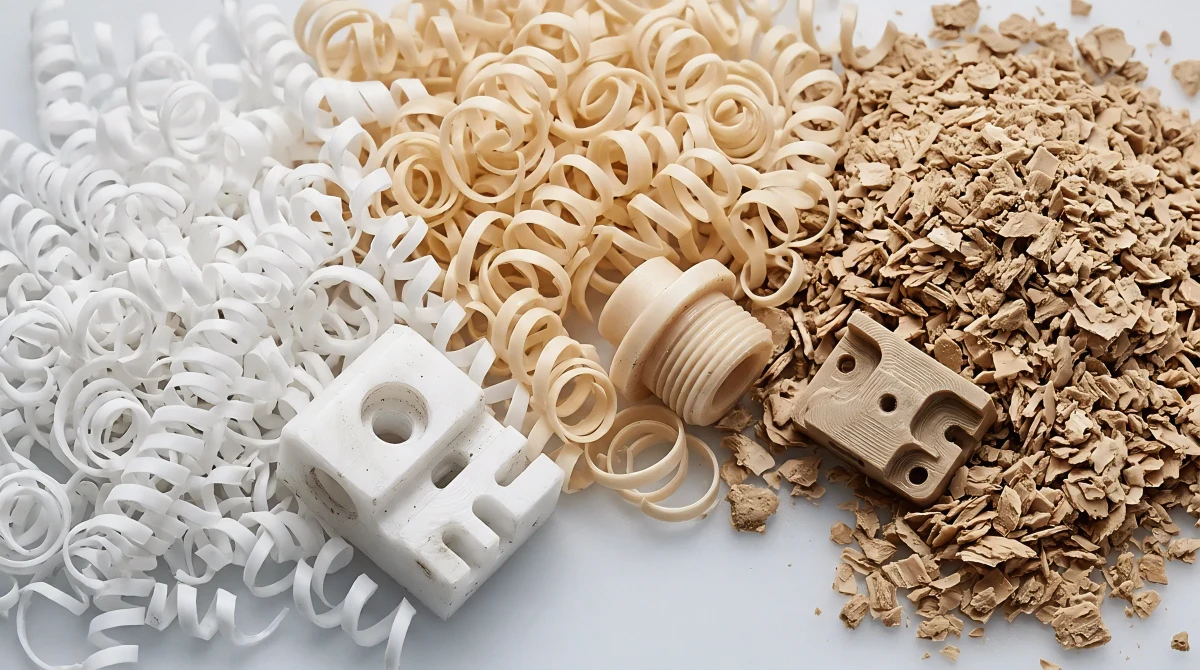
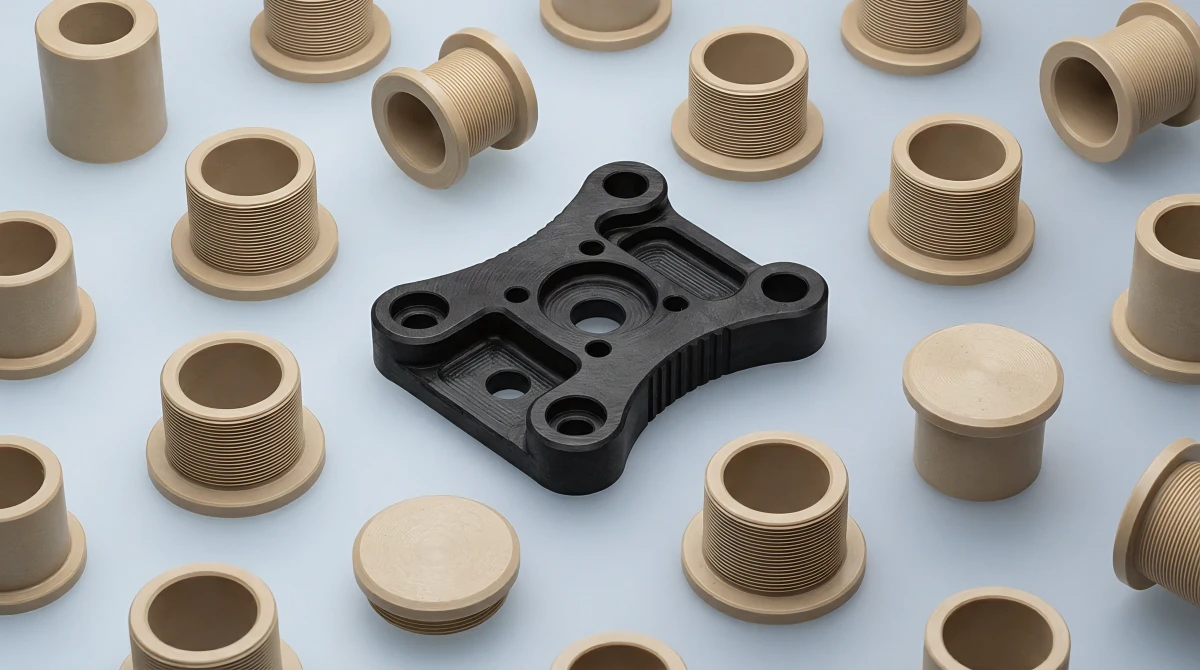
Carbon fiber is a reinforcement added to engineering plastics such as PEEK, as in the 30 % carbon-filled PEEK grades, to raise stiffness, creep strength and thermal conductivity. It turns a stiff thermoplastic into a composite at the machine: more abrasive to tools, sensitive to fiber direction and electrically conductive. The polymer name on the drawing stays the same, but the cutting data, the tooling and some of the part’s functions change.

Effect on Properties

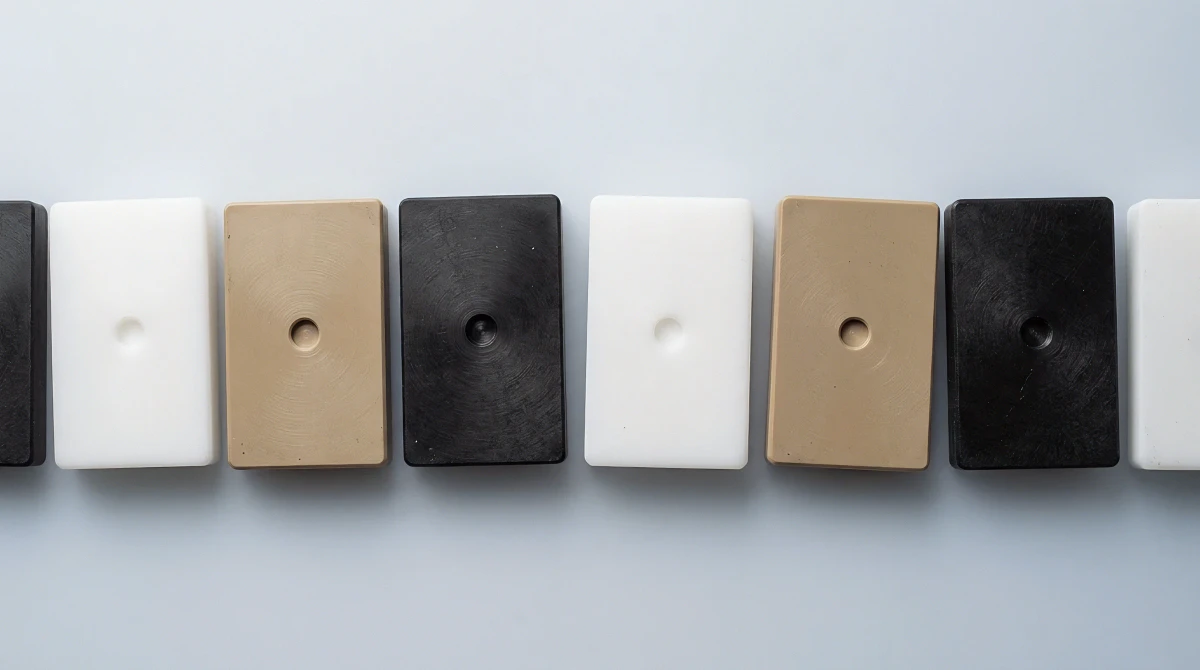
Ensinger’s sheets for TECAPEEK natural and TECAPEEK CF30 black, measured to the same ISO methods, show the shift. The tensile modulus rises from 4,200 MPa (609 ksi) to 6,000 MPa (870 ksi), thermal conductivity from 0.27 to 0.66 W/(m·K), while elongation at break falls from 15 % to 10 %. Surface resistivity drops from 10¹⁵ Ω to 10³ to 10¹² Ω, so the filled grade is no longer an insulator. Surface hardness hardly moves: Shore D 90 against 89.
Read More

Tooling

Mitsubishi Chemical Advanced Materials calls polycrystalline or CVD diamond tooling essential for glass-, carbon- and graphite-filled plastics, and for its filled PEEK grades lists carbide or diamond for every cut. Ensinger recommends K20 carbide or, ideally, PCD, with regular tool checks because of the abrasion, and advises against hardened steel tools. Mitsubishi’s general rule for fiber-filled stock is carbide, a lower speed and a higher feed.

Cutting Data

For filled PEEK, Mitsubishi gives turning at 100 to 200 m/min (328 to 656 ft/min), milling at 75 to 150 m/min (246 to 492 ft/min) with up to 0.3 mm (0.012 in) per tooth, and drilling at 50 to 80 m/min (164 to 262 ft/min). Reinforced grades are sawn on a band saw with a tooth pitch of 4 to 6 mm (0.16 to 0.24 in); standard circular saws usually crack them.

Fiber Direction

A carbon-filled plate is not the same in every direction. Ensinger asks for clamping in the extrusion direction, where compression strength is highest, with the lowest pressure that holds the part, and for even fly-cuts on both faces of the stock at no more than 0.5 mm (0.020 in) per pass. It warns that fiber orientation can increase warping, so the position of a long part in the plate belongs in the planning. In injection molding, fiber-reinforced compounds serve the same purpose of stiffness and dimensional stability, with their own fiber orientation set by the flow in the mold.
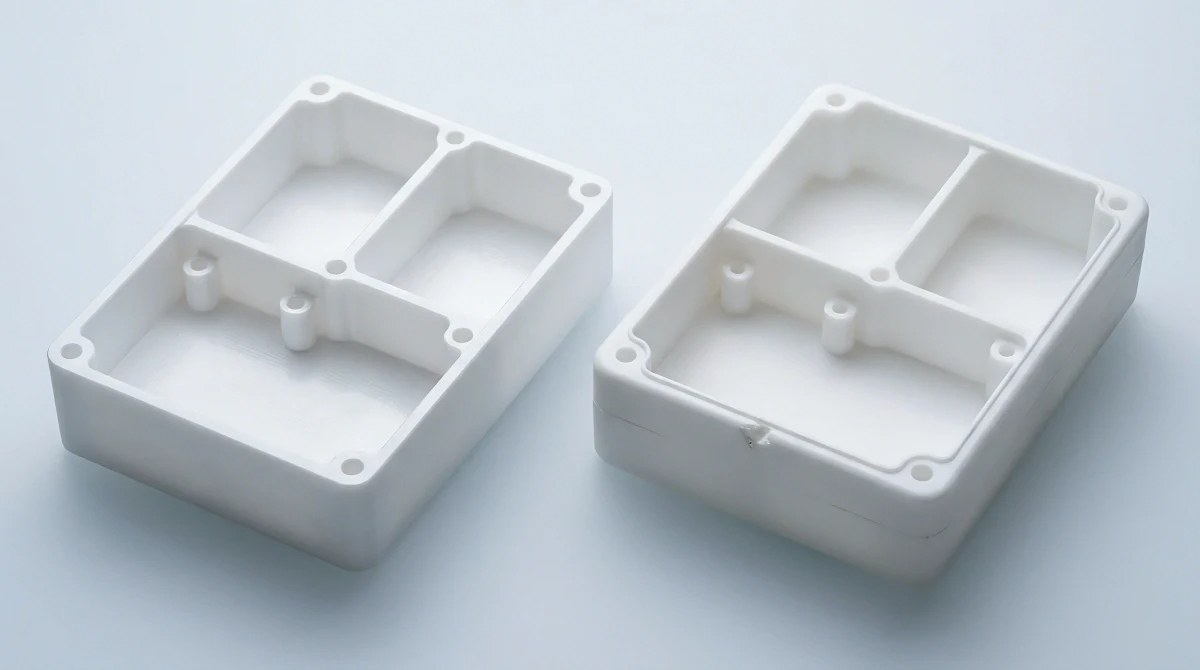
Speeds and Feeds for Machining Acetal, Nylon and PEEK

Acetal, nylon and PEEK share wide published cutting windows, and the right point inside each depends on making a chip that carries heat out of the part.

Speeds and Feeds for Acetal, Nylon and PEEK in One TableTable 1 sets the published cutting data for the three materials side by side, from MCAM's 2026 guide and from Tangram Technology, a UK plastics engineering consultancy that publishes indicative values. MCAM groups unfilled PEEK with PET-P and PAI, and filled PEEK with the other reinforced grades; Tangram does not list PEEK.

Shore D and Rockwell Hardness on Plastic Stock Data Sheets

Shore D and Rockwell values on plastic stock sheets rank surface hardness under named methods, cannot be converted into each other, and bind a supplier only when agreed.

What Shore D and Rockwell Numbers Mean on a Plastic Stock Data SheetBoth numbers rank how strongly a plastic resists a hard indenter pressed into its surface at room temperature. Neither is a strength, a wear rating or a design value.

Machining PEEK Unfilled and Carbon-Filled Stock

Unfilled and carbon-filled PEEK share a polymer but differ in stiffness, conductivity, tooling, cutting data and tolerance, so the grade belongs on the drawing.

How Unfilled and Carbon-Filled PEEK Stock Differ for Machined PartsUnfilled PEEK machines like a hard, stiff thermoplastic: short chips, little burr, high feed rates and fine finishes. Carbon-filled PEEK machines like a composite: abrasive to tools, sensitive to fiber direction, and best cut with carbide or diamond at lower speeds.

Sizing a Machined Plastic Run From Blanks to Batches

A machined run is sized from weeks and consumption, converted to plates and batches, and then matched to cutters and fixtures by run length.

How to Size a Machined Plastic RunCount the parts the program will consume until the next process delivers, add a spare for parts lost in testing, convert the total to blanks by nesting, and group the blanks into batches that share a rest, an oven load and a measuring session. Then choose the cutter and the fixture by the length of the run.

Machining Tolerances by Part Size for Engineering Plastics

Published plastic tolerances widen with feature size and split by polymer group, so a drawing has to state size, grade, temperature and rest.

Published Machining Tolerances by Feature Size and Material GroupTable 1 reproduces the Mitsubishi table for nine of its sizes, with inches beside each figure. The five groups are the guide's own: HDPE; the group that holds PET-P, PC, PEEK, PTFE 500, PPS, PEI, PPSU and PSU; the group that holds PA, POM and PTFE 207; PEEK with fillers; and PAI with PBI.

Acetal Homopolymer and Copolymer Stock for CNC Machined Parts

Homopolymer is stiffer and harder, copolymer is sold porosity-free with less water uptake and less thermal growth, and the stock a part is cut from decides which it inherits.

Acetal Homopolymer and Copolymer Differences in Machined PartsAcetal, the polyoxymethylene or POM family, reaches a machine shop as two chemistries. Homopolymer chains repeat one unit; copolymer chains carry two.

Request a Plastic CNC Quote

Send the 2D drawing and the 3D file, with the quantity and the stage of the project. An engineer replies within 1 working day.

The quote form, the mutual NDA and the private folder for your files are on Protolis Atelier, with Plastic CNC chosen.

Request a Quote