Feed per Tooth

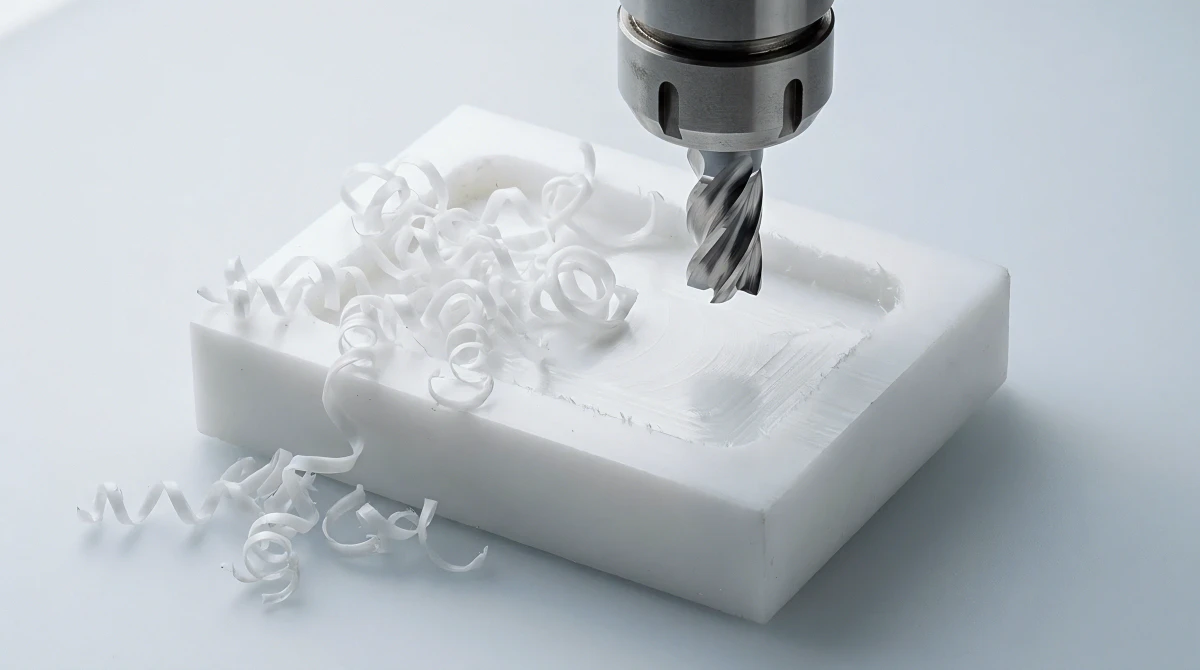
Feed per tooth is the chip each edge of a milling cutter takes per revolution.

Every Feed per Tooth article of the Plastic CNC Resources, newest first, each written from published standards, research and makers’ data.

Meaning

Feed per tooth is the chip each edge of a milling cutter takes per revolution. It decides whether a plastic cut shears or rubs. Mitsubishi prints milling feeds this way, by polymer family. Too little feed per tooth is as harmful in plastic as too much.

Family Values

Mitsubishi’s 2026 guide gives polyamide and UHMW-PE up to 0.5 mm (0.020 in) per tooth at 200 to 500 m/min (656 to 1,640 ft/min). Acetal takes up to 0.5 mm (0.020 in) at 200 to 400 m/min (656 to 1,312 ft/min). Unfilled PEEK and PET-P drop to 0.4 mm (0.016 in) at 150 to 300 m/min (492 to 984 ft/min). Reinforced grades run at 0.3 mm (0.012 in) and 75 to 150 m/min (246 to 492 ft/min). PBI, PI and MT-01 run at 0.15 mm (0.006 in) and 25 to 100 m/min (82 to 328 ft/min).
Read More

Chip Load

Tangram asks for a higher chip load on polyolefins than on hard plastics. It advises raising the feed if chips reweld. For UHMW-PE it gives up to about 0.5 mm (0.020 in) per tooth, with burrs controlled. A thin chip carries little heat, and the edge rubs instead of cutting. Mitsubishi’s advice for the softest stocks is maximum feed and speed, to get swarf away from the tool.

Table Feed

Feed per tooth turns into table feed by multiplying by the number of flutes and the spindle speed. A low flute count leaves chip room and limits recutting. That is why Tangram and Mitsubishi favor single, two or three-flute cutters on plastic.

Effect on Time

The limit of about 0.5 mm (0.020 in) per tooth keeps milled parts slower than turned ones. Pockets add passes. Machine time still stays small beside the rest and oven time a close-tolerance part needs.
Speeds and Feeds for Machining Acetal, Nylon and PEEK

Acetal, nylon and PEEK share wide published cutting windows, and the right point inside each depends on making a chip that carries heat out of the part.

Speeds and Feeds for Acetal, Nylon and PEEK in One TableTable 1 sets the published cutting data for the three materials side by side, from MCAM's 2026 guide and from Tangram Technology, a UK plastics engineering consultancy that publishes indicative values. MCAM groups unfilled PEEK with PET-P and PAI, and filled PEEK with the other reinforced grades; Tangram does not list PEEK.

How Long Resting, Annealing and Drying Add to Machined Plastic Parts

In a machined plastic order the cutting takes minutes, while resting, drying and heat treatment take days, so the drawing sets the lead time.

Where the Calendar Goes in a Machined Plastic OrderMost of the elapsed time in a machined plastic order is spent on stock preparation, resting, heat treatment, drying and measurement at a controlled temperature, and the cutting is a small fraction. When a part needs none of those steps, it goes from blank to finished in the machine time plus setup and deburring.

UHMW-PE and HDPE Stock for CNC Milling and Turning

UHMW-PE wears longest and HDPE holds shape better, and both need sharp tools, chip control and a stated measurement temperature to hold size.

UHMW-PE and HDPE Differences for Machined PartsBoth are polyethylene, and the difference starts with chain length. Mitsubishi describes its TIVAR 1000 Virgin UHMW-PE as setting the standard for ultra high molecular weight polyethylene shapes, with a combination of wear and corrosion resistance, a low-friction surface and excellent impact strength.

Request a Plastic CNC Quote

Send the 2D drawing and the 3D file, with the quantity and the stage of the project. An engineer replies within 1 working day.

The quote form, the mutual NDA and the private folder for your files are on Protolis Atelier, with Plastic CNC chosen.

Request a Quote