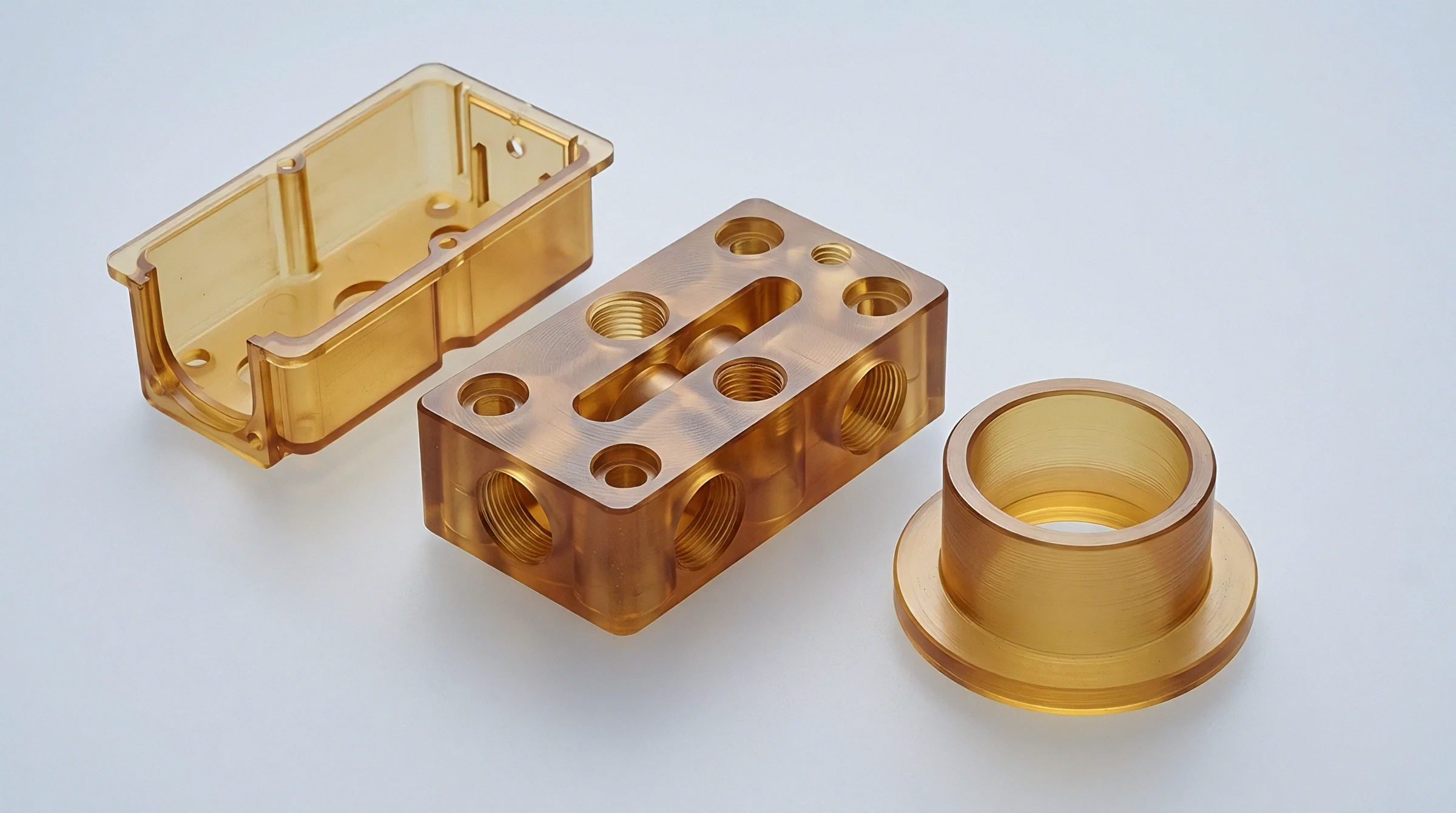
A bar of amber PEI lists a heat deflection temperature near 200 °C (392 °F) at 1.8 MPa (264 psi), and a machined part cut from it can still crack at room temperature, days later, because a cutting fluid or a wipe-down solvent found the stress the cutter left behind. High heat resistance and sensitivity to fluids sit in the same material.
That pairing explains most of what separates PEI from the engineering plastics around it. It is stiff, hot-service and flame-retardant on the data sheet, and it is amorphous, which makes it sensitive to fluid and to stress in the shop. The sections below take the properties, the cut and the heat treatment in the order a buyer meets them.
PEI Ultem Properties for Machined Parts
Polyetherimide, PEI for short, is an amorphous thermoplastic, and Ensinger, which extrudes it into rod and plate, notes that it is commonly referred to as ULTEM plastic after the resin’s trade name. Ensinger describes the material as having high mechanical strength and rigidity, exceptional creep resistance over a wide temperature range and very good hydrolysis resistance, and as inherently flame retardant with low smoke emission, which makes it a preferred material for aircraft interiors. Its unfilled stock, TECAPEI natural, is extruded from SABIC’s ULTEM 1000 series resin and its glass-reinforced stock, TECAPEI GF30, from the 2300 series. Mitsubishi sells the same family as Duratron U1000.
Amorphous matters on the machine. There is no crystalline melting point to stay below, so heat in the cut shows up as a surface that smears and as stress that stays in the part. Tangram Technology’s machining guide puts amorphous thermoplastics, PEI’s group, among the materials more sensitive to stress and to cooling fluids than semicrystalline ones such as acetal or polyethylene.
Thermal conductivity is the other number that explains the shop floor. Ensinger lists 1.5 BTU·in/(h·ft²·°F) for unfilled TECAPEI and 1.56 for the glass-filled grade, about 0.22 W/m·K either way. Heat stays where the cutter put it.
PEI offers high stiffness, high heat deflection and a UL 94 V-0 resin rating. The trade-off is sensitivity to fluids, to stress and to heat concentrated at the cutting edge.
PEI Ultem Properties in Metric and Inch Units
Table 1 compares unfilled PEI with the 30 percent glass grade, both from Ensinger’s own product pages. Ensinger publishes inch-pound units with the ASTM method beside each value; the metric values are conversions, rounded.
| Property (test method) | TECAPEI natural, unfilled | TECAPEI GF30, 30 % glass |
|---|---|---|
| Tensile strength at break (ASTM D638), MPa (psi) | 120.7 (17,500) | 124.1 (18,000) |
| Tensile modulus (ASTM D638), GPa (psi) | 2.96 (430,000) | 5.52 (800,000) |
| Elongation at break (ASTM D638) | 40 % | 3 % |
| Flexural strength (ASTM D790), MPa (psi) | 158.6 (23,000) | 193.1 (28,000) |
| Flexural modulus (ASTM D790), GPa (psi) | 3.31 (480,000) | 5.52 (800,000) |
| Heat deflection at 1.8 MPa (264 psi) (ASTM D648), °C (°F) | 201 (394) | 209 (409) |
| Heat deflection at 0.45 MPa (66 psi) (ASTM D648), °C (°F) | 210 (410) | 212 (414) |
| Linear thermal expansion, per K | 56 x 10⁻⁶ (ASTM E831) | 20 x 10⁻⁶ (ASTM D696) |
| Rockwell hardness, M scale (ASTM D785) | 110 | 110 |
| Water absorption 24 h / saturation (ASTM D570), % | 0.25 / 1.25 | 0.16 / 0.90 |
| Notched Izod impact (ASTM D256), J/m (ft·lb/in) | 32 (0.60) | 59 (1.1), unnotched not stated |
| Flammability (UL 94) | V-0 | V-0 |
Two columns are worth a second reading. Glass fiber lifts stiffness by a factor of three at 30 percent loading and cuts thermal expansion to about a third, which is why a glass-filled PEI part holds size across temperature far better than an unfilled one. The same fiber is what ruins ordinary tools, and Tangram’s guide says glass-filled, carbon-filled and graphite-filled grades are specifically more abrasive.
Water is a second movement. PEI takes up 1.25 percent at equilibrium in the unfilled grade, which is five times the 24-hour figure, so a part measured fresh from the machine and again after weeks in humid air is not guaranteed to match. Glass dilutes the uptake, to 0.90 percent at 30 percent loading.
The heat figures need one caution. Heat deflection of about 200 °C is a test result for a short load on a bar. Ensinger gives the long-term service temperature of unfilled TECAPEI as 338 °F (170 °C) and of the glass grade as 356 °F (180 °C), with 392 °F (200 °C) for short-term exposure on both, so a part that lives near 200 °C is designed to the long-term figure.
That 30 °C gap is not a flaw in the data. It is the difference between a lab’s test condition and a service life.
Stress Cracking and Fluids on PEI
Mitsubishi’s guide to machining plastic parts warns that mineral-oil-based cutting fluids, suitable for many metals and plastics, may contribute to stress cracking of amorphous plastics, naming Duratron U1000 PEI among them. It recommends nonaromatic, water-soluble coolants when a coolant is used, and a prompt wash in isopropyl alcohol and pure water afterward.
Tangram’s guide says the same in general terms. Many plastics can suffer environmental stress cracking when exposed to unsuitable fluids, and choosing a coolant is a question of chemical compatibility as much as cooling.
The practical rules are short:
- Cut PEI dry with air or a mist where the geometry allows it. Mitsubishi calls spray mists and pressurized air very effective for cooling the cutting interface.
- Use a water-soluble, nonaromatic coolant when drilling deep holes, and wash the part in isopropyl alcohol and pure water right after.
- Oils, solvents and aggressive cleaners stay away from a stressed part until it has been stress-relieved.
- Chamfers belong on sharp corners. The Mitsubishi troubleshooting table lists missing chamfers at sharp corners among the causes of cracking and corner chipping.
Stress cracking is delayed damage, which is why a clean-looking first article proves little. Ensinger’s stock catalog states that its stock shapes are annealed after production to reduce the internal tension created in manufacture, in a recirculating air oven, under nitrogen or in an oil bath. Machining starts from that relieved blank and cuts into it, and the more material a part loses to the cutter, the more of its original balance of stress goes with it.
Where the fluid leaves the shop matters too. A part that was cut dry and washed once may still carry stress, and any later wipe with a solvent meets the same stress that the cutter put there. The drawing for a PEI part can state the cleaning method it will accept.
Cutting Data for PEI
Mitsubishi’s guide gives starting values for PEI and for filled PEI, side by side with the polymers around them. Table 2 reproduces the Duratron U1000 PEI line and the line for the guide’s filled PEI grades.
| Operation | Unfilled PEI (Duratron U1000) | Filled PEI (Semitron ESd 410C line) |
|---|---|---|
| Turning, speed | 200 to 400 m/min (655 to 1,310 ft/min) | 100 to 200 m/min (330 to 655 ft/min) |
| Turning, feed | 0.05 to 0.4 mm/rev (0.002 to 0.016 in/rev) | 0.05 to 0.3 mm/rev (0.002 to 0.012 in/rev) |
| Turning tool | carbide | carbide or PCD/CVD diamond |
| Milling, speed | 200 to 400 m/min (655 to 1,310 ft/min) | 75 to 150 m/min (245 to 490 ft/min) |
| Milling, feed | up to 0.4 mm/tooth (0.016 in) | up to 0.3 mm/tooth (0.012 in) |
| Drilling, speed | 50 to 100 m/min (165 to 330 ft/min) | 50 to 80 m/min (165 to 262 ft/min) |
| Drilling, feed | 0.1 to 0.3 mm/rev (0.004 to 0.012 in/rev) | 0.1 to 0.3 mm/rev (0.004 to 0.012 in/rev) |
| Drilling, tool | carbide | carbide or PCD/CVD diamond |
Tool geometry for the unfilled grade in the same guide: relief 5 to 15 degrees and rake 0 to 10 degrees for turning, relief 5 to 15 and rake 0 to 15 degrees for milling, and for drilling a point angle of 90 to 120 degrees with relief of 5 to 10 and rake of 3 to 5 degrees. The guide says tools have to be kept sharp and smooth, that feed rates should be as high as possible, and that swarf has to be removed well.
Three rules show up on every page of the guide, and PEI follows all three. Sharpen the cutting edge. Move the chip. Stop the part rubbing, because rubbing is the heat that PEI cannot shed.
Sawing the blank comes first, and the guide gives data for it. For the PEI group it lists a circular saw with a tooth pitch of 8 to 25 mm at 1,000 to 3,000 m/min, relief of 10 to 15 degrees and rake of 0 to 15 degrees, and a band saw with a pitch of 4 to 6 mm at 50 to 400 m/min. It warns that standard circular saws usually lead to cracks in the reinforced and filled grades it lists, and that the set of the teeth has to be as large as possible to keep the material from closing on the blade. A cracked blank is a crack that machining cannot remove.
Drilling gets its own caution. The guide notes that plastics build up heat easily when hole depth is greater than twice the diameter, that frequent pull-outs are necessary, and that most plastics close up after drilling, which can make taps tight.
For glass-filled or carbon-filled PEI, the guide states that polycrystalline diamond or CVD diamond tooling is essential, and the same abrasion means a part from filled stock wears through more tools than one from unfilled bar. That is a reason to name the grade on the drawing.
Holding Size on a PEI Part
Mitsubishi’s turning tips apply directly to PEI. To improve tolerances, rough out large sections and leave them for 24 hours before finishing. Most diameters grow after cutting, so the guide advises aiming for the lowest dimension when setting. It also suggests capability studies on the machine, since the same program on the same bar will drift differently on a worn spindle than on a new one.
The guide’s general rules add three more. Consider rod as well as plate, because the extrusion centerline sits in different places. Machine equally to the centerline, so the stress released from one face is balanced by the other. Cut pockets in intermediate steps, and when a part is machined on one side only, expect top and bottom bow, which the guide illustrates as the result of cutting asymmetrically about the centerline of the extrusion.
Fixturing carries the rest. The guide recommends vacuum plates for plate parts and supports around the edges of the part on the plate. A vacuum table spreads the hold over the whole face, which avoids the clamp distortion Tangram warns about, and it suits PEI’s stiffness well. PEI is also molded in volume, so a machined PEI part is often the first lot of a component that will later be injection molded from a molding grade of the same polymer, with its own sheet and its own rating.
Annealing PEI After Machining
PEI is one of the plastics that machinists anneal after cutting, when much material has been removed, the walls are thin or the part will meet solvents in service. Mitsubishi’s machining guide gives a schedule for it, and the decision to run it is a judgment about the part rather than a rule for every PEI component.
Mitsubishi’s guide gives the reasons in a sentence. Extrusion, molding and machining can leave residual stresses, and when material is removed or the component sees elevated temperatures, those stresses can redistribute and warp the part. Annealing heats below the melting temperature and then cools slowly and uniformly. The guide lists it as useful for tight-tolerance, large or asymmetrical parts, parts with substantial material removal and parts exposed to elevated service temperatures.
| Item | Mitsubishi guide, PEI |
|---|---|
| Hold temperature | 200 °C (392 °F) |
| Heat-up | 10 to 20 °C/h (18 to 36 °F/h) |
| Hold time | 10 min per mm of wall (about 63 min per 6.35 mm, 1/4 in) |
| Cool-down | 5 to 10 °C/h (9 to 18 °F/h) |
| Environment | air or nitrogen |
The hold sits about the heat deflection temperature in Table 1, and the slow heat-up and slower cool-down are what keep the relieved part from taking on new stress. The guide states its figures as guidelines, so a shop that anneals PEI writes down the cycle it ran, fixtures the part through it and tests the first article.
Annealing tips from the Mitsubishi guide apply to every material. Leave enough oversize before annealing to cut to final size afterward. Fixture parts to the desired shape or flatness through the entire cycle, and do not unfix until the part has cooled slowly to the touch. Hold oven temperature within plus or minus 3 °C everywhere in the load.
A related rule from both guides concerns symmetry. Machine equally to the centerline, and for flat precision parts rough, anneal and finish with a very light cut.
Choosing PEI Stock and Writing the Call-Out
PEI answers a short list of needs. It holds shape and stiffness at temperatures where acetal and polyethylene soften, it carries a V-0 resin rating, and its heat deflection of about 200 °C compares with 104 to 125 °C for the acetal stock in the same kind of sheets. The trade-off is a part that has to be cut, cleaned and often stress-relieved with care.
When PEI is the answer, the call-out on a drawing does most of the protecting:
- Name the polymer, the maker’s grade and whether it is glass-filled, and at what percentage.
- Give the cleaning method or fluid the part will see, so a wipe-down does not undo the machining.
- Note whether the part is to be annealed, by which cycle and before or after the finish cut.
- Give the measurement temperature and humidity condition for any dimension under about 0.1 mm (0.004 in).
- Flag corners that cannot take a chamfer.
Glass-filled PEI is the answer when stiffness and thermal stability outweigh toughness, and it is the one that wears tools. The unfilled grade is the answer when a part needs toughness and clean machined edges. Table 1 shows both sides of the trade: Ensinger lists the unfilled grade’s elongation at break at 40 percent against 3 percent for the glass-filled grade, which is what the fiber takes away, while the tensile modulus nearly doubles.
Glass fiber triples stiffness and cuts expansion by about two thirds, and it asks for diamond tooling. Unfilled PEI stays tough and is the one to anneal.
For a run of one to a few hundred PEI parts ahead of an injection tool, low-volume plastic CNC with bridge production behind it can start from the same polymer the tool will later mold, which keeps early parts and production parts comparable in material family.
Sources and Further Reading
- Ensinger, TECAPEI natural, unfilled PEI, product data
- Ensinger, TECAPEI GF30 natural, glass-fiber reinforced PEI, product data
- Ensinger, PEI material, polyetherimide
- Ensinger, Stock Shapes catalog, 2024
- Mitsubishi Chemical Advanced Materials, Guide to machining plastic parts (MCG Machinist Toolkit, metric)
- Tangram Technology, Plastics Topics, Machining of plastics