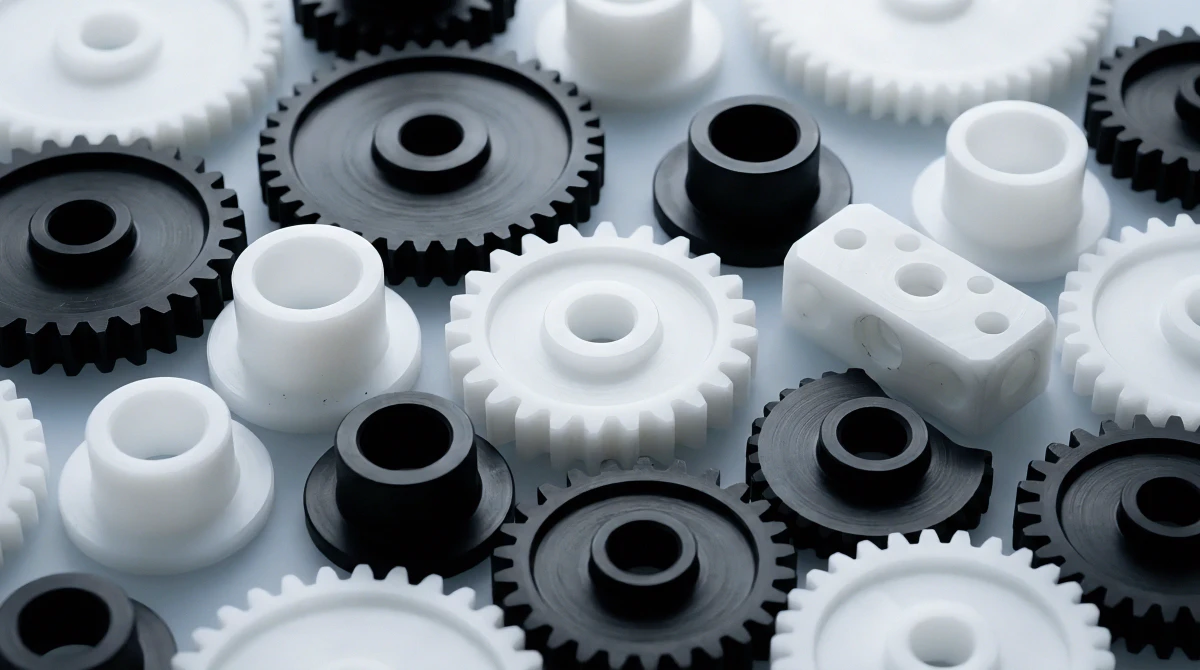
Drilling

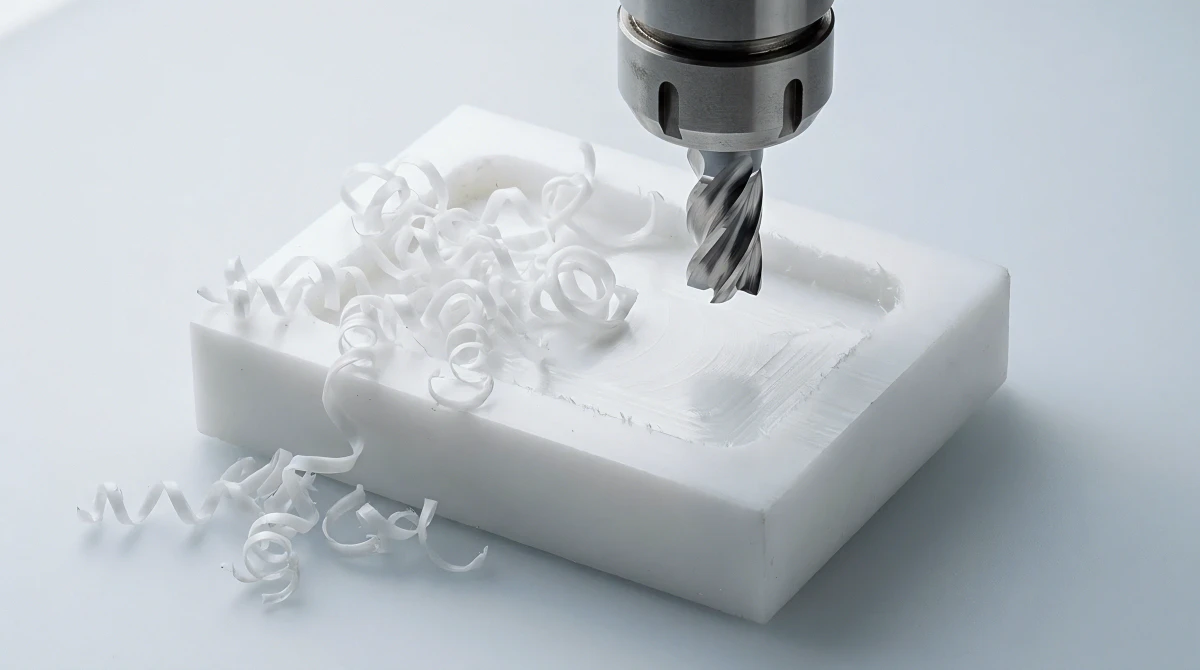
Drilling is making a hole in plastic with a rotating drill, the operation Tangram Technology calls the most problematic in plastic machining.

Every Drilling article of the Plastic CNC Resources, newest first, each written from published standards, research and makers’ data.

Meaning

Drilling is making a hole in plastic with a rotating drill, the operation Tangram Technology calls the most problematic in plastic machining. It combines concentrated heat with chip congestion in a confined space. Tangram lists smearing, local melting, internal stress, cracking and dimensional error as the results. A drilled hole in plastic also tends to close in behind the drill.

Starting Data

Mitsubishi prints 50 to 100 m/min (165 to 330 ft/min) and 0.1 to 0.3 mm/rev (0.004 to 0.012 in/rev) for most families. The drill point has a top angle of 90 to 120 degrees, relief of 5 to 10 degrees and rake of 3 to 5 degrees. PBI, PI and filled PTFE MT-01 drop to 25 to 50 m/min (82 to 164 ft/min), with carbide or PCD/CVD. Filled PEI and PEEK run at 50 to 80 m/min (165 to 262 ft/min). These are starting values, and Mitsubishi tells the machinist to experiment.
Read More

Hole Size

Mitsubishi states that most plastics close up after drilling, which can make taps bind. Tangram lists undersized holes as an acetal fault unless an adequate cut is given. Mitsubishi’s fault table ties oversize holes to a drill ground off-center or a web too thick. It ties undersize holes to a dull drill or a point angle too small. The tool’s condition decides the hole.

Feed Discipline

Quadrant asks for a lower feed at the bottom of a through hole and never a hand feed. Hand feeding is avoided on notch-sensitive grades, because a grabbing drill starts microcracks. Tangram recommends extra care at breakthrough to avoid chipping on exit.

Stock Axis Risk

A bore on the axis of acetal rod or plate runs straight down the centerline seam of pores. Offsetting the bore, or choosing a stock size that cuts the part away from the centerline, keeps the pores out of the wall.

Large-Rod Method

Quadrant replaces twist drills with an insert drill or flat boring tool in large rods. The limit is over 50 mm (2 in) for PBI, PAI and filled PEEK and PPS. Some machinists heat such rods to 120 to 150 °C (248 to 302 °F) first and let them cool fully before finishing.
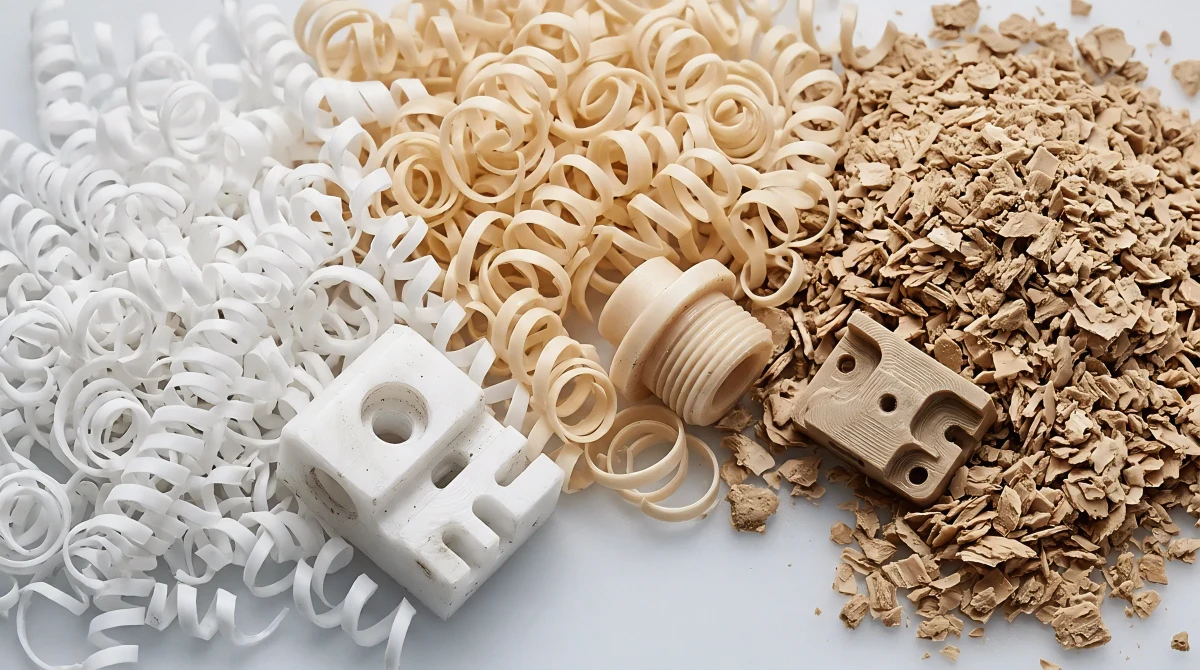
Speeds and Feeds for Machining Acetal, Nylon and PEEK

Acetal, nylon and PEEK share wide published cutting windows, and the right point inside each depends on making a chip that carries heat out of the part.

Speeds and Feeds for Acetal, Nylon and PEEK in One TableTable 1 sets the published cutting data for the three materials side by side, from MCAM's 2026 guide and from Tangram Technology, a UK plastics engineering consultancy that publishes indicative values. MCAM groups unfilled PEEK with PET-P and PAI, and filled PEEK with the other reinforced grades; Tangram does not list PEEK.

Drilling Deep Holes in Plastic Without Melting or Cracking

Holes deeper than two diameters trap heat in plastic, so drill grind, peck cycle, coolant choice and cool-down decide whether the part cracks or holds its size.

How to Drill a Deep Hole in Plastic Without Melting or CrackingTreat any hole deeper than two diameters as a cooling problem first and a cutting problem second. Both Mitsubishi Chemical Advanced Materials (MCAM) and Ensinger name the same threshold: heat builds very easily once the depth passes twice the diameter.

Flatness and Warp of Thin Machined Plastic Plates

Thin plastic plates bow when stress, heat, clamping or moisture act on one face more than the other, so flatness is planned through stock, sequence, rest and measurement.

Why Thin Machined Plastic Plates Lose FlatnessA thin plate loses flatness when the stresses on its two faces stop balancing. Mitsubishi Chemical Advanced Materials (MCAM) explains the mechanism in its machining guide: extrusion, molding and machining leave residual stresses inside a thermoplastic, and when material is removed or the part meets elevated temperatures, those stresses redistribute and cause warping or dimensional change.

Machining PEEK Unfilled and Carbon-Filled Stock

Unfilled and carbon-filled PEEK share a polymer but differ in stiffness, conductivity, tooling, cutting data and tolerance, so the grade belongs on the drawing.

How Unfilled and Carbon-Filled PEEK Stock Differ for Machined PartsUnfilled PEEK machines like a hard, stiff thermoplastic: short chips, little burr, high feed rates and fine finishes. Carbon-filled PEEK machines like a composite: abrasive to tools, sensitive to fiber direction, and best cut with carbide or diamond at lower speeds.

Cast and Extruded Nylon PA6 Stock for Machined Parts

Cast and extruded PA6 share a name but not their stress, crystallinity, chips or moisture behavior, and a machined nylon part keeps changing size after the cut.

Cast or Extruded PA6 for a Machined PartCast PA6 is usually the better machining stock when the part is large, flat, stiff or close-toleranced. Extruded PA6 is the tougher, more elastic choice for smaller parts where impact strength and elongation matter more than the last hundredth of a millimeter.

Sizing a Machined Plastic Run From Blanks to Batches

A machined run is sized from weeks and consumption, converted to plates and batches, and then matched to cutters and fixtures by run length.

How to Size a Machined Plastic RunCount the parts the program will consume until the next process delivers, add a spare for parts lost in testing, convert the total to blanks by nesting, and group the blanks into batches that share a rest, an oven load and a measuring session. Then choose the cutter and the fixture by the length of the run.

PEI Ultem Stock for CNC Machined Parts

PEI holds stiffness and shape at heat, and it asks for dry cutting, careful fluids and an annealing decision before the first part is cut.

PEI Ultem Properties for Machined PartsPolyetherimide, PEI for short, is an amorphous thermoplastic, and Ensinger, which extrudes it into rod and plate, notes that it is commonly referred to as ULTEM plastic after the resin's trade name. Ensinger describes the material as having high mechanical strength and rigidity, exceptional creep resistance over a wide temperature range and very good hydrolysis resistance, and as inherently flame retardant with low smoke emission, which makes it a preferred material for aircraft interiors.

Acetal Homopolymer and Copolymer Stock for CNC Machined Parts

Homopolymer is stiffer and harder, copolymer is sold porosity-free with less water uptake and less thermal growth, and the stock a part is cut from decides which it inherits.

Acetal Homopolymer and Copolymer Differences in Machined PartsAcetal, the polyoxymethylene or POM family, reaches a machine shop as two chemistries. Homopolymer chains repeat one unit; copolymer chains carry two.

Request a Plastic CNC Quote

Send the 2D drawing and the 3D file, with the quantity and the stage of the project. An engineer replies within 1 working day.

The quote form, the mutual NDA and the private folder for your files are on Protolis Atelier, with Plastic CNC chosen.

Request a Quote