Acrylic

Acrylic, or PMMA, is the amorphous plastic that Röhm sells as PLEXIGLAS GS (cast) and XT (extruded) sheet.

Every Acrylic article of the Plastic CNC Resources, newest first, each written from published standards, research and makers’ data.

Meaning

Acrylic, or PMMA, is the amorphous plastic that Röhm sells as PLEXIGLAS GS (cast) and XT (extruded) sheet. Röhm’s workshop guide is the method these resources follows for cutting it. Acrylic cuts cleanly with the right geometry. It crazes when stress meets the wrong fluid, and it moves a great deal with temperature.

Thermal Movement

Röhm gives linear thermal expansion of 0.07 mm per meter per kelvin for GS and XT, which is 70 x 10⁻⁶ per K. A 1,000 mm (39.4 in) part grows 1.4 mm (0.055 in) between 10 and 30 °C (50 and 86 °F). Röhm’s instruction is to compare identical parts only at the same ambient and material temperatures. It adds that moisture influences size less than heat does. Take a 100 mm (3.94 in) acrylic part measured 5 K (9 °F) away from 20 °C (68 °F). At 70 x 10⁻⁶ per K, it moves by 0.035 mm (0.0014 in). That is comparable to the 0.05 mm (0.002 in) minimum tolerance Quadrant gives for small sizes. Parts therefore sit in the measuring room until their core and the room share one temperature. The room itself is held near 20 °C (68 °F).
Read More

Annealing Practice

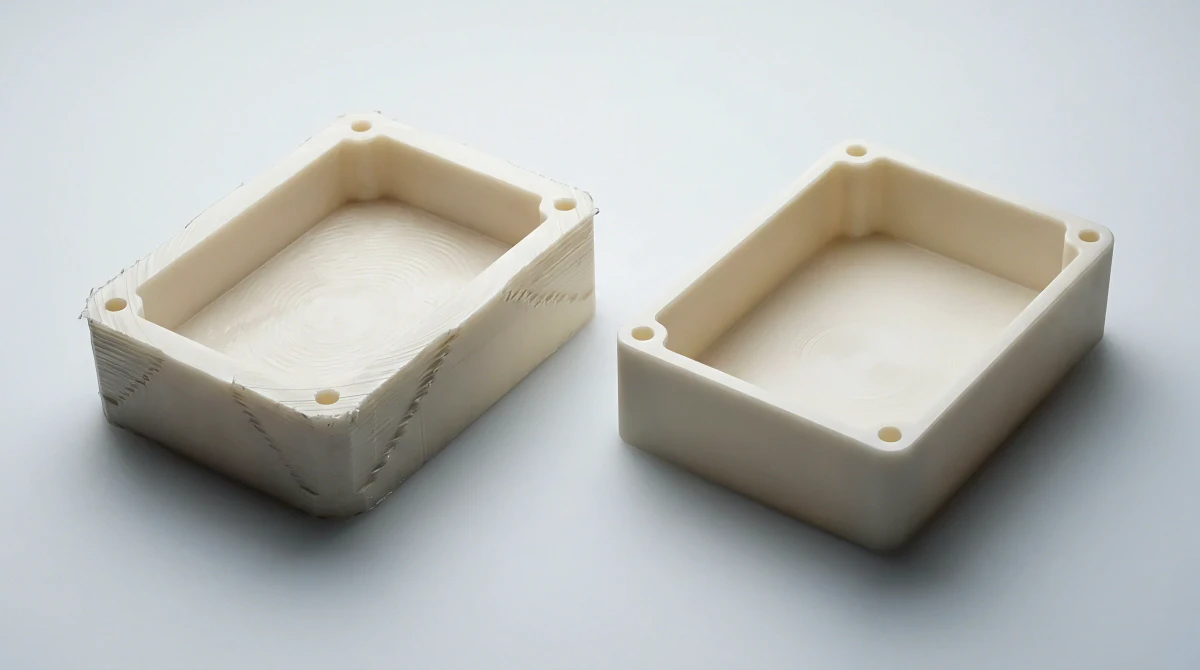
Röhm explains that a stressed acrylic part crazes when solvents, thinners, monomer vapors, plasticizers or aggressive cleaners reach it. The remedy is annealing below the softening point. GS anneals at 80 °C (176 °F), and unformed parts up to 100 °C (212 °F). XT anneals at 70 to 80 °C (158 to 176 °F), and unformed parts up to 85 °C (185 °F). Time in hours is the thickness in millimeters divided by 3, with a minimum of 2 hours. Oven cooling takes the thickness divided by 4, at no more than 15 °C (27 °F) per hour. Parts leave the oven at 60 °C (140 °F) or less. Röhm notes that machining only one surface of a sheet can distort the workpiece slightly. Annealing reverses the distortion. For more complex technical parts, annealing before machining avoids it.

Drilling Geometry

Twist drills for metal cannot be used on PLEXIGLAS unless the point angle is reduced from 120 degrees to 60 to 90 degrees. The rake is ground to 4 to 0 degrees, and the clearance is at least 3 degrees. That geometry prevents chipping where the drill exits. Holes are lightly chamfered or countersunk to rule out notch effects. From a thickness of 5 mm (0.2 in), a drilling emulsion compatible with acrylic is advised. At 0.1 to 0.3 mm/rev (0.004 to 0.012 in/rev), Röhm reports nearly transparent, silky matte hole walls. Röhm reads the chip to judge speed and feed. A crumbly chip and an uneven cut mean speed or feed is too high. A molten chip means it is too low, and a smooth, continuous chip marks the right pair. For a 25 mm (1 in) drill, its most favorable speed is 510 rpm, about 40 m/min (131 ft/min).

Milling and Turning Data

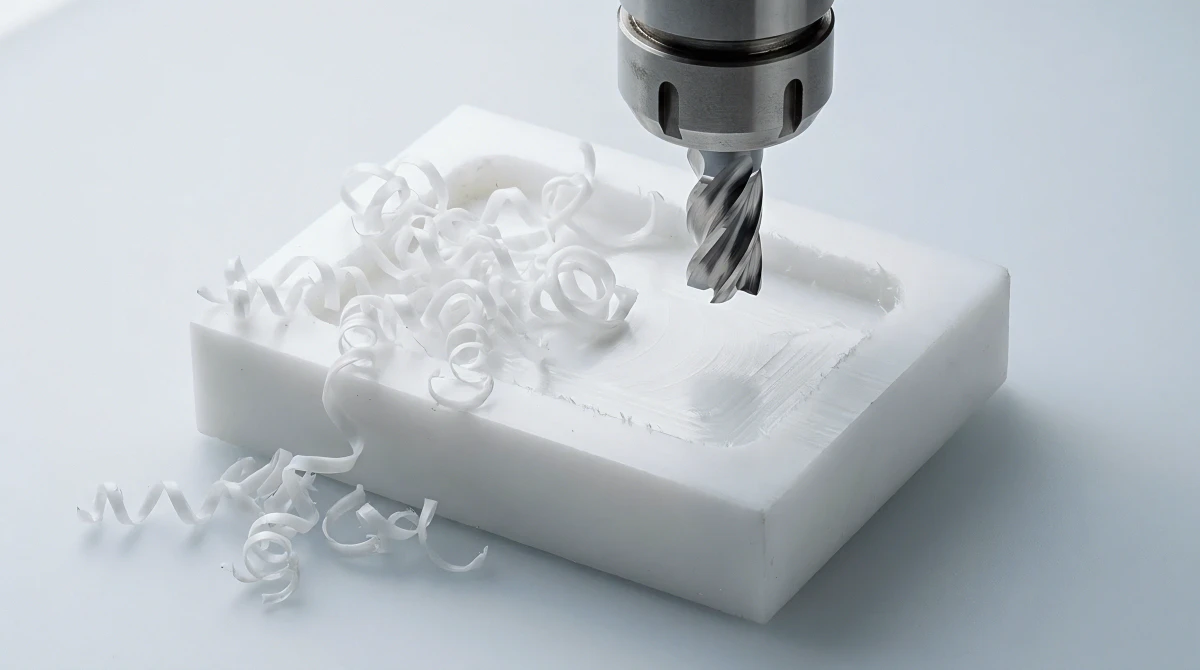
Röhm’s milling band is 200 to 4,500 m/min (656 to 14,760 ft/min), with a feed up to 0.5 mm/rev (0.020 in/rev). Cutting depth reaches 6 mm (0.24 in). An 8 mm (0.31 in) cutter at 11,000 rpm, about 276 m/min (905 ft/min), is named as a good result. Turning uses a rake of 0 to minus 4 degrees and a relief of 5 to 10 degrees. Its speed band is 20 to 300 m/min (65 to 984 ft/min). Tool bit radii are at least 0.5 mm (0.02 in). Carbide suits roughing, while HSS is usually used for the finishing pass. Röhm allows a drilling emulsion or cutting oil compatible with acrylic to cool turning and drilling cuts. It does not recommend cooling for finishing with diamond tools, because cooling causes optical flaws on high-gloss surfaces. Tangram gives acrylic drilling 20 to 60 m/min (65 to 197 ft/min) at 0.1 to 0.5 mm/rev (0.004 to 0.020 in/rev). Its note is that acrylic softens when heated, so cuts stay light.

Sheet Handling

The masking film stays on through all machining, and layout is marked on the film. Once it is off, soft lead or grease pencils are used. Scribers and prick punches leave notches that can make even impact-modified acrylic crack under load. Thin sheet is clamped on a flat, solid support so the underside does not chip. Finished parts are protected with strippable coatings, compatible crêpe tapes or closed polyethylene bags.
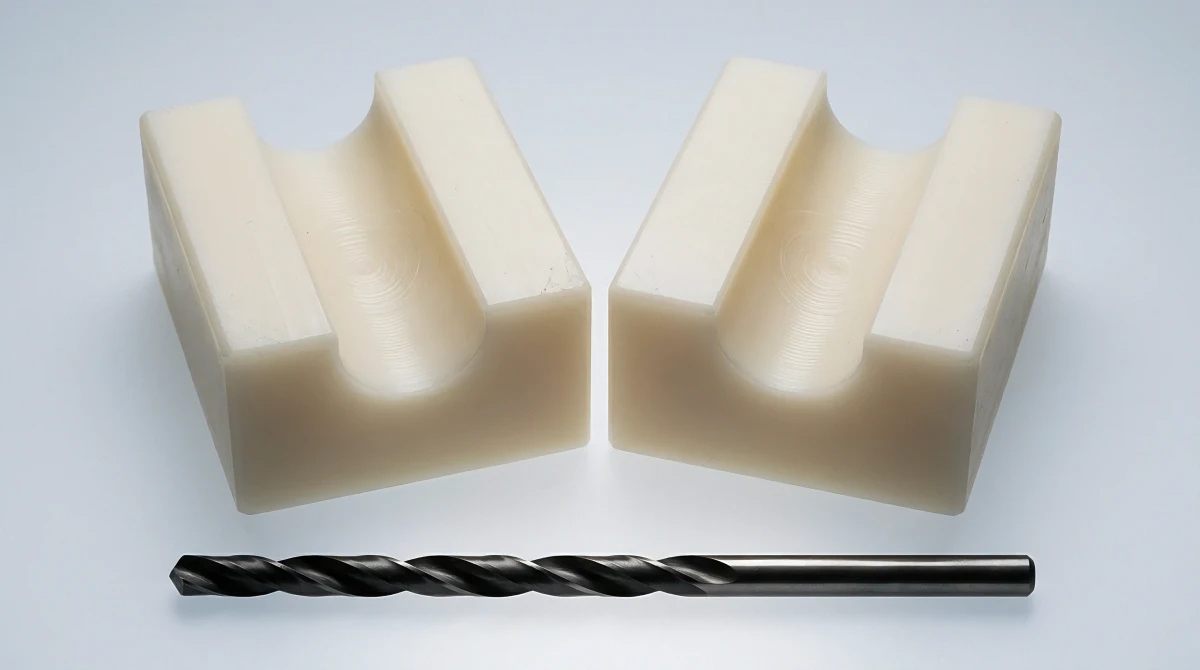
Drilling Deep Holes in Plastic Without Melting or Cracking

Holes deeper than two diameters trap heat in plastic, so drill grind, peck cycle, coolant choice and cool-down decide whether the part cracks or holds its size.

How to Drill a Deep Hole in Plastic Without Melting or CrackingTreat any hole deeper than two diameters as a cooling problem first and a cutting problem second. Both Mitsubishi Chemical Advanced Materials (MCAM) and Ensinger name the same threshold: heat builds very easily once the depth passes twice the diameter.

Surface Finish of Machined Plastics by Material and Tool

Measured roughness on machined plastics follows feed first, then tool edge and material, and a finish call-out needs its parameter, surface, direction and part condition.

What Surface Finish Machined Plastics Reach and What Sets ItTwo open studies give a measured range for ordinary turning and milling of tough engineering plastics. Turning HDPE and PA6 with a carbide insert produced average roughness (Ra) from about 2.1 µm (83 µin) to about 11 µm (439 µin) across the tested conditions.

Flatness and Warp of Thin Machined Plastic Plates

Thin plastic plates bow when stress, heat, clamping or moisture act on one face more than the other, so flatness is planned through stock, sequence, rest and measurement.

Why Thin Machined Plastic Plates Lose FlatnessA thin plate loses flatness when the stresses on its two faces stop balancing. Mitsubishi Chemical Advanced Materials (MCAM) explains the mechanism in its machining guide: extrusion, molding and machining leave residual stresses inside a thermoplastic, and when material is removed or the part meets elevated temperatures, those stresses redistribute and cause warping or dimensional change.

How Long Resting, Annealing and Drying Add to Machined Plastic Parts

In a machined plastic order the cutting takes minutes, while resting, drying and heat treatment take days, so the drawing sets the lead time.

Where the Calendar Goes in a Machined Plastic OrderMost of the elapsed time in a machined plastic order is spent on stock preparation, resting, heat treatment, drying and measurement at a controlled temperature, and the cutting is a small fraction. When a part needs none of those steps, it goes from blank to finished in the machine time plus setup and deburring.

Inspecting a Batch of Machined Plastic Parts Before It Ships

Inspecting machined plastic means stating the temperature, the probe force and the sample size, because a plastic part changes with all three.

How to Inspect a Batch of Machined Plastic PartsInspect the batch at a stated temperature, with a low-force or non-contact method for soft or thin parts, on a sample whose size is chosen in advance, and record the conditions with the results. Those four elements separate a measurement that can be repeated from one that cannot.

Holding Plastic Parts for CNC Machining Without Bending Them

Plastic parts distort under clamps that metal parts shrug off, so the hold, the support and the symmetry of the cut set the final size.

How to Hold a Plastic Part on a CNC MachineHold it on as much surface as the geometry allows, with the lowest force that keeps it from moving, and with every thin wall backed by something solid. That sentence compresses three recommendations that recur across the stock-shape makers' guides: light clamping, support under the cut, and distribution of the force by vacuum or soft jaws instead of point contact.

Annealing Machined Plastic Parts Between Roughing and Finishing

Annealing between roughing and finishing trades oven days for flat, stable parts, and it pays only when stress, shape or tolerance demand it.

When a Machined Plastic Part Needs AnnealingA machined plastic part needs an intermediate anneal when it has tight tolerances, an asymmetric shape, or a large share of its blank removed, and when it does not need one the stock maker has already done the work. Ensinger states the starting condition: its semi-finished products are always annealed after production, which is why a first cut can start without a stress-relief step.

Thermal Expansion of Machined Plastic Parts by Material and Size

Every machined plastic dimension has a temperature, and the material decides how many degrees of drift a given tolerance can absorb.

Thermal Expansion of Machined Plastic Parts per 10 DegreesThe coefficient of linear thermal expansion, CTE, is the fractional length change per degree. Plastic sheets print it in 10⁻⁶ per kelvin or in inches per inch per degree Fahrenheit, and the two convert by a factor of 1.8: one in/in/°F is 1.8 per °C.

Request a Plastic CNC Quote

Send the 2D drawing and the 3D file, with the quantity and the stage of the project. An engineer replies within 1 working day.

The quote form, the mutual NDA and the private folder for your files are on Protolis Atelier, with Plastic CNC chosen.

Request a Quote