Meaning
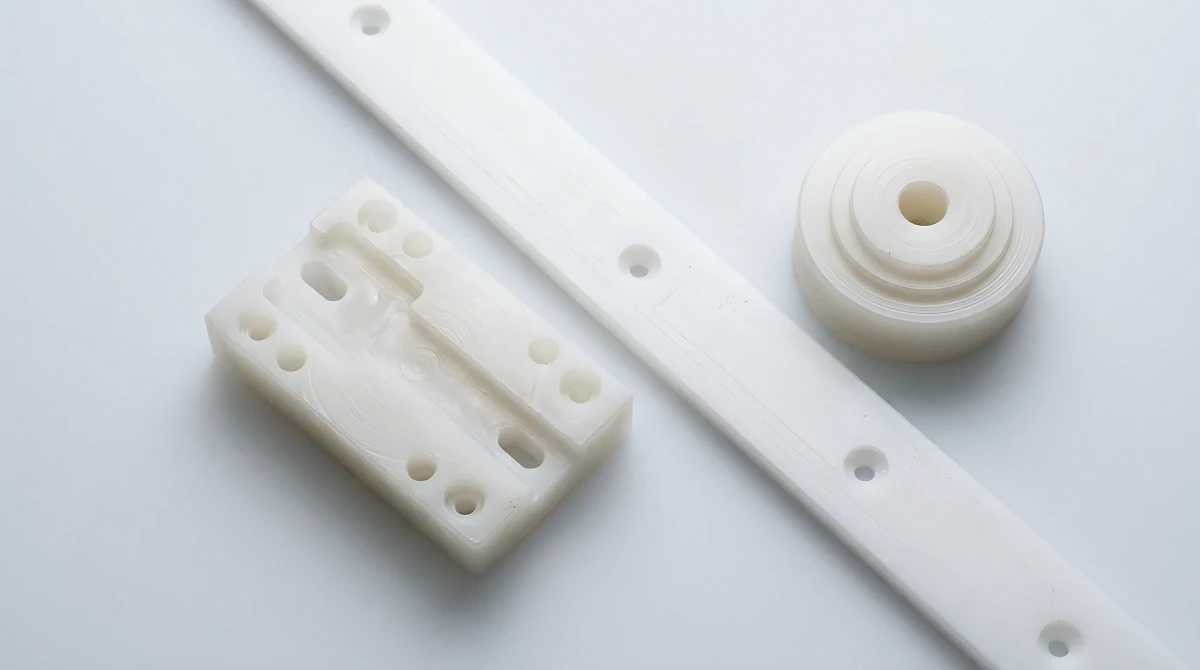
HDPE is high-density polyethylene, a stiff, light, low-cost stock sold as sheet and used for light-duty guides, tanks and handling devices. It shares its chemistry with UHMW-PE and behaves differently on the machine. Its higher stiffness and lower expansion make it the better of the two for parts that have to hold flat. Tangram Technology rates polyolefins as fair to machine.Sheet Comparison
Two HDPE sheets in these resources describe noticeably different bars. Spartech lists a tensile strength of 31.0 MPa (4,500 psi) and 800 percent elongation for its SP-1010 sheet. Spartech’s SP-1010 sheet lists 31.0 MPa (4,500 psi), without saying whether it is yield, and 800 percent elongation. Tensile modulus reads 1,550 MPa (224,812 psi) on the first and 1,344 MPa (195,000 psi) on the second. Flexural modulus reverses the order, 1,150 MPa (166,796 psi) against 1,551 MPa (225,000 psi). Both are sold as HDPE sheet, so any one column is one maker’s sample. The HDPE sheets show three habits worth checking on any data sheet. Spartech prints heat deflection at one load only, which makes a comparison with another sheet unsafe. The flexural and tensile moduli differ on both sheets, so one cannot stand in for the other without a note.Read More
Shared Properties
Density is 0.96 g/cm³ (59.88 lb/ft³) on both. Hardness reads Shore D 66 to 67. Tensile impact is about 1,200 kJ/m² (570 ft-lb/in²), about half the UHMW-PE figure. Spartech prints a UL 94 rating of HB for sheet thicker than 3.2 mm (0.125 in).Heat Limit
Spartech gives heat deflection as 80 °C (176 °F) at the light load of 0.455 MPa (66 psi). The sheet prints no value at the heavier 1.82 MPa (264 psi). Linear thermal expansion is 108 x 10⁻⁶ per K (6.0 x 10⁻⁵ in/in/°F). A 100 mm (3.94 in) feature therefore grows about 0.11 mm (0.004 in) over 10 K (18 °F). A worked reading for a bracket at 80 °C (176 °F) in these resources rules polyethylene out.Machining Practice
Tangram lists heavy burrs, gumming, chip welding and marks from work holding as the polyolefin faults. It asks for aggressive chip evacuation and a larger chip thickness, and for a higher feed if chips reweld. Its indicative data give 250 to 500 m/min (820 to 1,640 ft/min) for turning and milling at 0.1 to 0.5 mm/rev (0.004 to 0.020 in/rev). Drilling runs at 50 to 150 m/min (165 to 490 ft/min) and 0.1 to 0.3 mm/rev (0.004 to 0.012 in/rev). The polyethylene article lists the habits that keep burrs down on HDPE as on UHMW-PE. Cutters stay sharp, with positive geometry, polished flutes and generous chip clearance. The chip load stays up, flute counts stay low, and an air blast or vacuum clears the chips. Deburring is planned as a normal step.Tolerance Column
HDPE is the only polyolefin in Mitsubishi’s best-tolerance table, and its column is the widest. It reads 0.05 mm (0.0020 in) up to 25 mm (0.98 in) and 0.15 mm (0.0059 in) at 100 mm (3.94 in). At 200 mm (7.87 in) it reaches 0.26 mm (0.0102 in). As a share of size that is 0.50 percent at 10 mm (0.39 in) and 0.13 percent at 200 mm (7.87 in). The guide does not say whether the figures are bands or plus-and-minus values. At 108 x 10⁻⁶ per K, a 10 K (18 °F) difference between the part and the room is already larger than most drawn tolerances. A drawing states the measurement temperature for any feature under about 0.2 mm (0.008 in). The part reaches that temperature before it is checked. A first article is read on its clamped faces as well as its cut ones, since marks from work holding are a polyolefin fault.Selection Rule
The sources favor HDPE for thin walls, tall features and parts that must stay flat under load. Its modulus and its lower expansion both beat UHMW-PE there. UHMW-PE takes the parts that slide or wear.