Acetal Copolymer

Acetal copolymer (POM-C) is the polyoxymethylene whose chains carry two repeating units, sold as Celcon, Ultraform and many stock-shape trade names.

Every Acetal Copolymer article of the Plastic CNC Resources, newest first, each written from published standards, research and makers’ data.

Meaning

Acetal copolymer (POM-C) is the polyoxymethylene whose chains carry two repeating units, sold as Celcon, Ultraform and many stock-shape trade names. It machines like homopolymer and costs nearly the same. Ensinger prints its copolymer stock at 9,300 psi (64.1 MPa) at yield against 11,000 psi (75.8 MPa) for its homopolymer, with a lower flexural modulus. It earns its place in hot water, in chlorine-bearing cleaners and in parts that must hold a fluid.

Service Environment

Ensinger lists low water absorption and good chemical resistance among the copolymer’s features, with 0.18 percent after 24 hours against 0.25 percent for its homopolymer. It also resists bleach, other chlorine-bearing cleaners and strong alkalies better. Ensinger rates its copolymer for 91 °C (195 °F) long term and its homopolymer for 85 °C (185 °F). Copolymer has the lower heat deflection temperature but is reported to resist thermal degradation better at higher temperature. Ensinger’s stock values are 64.1 MPa (9,300 psi) at yield and 110 °C (230 °F) heat deflection at 1.82 MPa (264 psi).
Read More

Centerline Porosity

Extrusion leaves a seam of pores along the centerline of acetal rod and plate. Ensinger sells its copolymer stock as porosity-free, and ASTM D6100 lists porosity level among the properties of acetal shapes. It calls homopolymer worse. Some makers claim zero centerline porosity, and Ensinger sells TECAFORM AH as porosity-free POM-C. Mitsubishi’s Acetron GP is sold on low centerline porosity and very low internal stress. For a manifold, a valve body or an axial bore, this is the reason the sources lean to copolymer.

Annealing Cycle

Two published cycles give very different oven times for the same copolymer wall. Mitsubishi’s 2026 guide holds acetal at 155 °C (311 °F). Its rates add up to about 22 to 43 hours for a 10 mm (0.39 in) wall. That total is computed from the printed heat-up, hold and cool-down rates. Mitsubishi’s guide holds POM-C at 155 °C (311 °F) and cools at 5 to 10 °C (9 to 18 °F) per hour. Its rates sum to about 9.6 hours for the same wall. A buyer comparing two quotes can read that gap as a difference in published cycle.
Shore D and Rockwell Hardness on Plastic Stock Data Sheets

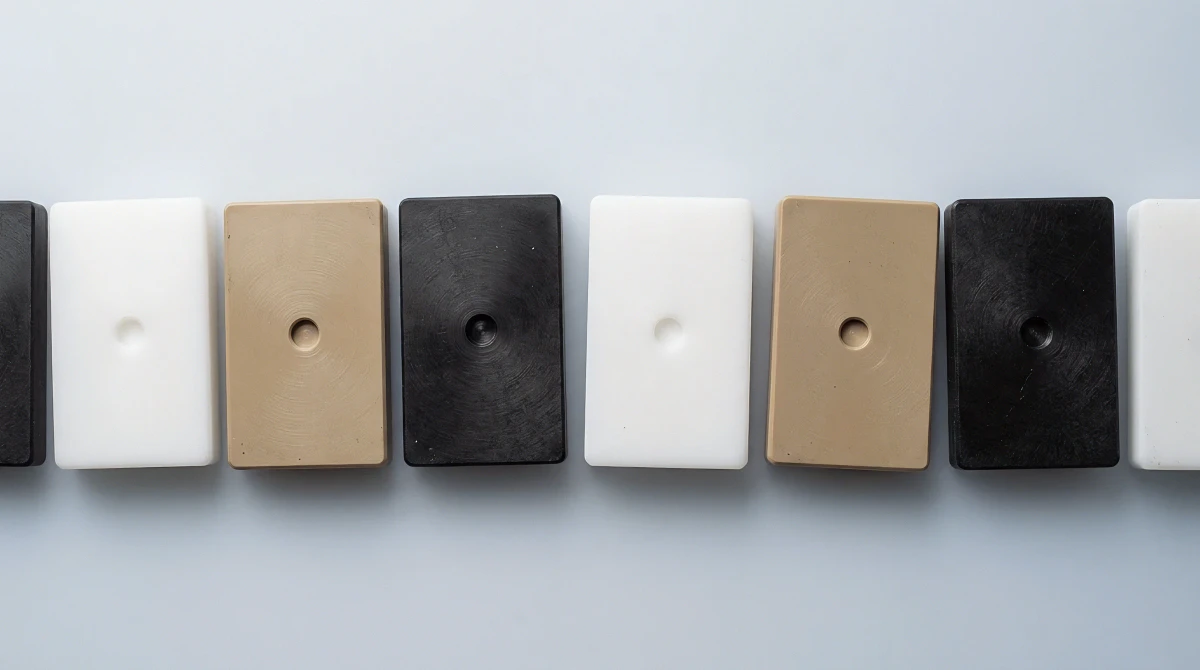
Shore D and Rockwell values on plastic stock sheets rank surface hardness under named methods, cannot be converted into each other, and bind a supplier only when agreed.

What Shore D and Rockwell Numbers Mean on a Plastic Stock Data SheetBoth numbers rank how strongly a plastic resists a hard indenter pressed into its surface at room temperature. Neither is a strength, a wear rating or a design value.

Sizing a Machined Plastic Run From Blanks to Batches

A machined run is sized from weeks and consumption, converted to plates and batches, and then matched to cutters and fixtures by run length.

How to Size a Machined Plastic RunCount the parts the program will consume until the next process delivers, add a spare for parts lost in testing, convert the total to blanks by nesting, and group the blanks into batches that share a rest, an oven load and a measuring session. Then choose the cutter and the fixture by the length of the run.

How Long Resting, Annealing and Drying Add to Machined Plastic Parts

In a machined plastic order the cutting takes minutes, while resting, drying and heat treatment take days, so the drawing sets the lead time.

Where the Calendar Goes in a Machined Plastic OrderMost of the elapsed time in a machined plastic order is spent on stock preparation, resting, heat treatment, drying and measurement at a controlled temperature, and the cutting is a small fraction. When a part needs none of those steps, it goes from blank to finished in the machine time plus setup and deburring.

Annealing Machined Plastic Parts Between Roughing and Finishing

Annealing between roughing and finishing trades oven days for flat, stable parts, and it pays only when stress, shape or tolerance demand it.

When a Machined Plastic Part Needs AnnealingA machined plastic part needs an intermediate anneal when it has tight tolerances, an asymmetric shape, or a large share of its blank removed, and when it does not need one the stock maker has already done the work. Ensinger states the starting condition: its semi-finished products are always annealed after production, which is why a first cut can start without a stress-relief step.

UL 94 Flammability Ratings for Machined Plastic Parts

A flame rating belongs to a material, a color and a thickness, so the call-out has to name all three and the machined wall has to stay inside them.

What UL 94 Covers and What It Leaves OutThe UL standards catalog lists UL 94 as Tests for Flammability of Plastic Materials for Parts in Devices and Appliances, in its seventh edition. Its scope states that the requirements cover tests for flammability of polymeric materials used for parts in devices and appliances, and that they serve as a preliminary indication of acceptability with respect to flammability for a particular application.

ASTM D638 Tensile Strength on Plastic Stock Data Sheets

A tensile figure on a data sheet belongs to one bar, one speed and one reading, so the sheet has to name all three before the number guides a design.

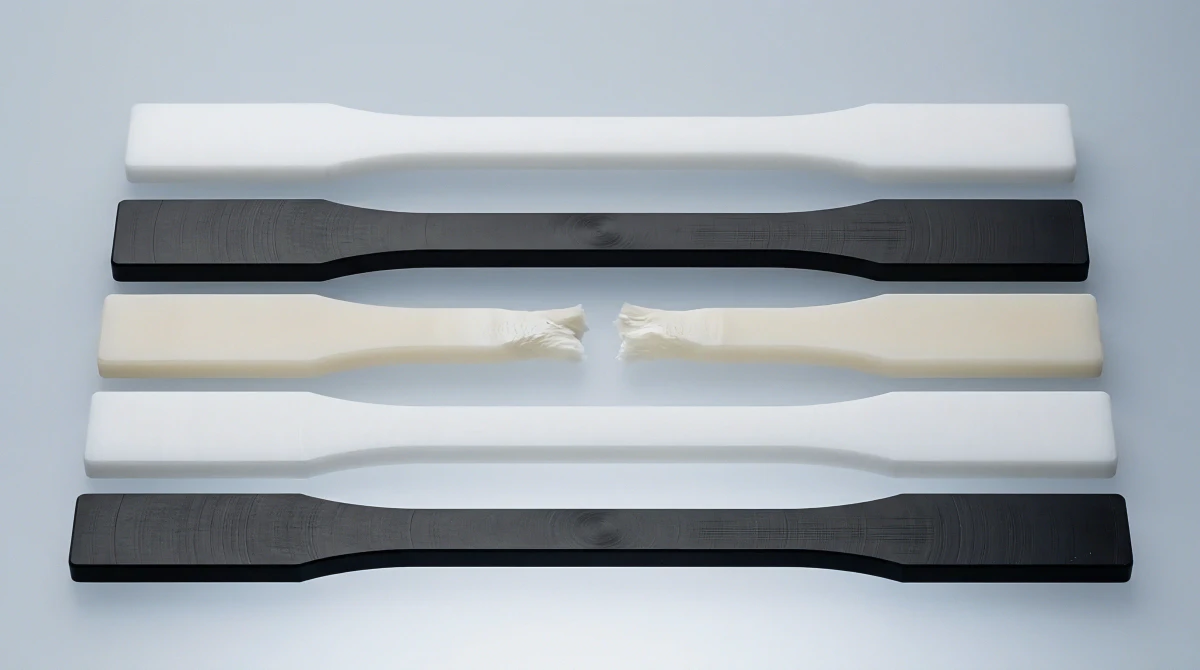
What ASTM D638 CoversThe scope of ASTM D638, Standard Test Method for Tensile Properties of Plastics, is the determination of the tensile properties of unreinforced and reinforced plastics in the form of standard dumbbell-shaped specimens, tested under defined conditions of pretreatment, temperature, humidity and testing machine speed. On astm.org the 2022 edition is listed as active.

Request a Plastic CNC Quote

Send the 2D drawing and the 3D file, with the quantity and the stage of the project. An engineer replies within 1 working day.

The quote form, the mutual NDA and the private folder for your files are on Protolis Atelier, with Plastic CNC chosen.

Request a Quote