Spindle Speed

Spindle speed is the spindle's rotation rate in revolutions per minute, set from the cutting speed and the diameter of the tool or part.

Every Spindle Speed article of the Plastic CNC Resources, newest first, each written from published standards, research and makers’ data.

Meaning

Spindle speed is the spindle’s rotation rate in revolutions per minute, set from the cutting speed and the diameter of the tool or part. Plastic guides print surface speeds, so the shop converts them. A small tool needs far more revolutions than a large one for the same cut.

Formula

Tangram Technology prints the conversion. Spindle speed in rev/min is 1,000 times the cutting speed in m/min, divided by pi times the diameter in millimeters. Table feed follows as feed per tooth times the number of flutes times the spindle speed.
Read More

Drill Example

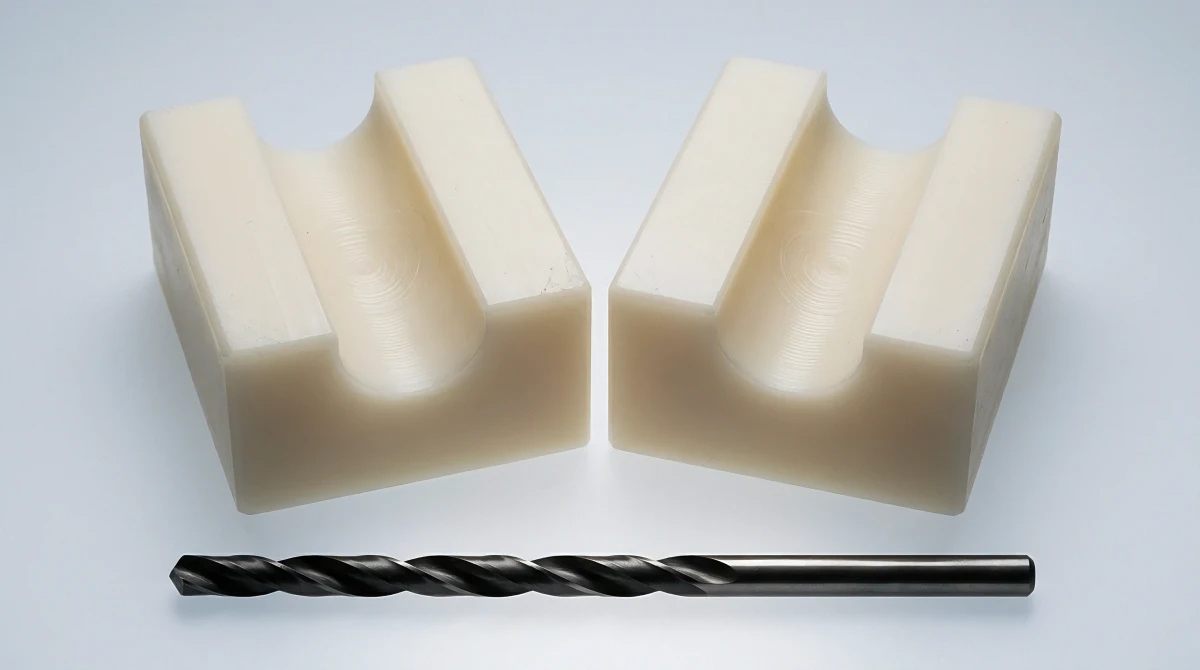
For drilling at 50 to 100 m/min (165 to 330 ft/min), a 6 mm (0.24 in) drill runs at 2,650 to 5,300 rev/min. A 12 mm (0.47 in) drill runs at 1,330 to 2,650 rev/min. A 25 mm (0.98 in) drill runs at 640 to 1,270 rev/min. Röhm gives 510 rev/min as the most favorable speed for a 25 mm (0.98 in) acrylic drill. By the formula that is about 40 m/min (131 ft/min), inside Tangram’s acrylic band of 20 to 60 m/min (65 to 197 ft/min).

Lathe Example

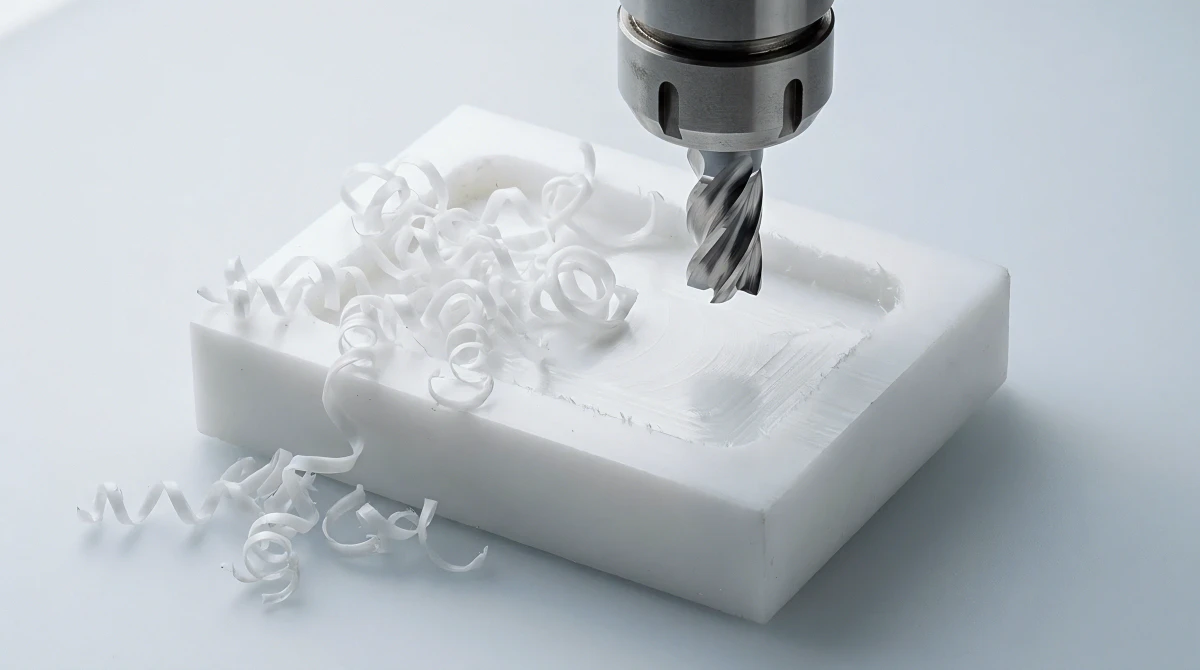
A 50 mm (2 in) acetal rod at 200, 300 and 500 m/min (656, 984 and 1,640 ft/min) turns at 1,273, 1,910 and 3,183 rev/min. Röhm’s milling example runs an 8 mm (0.31 in) cutter at 11,000 rev/min, about 276 m/min (905 ft/min).

Excess Speed Fault

Mitsubishi’s charts tie a spindle speed too high, with a feed too low, to a melted surface in turning. In drilling they tie a spindle speed too slow to holes that run off center. Neither fault is fixed by speed alone, since the feed decides how much heat each chip carries.
Speeds and Feeds for Machining Acetal, Nylon and PEEK

Acetal, nylon and PEEK share wide published cutting windows, and the right point inside each depends on making a chip that carries heat out of the part.

Speeds and Feeds for Acetal, Nylon and PEEK in One TableTable 1 sets the published cutting data for the three materials side by side, from MCAM's 2026 guide and from Tangram Technology, a UK plastics engineering consultancy that publishes indicative values. MCAM groups unfilled PEEK with PET-P and PAI, and filled PEEK with the other reinforced grades; Tangram does not list PEEK.

Drilling Deep Holes in Plastic Without Melting or Cracking

Holes deeper than two diameters trap heat in plastic, so drill grind, peck cycle, coolant choice and cool-down decide whether the part cracks or holds its size.

How to Drill a Deep Hole in Plastic Without Melting or CrackingTreat any hole deeper than two diameters as a cooling problem first and a cutting problem second. Both Mitsubishi Chemical Advanced Materials (MCAM) and Ensinger name the same threshold: heat builds very easily once the depth passes twice the diameter.

How Long Resting, Annealing and Drying Add to Machined Plastic Parts

In a machined plastic order the cutting takes minutes, while resting, drying and heat treatment take days, so the drawing sets the lead time.

Where the Calendar Goes in a Machined Plastic OrderMost of the elapsed time in a machined plastic order is spent on stock preparation, resting, heat treatment, drying and measurement at a controlled temperature, and the cutting is a small fraction. When a part needs none of those steps, it goes from blank to finished in the machine time plus setup and deburring.

Holding Plastic Parts for CNC Machining Without Bending Them

Plastic parts distort under clamps that metal parts shrug off, so the hold, the support and the symmetry of the cut set the final size.

How to Hold a Plastic Part on a CNC MachineHold it on as much surface as the geometry allows, with the lowest force that keeps it from moving, and with every thin wall backed by something solid. That sentence compresses three recommendations that recur across the stock-shape makers' guides: light clamping, support under the cut, and distribution of the force by vacuum or soft jaws instead of point contact.

Request a Plastic CNC Quote

Send the 2D drawing and the 3D file, with the quantity and the stage of the project. An engineer replies within 1 working day.

The quote form, the mutual NDA and the private folder for your files are on Protolis Atelier, with Plastic CNC chosen.

Request a Quote