Cutting Speed

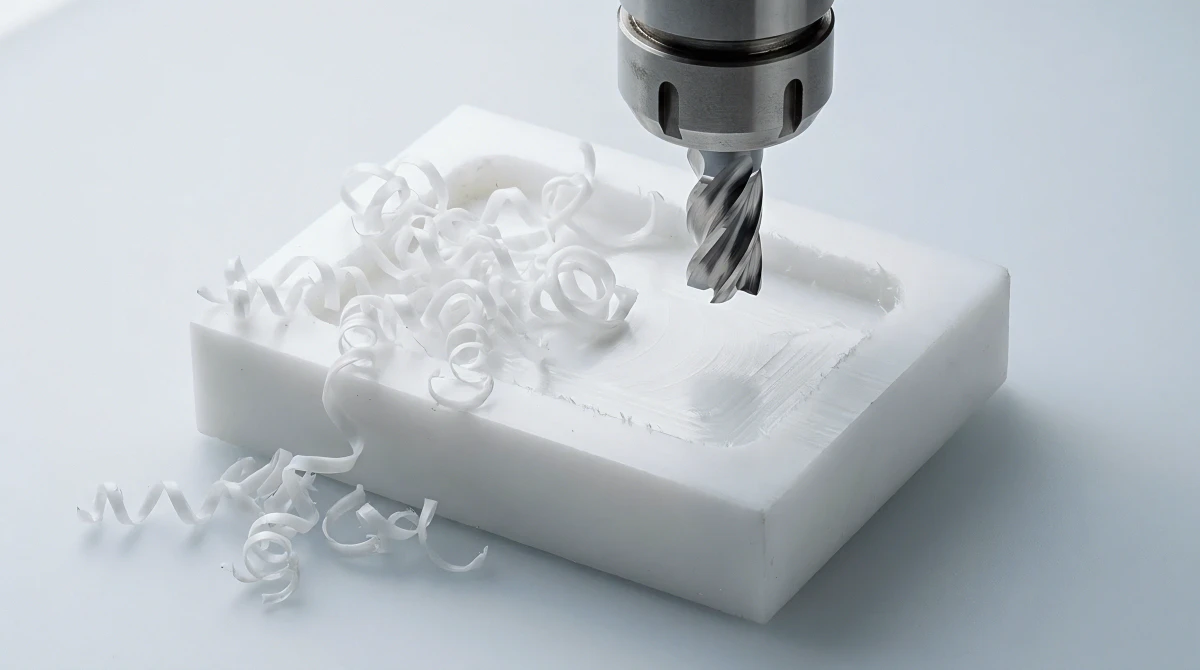
Cutting speed is the surface speed of the cutting edge against the material, in meters per minute (feet per minute).

Every Cutting Speed article of the Plastic CNC Resources, newest first, each written from published standards, research and makers’ data.

Meaning

Cutting speed is the surface speed of the cutting edge against the material, in meters per minute (feet per minute). It sets the spindle speed through the tool or workpiece diameter. Plastic machining guides print it as a range per material family and operation. Inside that range, the machine, the tool and the finish required decide where the cut runs.

Published Ranges

Mitsubishi Chemical Advanced Materials gives turning speeds of 200 to 500 m/min (656 to 1,640 ft/min) for acetal and nylon and 200 to 400 m/min (656 to 1,312 ft/min) for unfilled PEEK. In milling, acetal runs at 200 to 400 m/min, nylon at 200 to 500, unfilled PEEK at 150 to 300 (492 to 984 ft/min) and filled PEEK at 75 to 150 (246 to 492 ft/min). Drilling drops to 50 to 100 m/min (164 to 328 ft/min) for acetal and nylon and 50 to 80 m/min for PEEK. Tangram Technology prints matching values for acetal and nylon.
Read More

Conversion to Spindle Speed

Spindle speed in rpm equals 1,000 times the cutting speed in m/min divided by pi times the diameter in mm. A 10 mm (0.39 in) cutter at 200 m/min turns at about 6,366 rpm; a 6 mm (0.24 in) cutter needs more than 10,000 rpm for the same surface speed, which is why small tools often run below the published window. A 3 mm (0.12 in) drill at 50 m/min turns at about 5,300 rpm.

Effect on Finish

A 2022 study in Polymers found that raising cutting speed and feed raised the roughness of turned PA6 between 50 and 150 m/min, with the best finish at the lowest speed and feed. The makers favor high speeds for a different reason: a fast, properly loaded cut carries heat away with the chip. For acrylic, Tangram gives a lower speed of 15 to 30 m/min (49 to 98 ft/min) for the best turned finish.

Heat

Speed alone rarely melts plastic. Mitsubishi’s troubleshooting chart traces a melted turned surface to a dull tool or rubbing heel, too little side clearance, a feed that is too slow and a spindle speed that is too fast, in that order. Correcting the tool and the feed usually comes before lowering the speed.
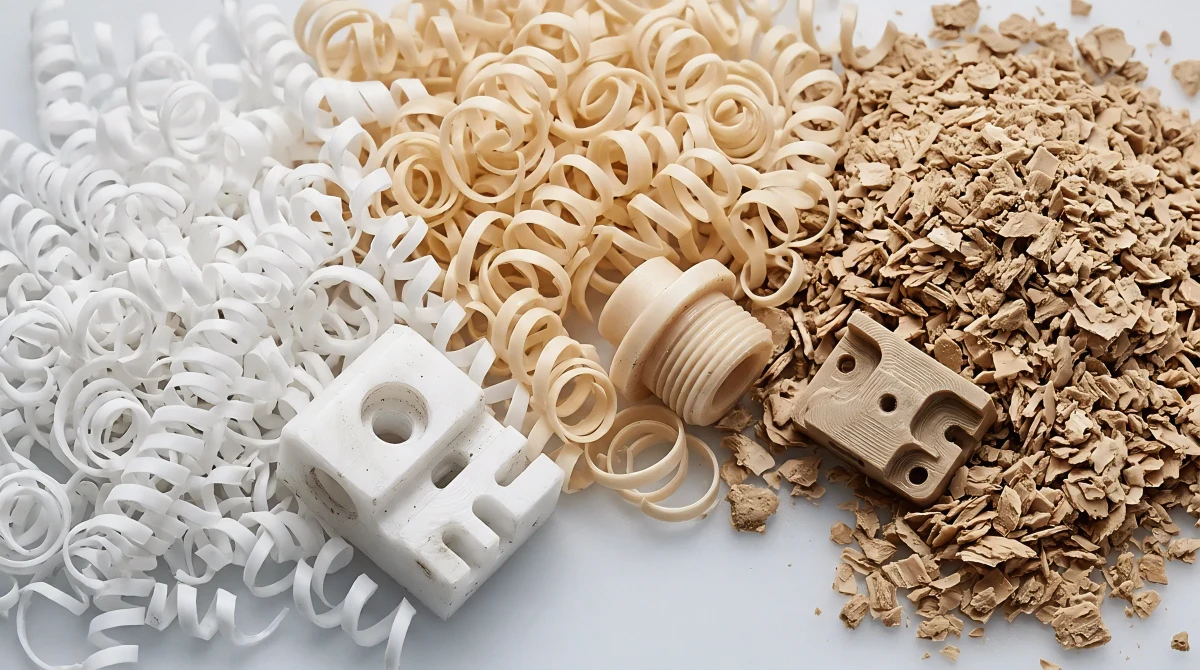
Speeds and Feeds for Machining Acetal, Nylon and PEEK

Acetal, nylon and PEEK share wide published cutting windows, and the right point inside each depends on making a chip that carries heat out of the part.

Speeds and Feeds for Acetal, Nylon and PEEK in One TableTable 1 sets the published cutting data for the three materials side by side, from MCAM's 2026 guide and from Tangram Technology, a UK plastics engineering consultancy that publishes indicative values. MCAM groups unfilled PEEK with PET-P and PAI, and filled PEEK with the other reinforced grades; Tangram does not list PEEK.

Drilling Deep Holes in Plastic Without Melting or Cracking

Holes deeper than two diameters trap heat in plastic, so drill grind, peck cycle, coolant choice and cool-down decide whether the part cracks or holds its size.

How to Drill a Deep Hole in Plastic Without Melting or CrackingTreat any hole deeper than two diameters as a cooling problem first and a cutting problem second. Both Mitsubishi Chemical Advanced Materials (MCAM) and Ensinger name the same threshold: heat builds very easily once the depth passes twice the diameter.

Surface Finish of Machined Plastics by Material and Tool

Measured roughness on machined plastics follows feed first, then tool edge and material, and a finish call-out needs its parameter, surface, direction and part condition.

What Surface Finish Machined Plastics Reach and What Sets ItTwo open studies give a measured range for ordinary turning and milling of tough engineering plastics. Turning HDPE and PA6 with a carbide insert produced average roughness (Ra) from about 2.1 µm (83 µin) to about 11 µm (439 µin) across the tested conditions.

How Long Resting, Annealing and Drying Add to Machined Plastic Parts

In a machined plastic order the cutting takes minutes, while resting, drying and heat treatment take days, so the drawing sets the lead time.

Where the Calendar Goes in a Machined Plastic OrderMost of the elapsed time in a machined plastic order is spent on stock preparation, resting, heat treatment, drying and measurement at a controlled temperature, and the cutting is a small fraction. When a part needs none of those steps, it goes from blank to finished in the machine time plus setup and deburring.

Holding Plastic Parts for CNC Machining Without Bending Them

Plastic parts distort under clamps that metal parts shrug off, so the hold, the support and the symmetry of the cut set the final size.

How to Hold a Plastic Part on a CNC MachineHold it on as much surface as the geometry allows, with the lowest force that keeps it from moving, and with every thin wall backed by something solid. That sentence compresses three recommendations that recur across the stock-shape makers' guides: light clamping, support under the cut, and distribution of the force by vacuum or soft jaws instead of point contact.

Acetal Homopolymer and Copolymer Stock for CNC Machined Parts

Homopolymer is stiffer and harder, copolymer is sold porosity-free with less water uptake and less thermal growth, and the stock a part is cut from decides which it inherits.

Acetal Homopolymer and Copolymer Differences in Machined PartsAcetal, the polyoxymethylene or POM family, reaches a machine shop as two chemistries. Homopolymer chains repeat one unit; copolymer chains carry two.

Request a Plastic CNC Quote

Send the 2D drawing and the 3D file, with the quantity and the stage of the project. An engineer replies within 1 working day.

The quote form, the mutual NDA and the private folder for your files are on Protolis Atelier, with Plastic CNC chosen.

Request a Quote