Meaning
A post-cure is a long, stepped oven cycle that develops a polymer’s final wear and chemical performance, printed by the stock makers for polyamide-imide (PAI). Mitsubishi separates it from annealing. Annealing makes a part dimensionally predictable, and post-curing develops the material’s final properties. PAI sold as Duratron PAI typically needs no anneal, because of its dimensional stability, but it can be post-cured.Stepped Cycle
Quadrant and Mitsubishi print the same steps. The part holds 1 day at 150 °C (302 °F) and 1 day at 215 °C (419 °F). It then holds 2 days at 245 °C (473 °F) and 6 days at 260 °C (500 °F). Heating and cooling run at 10 to 20 °C (18 to 36 °F) per hour. The cycle is given for parts up to 12 mm (0.47 in) in wall thickness. The holds alone take 10 days. Adding the ramps computed from the printed rates gives about 11 to 12 days per load.Read More
Surface Layer
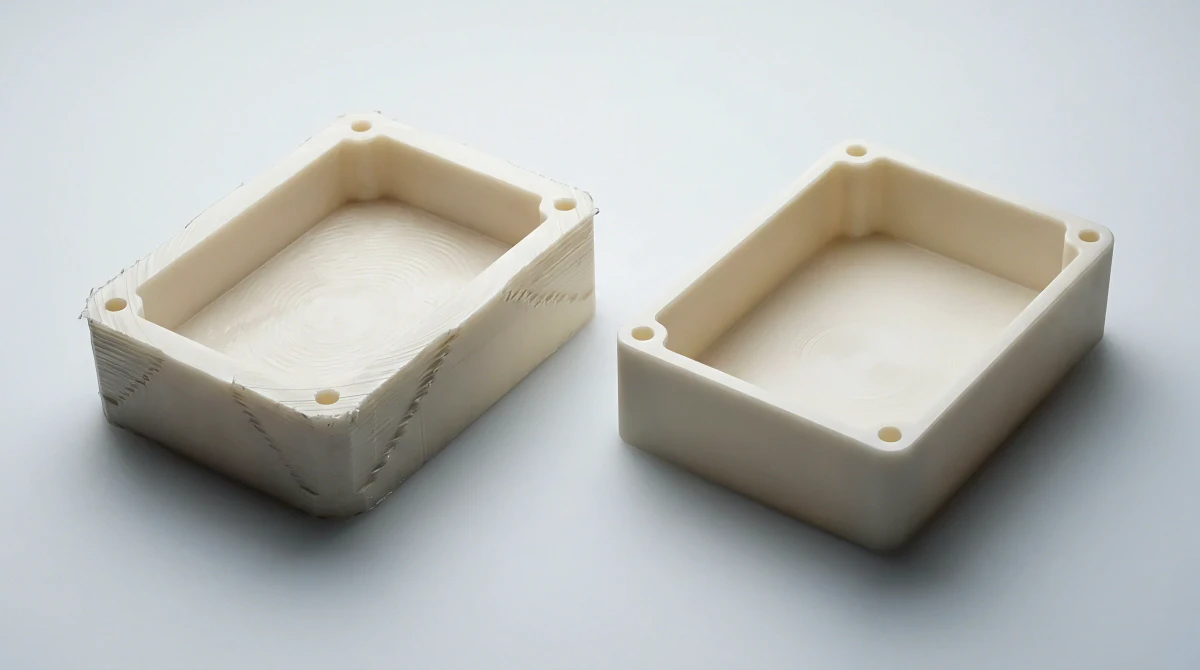
In air the surface turns dark brown from minor oxidation. That oxidized layer is what gives the wear resistance. Finishing after the post-cure removes no more than 0.5 mm (0.020 in) of it. A part that needs more stock removed than that is planned so the cure comes after the heavy cuts.Order of Operations
For close tolerances, Mitsubishi recommends doing the post-cure before final machining. The sequence is rough, post-cure and finish with a light cut that stays inside the 0.5 mm (0.020 in) limit. An inspection record notes the cycle, because a later cut would remove the cured layer.Drawing Wording
“Heat treated” on a drawing can mean a stress relief, a post-cure or a drying step. A drawing that names the post-cure and its stage lets a supplier book the oven days. It also lets the supplier plan the finishing pass and the inspection after it.