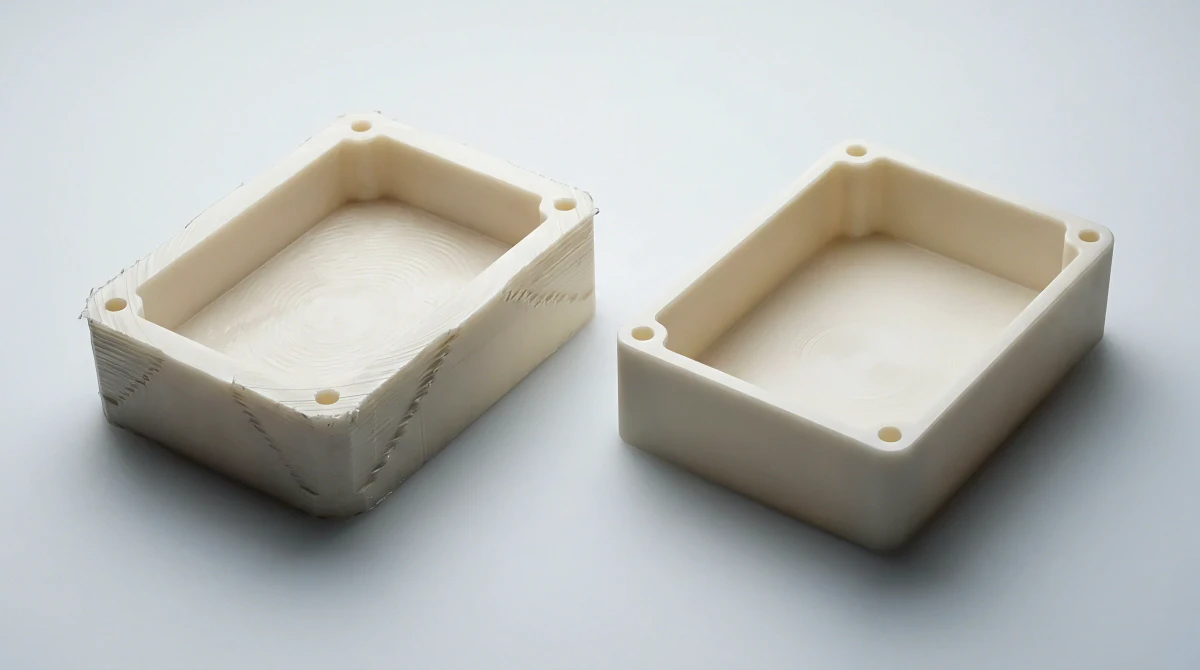
Polycarbonate

Polycarbonate (PC) is an amorphous engineering thermoplastic machined from stock shapes, grouped by the stock makers with PSU, PPSU and PEI for cutting and annealing.

Every Polycarbonate article of the Plastic CNC Resources, newest first, each written from published standards, research and makers’ data.

Meaning

Polycarbonate (PC) is an amorphous engineering thermoplastic machined from stock shapes, grouped by the stock makers with PSU, PPSU and PEI for cutting and annealing. Mitsubishi’s tables name carbide tools for it. It reacts badly to the wrong cutting fluid, and several of its shop rules follow from that.

Cutting Window

Mitsubishi’s 2026 turning table places PC with PPSU, PEI and PSU. It prints a rake angle of 0 to 10 degrees and a feed of 0.05 to 0.4 mm/rev (0.002 to 0.016 in/rev). Cutting speed is 200 to 400 m/min (656 to 1,312 ft/min), with carbide tools. The relief angle for the family is 5 to 15 degrees. These are ranges from one maker’s guide, and a program starts from the grade’s own sheet.
Read More

Coolant Limit

Mitsubishi and Quadrant name polycarbonate among the grades susceptible to environmental stress cracking. Petroleum-based cutting fluids and many water-soluble coolants can start it. The recommended coolant is pure water or compressed air. A part that met another coolant, in a deep or tapped hole, is washed in isopropyl alcohol. It is then rinsed in pure water.

Annealing Schedule

Both stock-shape guides hold polycarbonate at 130 °C (266 °F), in air or nitrogen. For a 10 mm (0.39 in) wall, Mitsubishi’s printed rates add up to about 19 to 35 hours of oven time. The total is computed from a 20 °C (68 °F) start. Mitsubishi’s guide holds it at 130 °C (266 °F). Its faster cool-down sums to about 8.9 hours for the same wall. Polycarbonate may be annealed after machining to limit stress crazing.

Tolerance Group

In Mitsubishi’s tolerance table polycarbonate shares a column with PEI, PEEK, PPS and PET-P. That group’s best published figure is 0.02 mm (0.0008 in) at 10 mm (0.39 in).
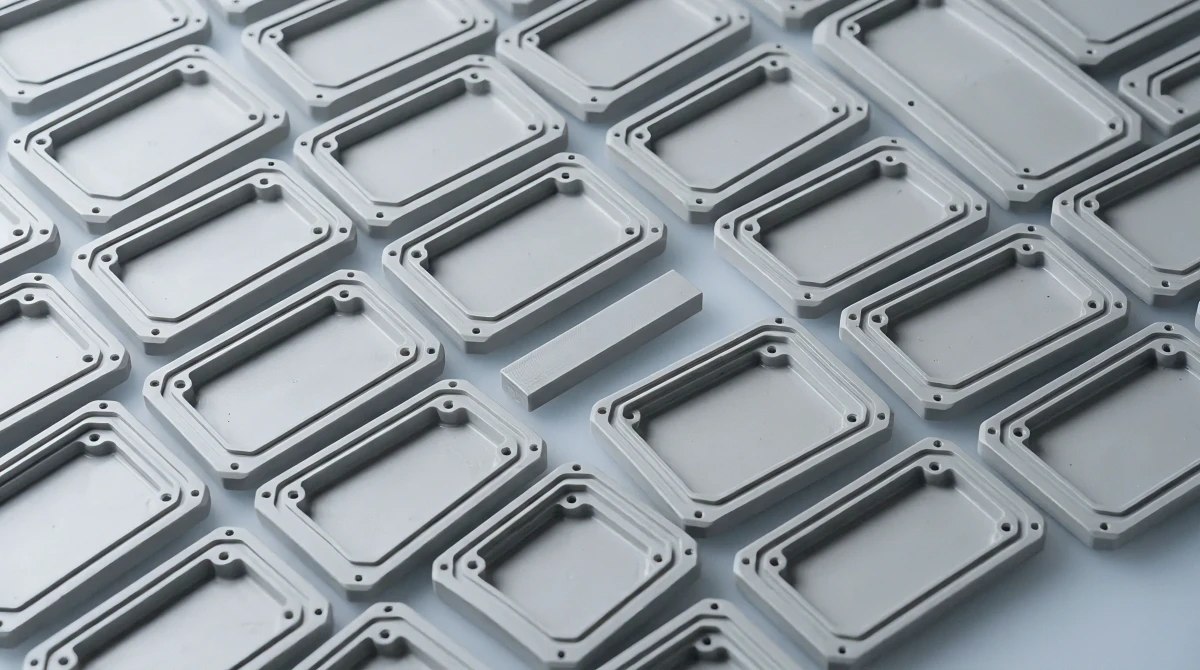
A Flame-Retardant Machined Plastic Batch and Its UL 94 V-0 Record

A machined batch carries a UL 94 V-0 rating only through its record of grade, color, thickness, listing and lot, plus proof the shop cut it dry and thick enough.

What a UL 94 V-0 Record Covers for a Machined Plastic BatchThe record covers the material, not the part. Ensinger, a stock-shape maker, states that combustibility testing to UL 94 is generally performed on the raw material.

Drilling Deep Holes in Plastic Without Melting or Cracking

Holes deeper than two diameters trap heat in plastic, so drill grind, peck cycle, coolant choice and cool-down decide whether the part cracks or holds its size.

How to Drill a Deep Hole in Plastic Without Melting or CrackingTreat any hole deeper than two diameters as a cooling problem first and a cutting problem second. Both Mitsubishi Chemical Advanced Materials (MCAM) and Ensinger name the same threshold: heat builds very easily once the depth passes twice the diameter.

Surface Finish of Machined Plastics by Material and Tool

Measured roughness on machined plastics follows feed first, then tool edge and material, and a finish call-out needs its parameter, surface, direction and part condition.

What Surface Finish Machined Plastics Reach and What Sets ItTwo open studies give a measured range for ordinary turning and milling of tough engineering plastics. Turning HDPE and PA6 with a carbide insert produced average roughness (Ra) from about 2.1 µm (83 µin) to about 11 µm (439 µin) across the tested conditions.

How Long Resting, Annealing and Drying Add to Machined Plastic Parts

In a machined plastic order the cutting takes minutes, while resting, drying and heat treatment take days, so the drawing sets the lead time.

Where the Calendar Goes in a Machined Plastic OrderMost of the elapsed time in a machined plastic order is spent on stock preparation, resting, heat treatment, drying and measurement at a controlled temperature, and the cutting is a small fraction. When a part needs none of those steps, it goes from blank to finished in the machine time plus setup and deburring.

Annealing Machined Plastic Parts Between Roughing and Finishing

Annealing between roughing and finishing trades oven days for flat, stable parts, and it pays only when stress, shape or tolerance demand it.

When a Machined Plastic Part Needs AnnealingA machined plastic part needs an intermediate anneal when it has tight tolerances, an asymmetric shape, or a large share of its blank removed, and when it does not need one the stock maker has already done the work. Ensinger states the starting condition: its semi-finished products are always annealed after production, which is why a first cut can start without a stress-relief step.

Request a Plastic CNC Quote

Send the 2D drawing and the 3D file, with the quantity and the stage of the project. An engineer replies within 1 working day.

The quote form, the mutual NDA and the private folder for your files are on Protolis Atelier, with Plastic CNC chosen.

Request a Quote