Meaning
Creep is the slow, continuing deformation of a plastic part held under a steady load over hours, months or years. Tangram Technology lists creep under load among the properties that separate plastics from metals. None of the short tests printed on a stock sheet includes it. A part can meet every printed figure and still change shape in service.Short-Test Limit
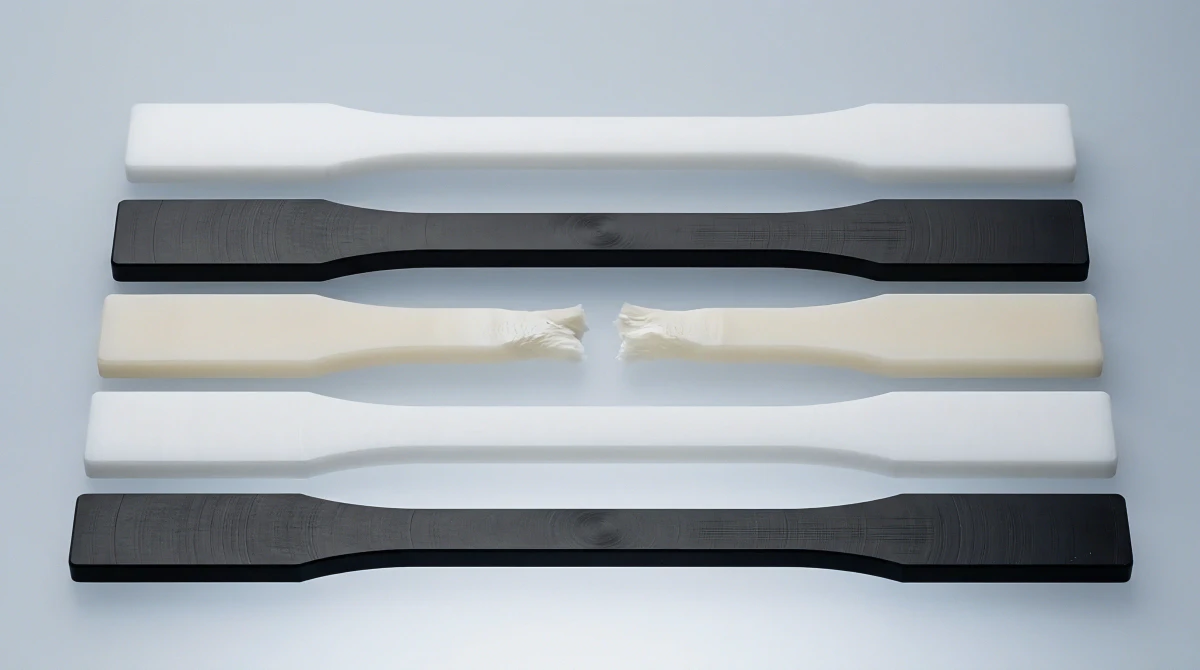
A tensile test under ASTM D638 pulls a bar to failure in minutes, and its modulus is read at the start. A heat deflection test under ASTM D648 runs while the bath warms at 2 °C (3.6 °F) per minute. That takes tens of minutes, and neither result carries time under load. ASTM D648 states that its data are not intended for design or for predicting endurance at high temperatures. ASTM D696, the expansion test, goes further. It requires the specimen to show negligible creep or elastic strain under the stresses imposed.Read More
Temperature Margin
The gap between service and the sheet’s thermal figures matters. A worked reading in these resources places an acetal copolymer bracket at 80 °C (176 °F) under a steady load. That sits 11 K (20 °F) below the TECAFORM AH long-term service figure of 91 °C (195 °F). It also sits 30 K (54 °F) below the heat deflection temperature of the same sheet. The margin is thin for a part that will creep. The sheets say nothing about how many months the bracket keeps its shape.Compressive Load
Soft stock shows the same effect under a pad or a bearing face. For UHMW-PE, the TIVAR 1000 sheet lists compressive deformation of 6 to 8 percent at 6.9 MPa (1,000 psi). A wear pad under steady pressure therefore gives way by a measurable amount.Design Basis
ASTM D638 calls its data useful in engineering design, with precautions. It asks for special additional tests where more precise data are needed. The sheet ranks materials, and the designer adds a safety factor for geometry, temperature and time. Parts load-tested in the real geometry, at the service temperature and for a stated time, answer what the sheet cannot.