Cutting Fluid

A cutting fluid is the liquid coolant or lubricant applied to a cut to carry heat away from tool and part.

Every Cutting Fluid article of the Plastic CNC Resources, newest first, each written from published standards, research and makers’ data.

Meaning

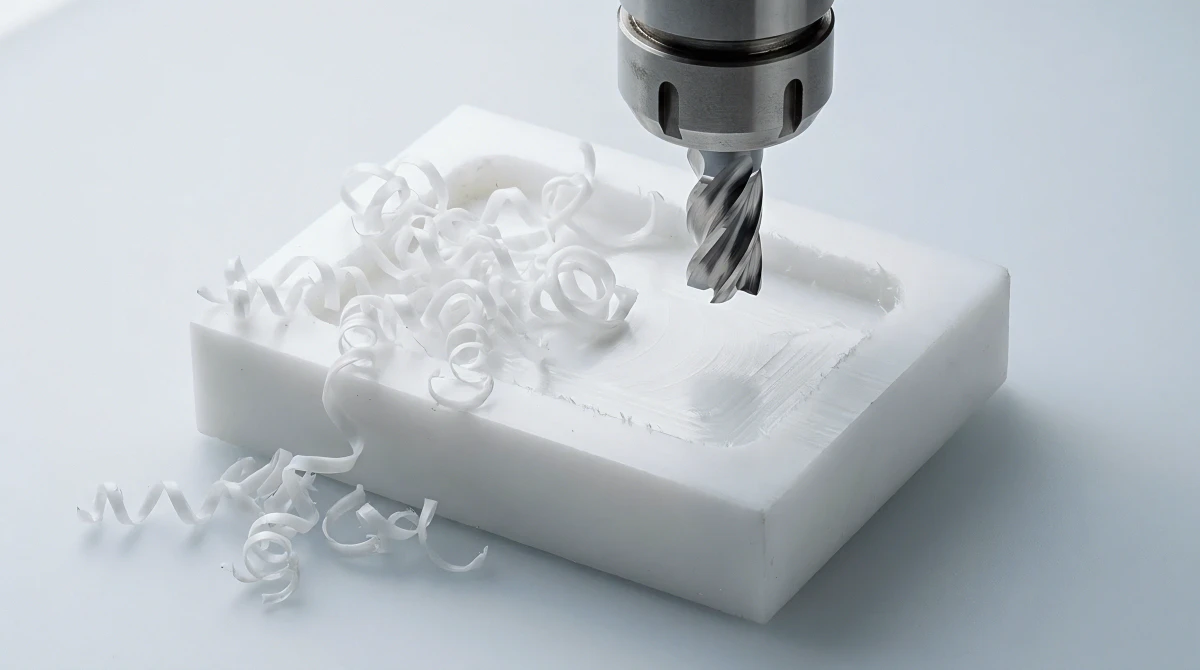
A cutting fluid is the liquid coolant or lubricant applied to a cut to carry heat away from tool and part. Most thermoplastic machining runs dry or with air instead. Quadrant says coolants are not typically needed apart from drilling and parting. Mitsubishi agrees that they are generally not required for most operations. The choice of coolant, when one is used, is as much a chemical question as a thermal one.

Default Practice

For the best finish and the closest tolerance, both guides suggest non-aromatic, water-soluble coolants, spray mists or pressurized air. These cool the interface and blow chips from the cut. Quadrant adds that a coolant is applied where a lot of heat is generated. Holes deeper than twice their diameter are the main case. Tangram Technology reminds the shop that choosing a coolant is a question of compatibility as much as of cooling.
Read More

Grade Limits

Polycarbonate, PSU, PPSU and PEI are the exception. Petroleum-based cutting fluids and many water-soluble coolants can start stress cracking in them. Pure water or compressed air is recommended. Where a coolant is unavoidable, the part is washed in isopropyl alcohol and rinsed in pure water. Mitsubishi marks one flame-retardant UHMW-PE grade as dry machining only, because its additives can react with liquids and corrode tooling.

Acrylic Practice

Röhm advises a drilling emulsion compatible with acrylic from a sheet thickness of 5 mm (0.2 in). A compatible emulsion or cutting oil can also cool turning cuts. Röhm does not recommend cooling for finishing work with diamond tools. It causes optical flaws on high-gloss surfaces.

Process Record

A shop that states the coolant used, and the cleaning step after it, has written down part of its process. That record lets the same part keep the same finish when the work moves between machinists.

Drilling Deep Holes in Plastic Without Melting or Cracking

Holes deeper than two diameters trap heat in plastic, so drill grind, peck cycle, coolant choice and cool-down decide whether the part cracks or holds its size.

How to Drill a Deep Hole in Plastic Without Melting or CrackingTreat any hole deeper than two diameters as a cooling problem first and a cutting problem second. Both Mitsubishi Chemical Advanced Materials (MCAM) and Ensinger name the same threshold: heat builds very easily once the depth passes twice the diameter.
Annealing Machined Plastic Parts Between Roughing and Finishing

Annealing between roughing and finishing trades oven days for flat, stable parts, and it pays only when stress, shape or tolerance demand it.

When a Machined Plastic Part Needs AnnealingA machined plastic part needs an intermediate anneal when it has tight tolerances, an asymmetric shape, or a large share of its blank removed, and when it does not need one the stock maker has already done the work. Ensinger states the starting condition: its semi-finished products are always annealed after production, which is why a first cut can start without a stress-relief step.

PEI Ultem Stock for CNC Machined Parts

PEI holds stiffness and shape at heat, and it asks for dry cutting, careful fluids and an annealing decision before the first part is cut.

PEI Ultem Properties for Machined PartsPolyetherimide, PEI for short, is an amorphous thermoplastic, and Ensinger, which extrudes it into rod and plate, notes that it is commonly referred to as ULTEM plastic after the resin's trade name. Ensinger describes the material as having high mechanical strength and rigidity, exceptional creep resistance over a wide temperature range and very good hydrolysis resistance, and as inherently flame retardant with low smoke emission, which makes it a preferred material for aircraft interiors.

Request a Plastic CNC Quote

Send the 2D drawing and the 3D file, with the quantity and the stage of the project. An engineer replies within 1 working day.

The quote form, the mutual NDA and the private folder for your files are on Protolis Atelier, with Plastic CNC chosen.

Request a Quote