Hole Depth

Hole depth is the length of a drilled hole measured against its diameter.

Every Hole Depth article of the Plastic CNC Resources, newest first, each written from published standards, research and makers’ data.

Meaning

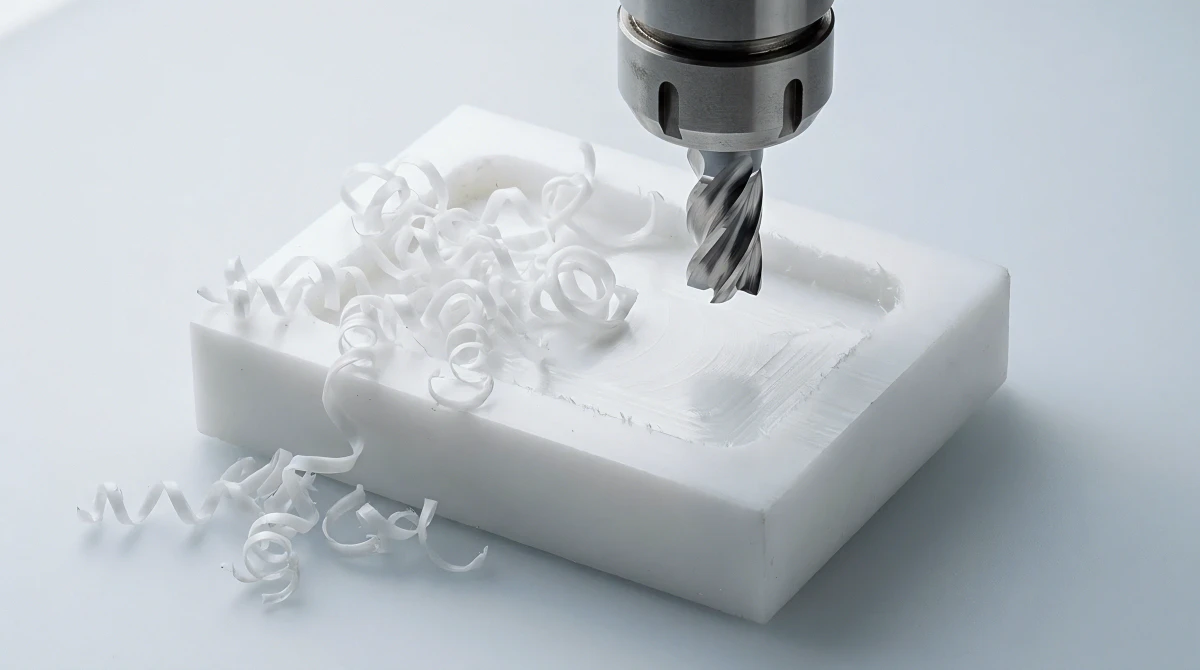
Hole depth is the length of a drilled hole measured against its diameter. In plastic, holes deeper than twice their diameter need pecking and cooling. Mitsubishi states that plastics build up heat readily past that depth. Quadrant applies coolant there, especially when the hole is deeper than twice its diameter. Depth is therefore the point where drilling changes method.

Peck Interval

Quadrant gives the interval: pull the drill out each time a depth of about 1.5 times its diameter is reached. Mitsubishi says frequent pull-outs are necessary, and Tangram recommends peck drilling for chip removal. Each pull clears the flutes before chips pack and rub. A pushed-through drill leaves its heat in the wall of the hole.
Read More

Coolant Choice

Deep holes are one of the few cases where most guides call for a liquid. Non-aromatic, water-soluble coolants are the usual choice. Röhm advises a drilling emulsion compatible with acrylic from a material thickness of 5 mm (0.2 in).

Amorphous-Grade Rule

Polycarbonate, PSU, PPSU and PEI are the exception. Petroleum-based fluids and many water-soluble coolants can start stress cracking in them. Pure water or compressed air is recommended. Where a coolant cannot be avoided in a deep hole, the part is washed in isopropyl alcohol and rinsed in pure water at once.

Hole Quality

Mitsubishi’s fault table links heat to burned or melted walls and to tapered holes. A deep hole that overheated has drifted in size before it is measured. The call-out for a deep hole on an amorphous part names the coolant allowed. For a hole that needs the closest figure, the drill opens it and a boring tool takes the final size.

PEI Ultem Stock for CNC Machined Parts

PEI holds stiffness and shape at heat, and it asks for dry cutting, careful fluids and an annealing decision before the first part is cut.

PEI Ultem Properties for Machined PartsPolyetherimide, PEI for short, is an amorphous thermoplastic, and Ensinger, which extrudes it into rod and plate, notes that it is commonly referred to as ULTEM plastic after the resin's trade name. Ensinger describes the material as having high mechanical strength and rigidity, exceptional creep resistance over a wide temperature range and very good hydrolysis resistance, and as inherently flame retardant with low smoke emission, which makes it a preferred material for aircraft interiors.

Request a Plastic CNC Quote

Send the 2D drawing and the 3D file, with the quantity and the stage of the project. An engineer replies within 1 working day.

The quote form, the mutual NDA and the private folder for your files are on Protolis Atelier, with Plastic CNC chosen.

Request a Quote