Resin

A resin is the polymer in the pellet form its maker sells, from which stock shapes are extruded or molded.

Every Resin article of the Plastic CNC Resources, newest first, each written from published standards, research and makers’ data.

Meaning

A resin is the polymer in the pellet form its maker sells, from which stock shapes are extruded or molded. Resin data sheets describe it. A machined part never meets the pellet directly. It meets the stock shape a converter made from it, so a resin figure and a stock figure describe different bars.

Resin and Shape Difference

Stock-shape makers extrude the resin into rod and plate: Ensinger makes its unfilled PEI from the ULTEM 1000 series and its acetal homopolymer from Delrin of the 150 series. One PEI stock sheet gives a break of 104.8 MPa (15,200 psi), below that yield. The ASTM D638 article reads the gap as different bars, speeds and lots, none of them named.
Read More

Resin Specification

Resin carries its own specification. The Delrin 150 sheet cites ASTM D4181 for the resin. Ensinger’s TECAFORM AH sheet cites ASTM D6778-06, which supersedes D4181-00. A claim that a bar meets ASTM D6100 covers the shape. A resin claim covers the pellet.

Extrusion Grade

Few resins are made for stock. Its enhanced-crystallinity, toughened, low-emission and glass-filled resins are injection molding grades. Resins built for injection molding are rarely the ones in the bar a shop buys.

Resin Record

Flame ratings often sit on the resin record. The UL 94 article notes that a 5VA rating on a resin record is a different statement from a V-0 on a stock sheet. Neither becomes a stock-shape claim until the supplier’s own record says so.

Effect on Molded Parts

A molded part leaves its tool smaller than the cavity, by an amount that depends on the resin, the wall and the cooling. A machined part is cut to the drawing’s size, so the resin’s shrinkage only returns when the part moves to a mold.
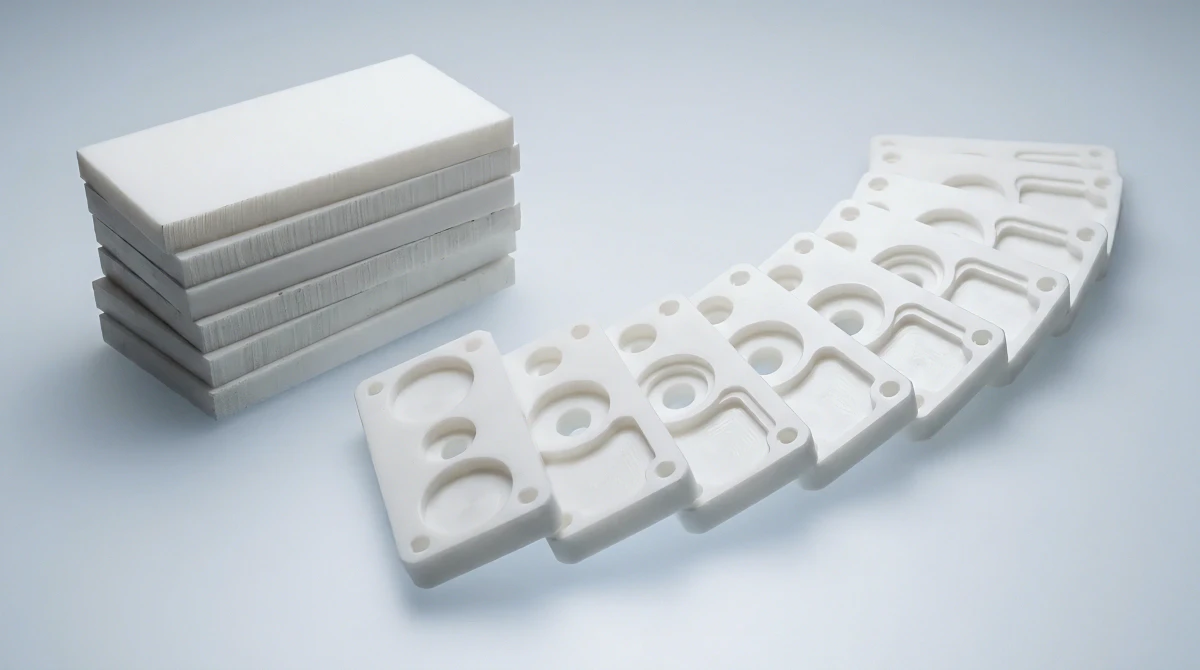
Sizing a Machined Plastic Run From Blanks to Batches

A machined run is sized from weeks and consumption, converted to plates and batches, and then matched to cutters and fixtures by run length.

How to Size a Machined Plastic RunCount the parts the program will consume until the next process delivers, add a spare for parts lost in testing, convert the total to blanks by nesting, and group the blanks into batches that share a rest, an oven load and a measuring session. Then choose the cutter and the fixture by the length of the run.

UL 94 Flammability Ratings for Machined Plastic Parts

A flame rating belongs to a material, a color and a thickness, so the call-out has to name all three and the machined wall has to stay inside them.

What UL 94 Covers and What It Leaves OutThe UL standards catalog lists UL 94 as Tests for Flammability of Plastic Materials for Parts in Devices and Appliances, in its seventh edition. Its scope states that the requirements cover tests for flammability of polymeric materials used for parts in devices and appliances, and that they serve as a preliminary indication of acceptability with respect to flammability for a particular application.

PEI Ultem Stock for CNC Machined Parts

PEI holds stiffness and shape at heat, and it asks for dry cutting, careful fluids and an annealing decision before the first part is cut.

PEI Ultem Properties for Machined PartsPolyetherimide, PEI for short, is an amorphous thermoplastic, and Ensinger, which extrudes it into rod and plate, notes that it is commonly referred to as ULTEM plastic after the resin's trade name. Ensinger describes the material as having high mechanical strength and rigidity, exceptional creep resistance over a wide temperature range and very good hydrolysis resistance, and as inherently flame retardant with low smoke emission, which makes it a preferred material for aircraft interiors.

Acetal Homopolymer and Copolymer Stock for CNC Machined Parts

Homopolymer is stiffer and harder, copolymer is sold porosity-free with less water uptake and less thermal growth, and the stock a part is cut from decides which it inherits.

Acetal Homopolymer and Copolymer Differences in Machined PartsAcetal, the polyoxymethylene or POM family, reaches a machine shop as two chemistries. Homopolymer chains repeat one unit; copolymer chains carry two.

Request a Plastic CNC Quote

Send the 2D drawing and the 3D file, with the quantity and the stage of the project. An engineer replies within 1 working day.

The quote form, the mutual NDA and the private folder for your files are on Protolis Atelier, with Plastic CNC chosen.

Request a Quote