DIN EN 15860

DIN EN 15860 is the European standard for thermoplastic semi-finished products for machining, setting requirements and test methods for round rods, tubular bars, sheets and flat bars.

Every DIN EN 15860 article of the Plastic CNC Resources, newest first, each written from published standards, research and makers’ data.

Meaning

DIN EN 15860 is the European standard for thermoplastic semi-finished products for machining, setting requirements and test methods for round rods, tubular bars, sheets and flat bars. It is the reference behind the size and straightness tolerances of plastic stock in Europe. Its tables are sold by the standards bodies and are not public.

Scope

DIN describes EN 15860:2010, prepared by the European committee CEN/TC 249 for plastics, as covering tolerances of size, straightness tolerances, physical properties of materials as guideline and set values, and dimensional stability. It brought modified and fiber-reinforced materials into scope and widened the diameter and thickness ranges. In Germany it replaced several older national standards for semi-finished plastic products.
Read More

On Data Sheets

Stock makers name the standard in their documents. Röchling states that the values on its sheets for Sustamid cast nylon and Polystone flame-retardant UHMW-PE are in accordance with DIN EN 15860. Ensinger states that the tolerances of its semi-finished products conform to DIN EN 15860 and that tolerances quoted for modified materials are a guide only.

Straightness in Practice

A maker’s own delivery specification shows the order of magnitude. Röchling’s specification for compression-molded SustaPEEK CF30 sheet allows a deviation at the crossing of the diagonals of up to 8, 3 and 2 mm (0.31, 0.12 and 0.08 in) for edge lengths of 1,000, 500 and 400 mm, with an oversize thickness tolerance of +0.5 to +3.5 mm. These are the maker’s factory tolerances, not the standard’s tables.

Purchase Order

For a buyer, the standard explains why stock arrives oversize and slightly bowed, and why a flat machined part is faced on both sides. Naming DIN EN 15860 on a stock order fixes the tolerance basis of the delivered bar; the machined part’s own tolerances stay on its drawing.
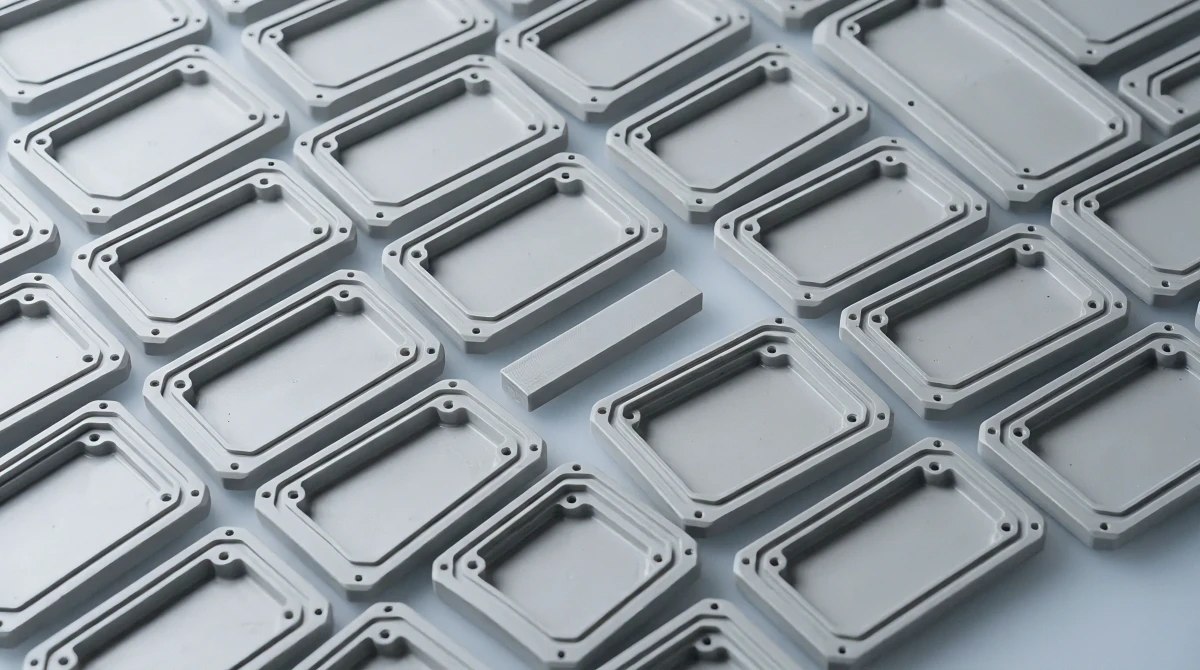
A Flame-Retardant Machined Plastic Batch and Its UL 94 V-0 Record

A machined batch carries a UL 94 V-0 rating only through its record of grade, color, thickness, listing and lot, plus proof the shop cut it dry and thick enough.

What a UL 94 V-0 Record Covers for a Machined Plastic BatchThe record covers the material, not the part. Ensinger, a stock-shape maker, states that combustibility testing to UL 94 is generally performed on the raw material.

Flatness and Warp of Thin Machined Plastic Plates

Thin plastic plates bow when stress, heat, clamping or moisture act on one face more than the other, so flatness is planned through stock, sequence, rest and measurement.

Why Thin Machined Plastic Plates Lose FlatnessA thin plate loses flatness when the stresses on its two faces stop balancing. Mitsubishi Chemical Advanced Materials (MCAM) explains the mechanism in its machining guide: extrusion, molding and machining leave residual stresses inside a thermoplastic, and when material is removed or the part meets elevated temperatures, those stresses redistribute and cause warping or dimensional change.

Shore D and Rockwell Hardness on Plastic Stock Data Sheets

Shore D and Rockwell values on plastic stock sheets rank surface hardness under named methods, cannot be converted into each other, and bind a supplier only when agreed.

What Shore D and Rockwell Numbers Mean on a Plastic Stock Data SheetBoth numbers rank how strongly a plastic resists a hard indenter pressed into its surface at room temperature. Neither is a strength, a wear rating or a design value.

Cast and Extruded Nylon PA6 Stock for Machined Parts

Cast and extruded PA6 share a name but not their stress, crystallinity, chips or moisture behavior, and a machined nylon part keeps changing size after the cut.

Cast or Extruded PA6 for a Machined PartCast PA6 is usually the better machining stock when the part is large, flat, stiff or close-toleranced. Extruded PA6 is the tougher, more elastic choice for smaller parts where impact strength and elongation matter more than the last hundredth of a millimeter.

Request a Plastic CNC Quote

Send the 2D drawing and the 3D file, with the quantity and the stage of the project. An engineer replies within 1 working day.

The quote form, the mutual NDA and the private folder for your files are on Protolis Atelier, with Plastic CNC chosen.

Request a Quote