ASTM D696

ASTM D696 is the test method for the linear thermal expansion of plastics from −30 to 30 °C (−22 to 86 °F).

Every ASTM D696 article of the Plastic CNC Resources, newest first, each written from published standards, research and makers’ data.

Meaning

ASTM D696 is the test method for the linear thermal expansion of plastics from −30 to 30 °C (−22 to 86 °F). It uses a vitreous silica dilatometer. Most stock sheets in these resources cite it for their expansion figure. On astm.org the 2016 edition shows as historical and a 2024 edition as active. Outside its range, the standard points to ASTM E228.

Scope

The method covers plastics with a coefficient greater than 1 µm/(m·°C). The material has to show negligible creep or elastic strain under the stresses imposed, insofar as these affect accuracy. The standard notes that there is no known ISO equivalent.
Read More

Excluded Effect

The expansion of a plastic has a reversible component. Changes in length from moisture, curing, loss of plasticizer or solvents, release of stresses and phase changes sit on top of it. D696 is intended to exclude those factors as far as possible. It admits it cannot exclude them completely, so it gives only an approximation to the true expansion. A machined part in a shop is subject to exactly those other factors.

Companion Method

ASTM E831 measures expansion by thermomechanical analysis over a scanned range from −120 to 900 °C (−184 to 1,652 °F). It recommends a lower limit of 5 µm/(m·°C). Ensinger cites E831 for its unfilled PEI and D696 for the glass-filled grade. Mitsubishi cites E831 for TIVAR 1000.

Sheet Citation

Spartech’s SP-1010 HDPE and Ensinger’s acetal and glass-filled PEI stock all print a D696 figure. A coefficient read from such a sheet is a value near room temperature. A part that runs at 80 or 150 °C (176 or 302 °F) lies outside the range the standard covers. The supplier is asked for the grade’s own value there.

A Flame-Retardant Machined Plastic Batch and Its UL 94 V-0 Record

A machined batch carries a UL 94 V-0 rating only through its record of grade, color, thickness, listing and lot, plus proof the shop cut it dry and thick enough.

What a UL 94 V-0 Record Covers for a Machined Plastic BatchThe record covers the material, not the part. Ensinger, a stock-shape maker, states that combustibility testing to UL 94 is generally performed on the raw material.
Cast and Extruded Nylon PA6 Stock for Machined Parts

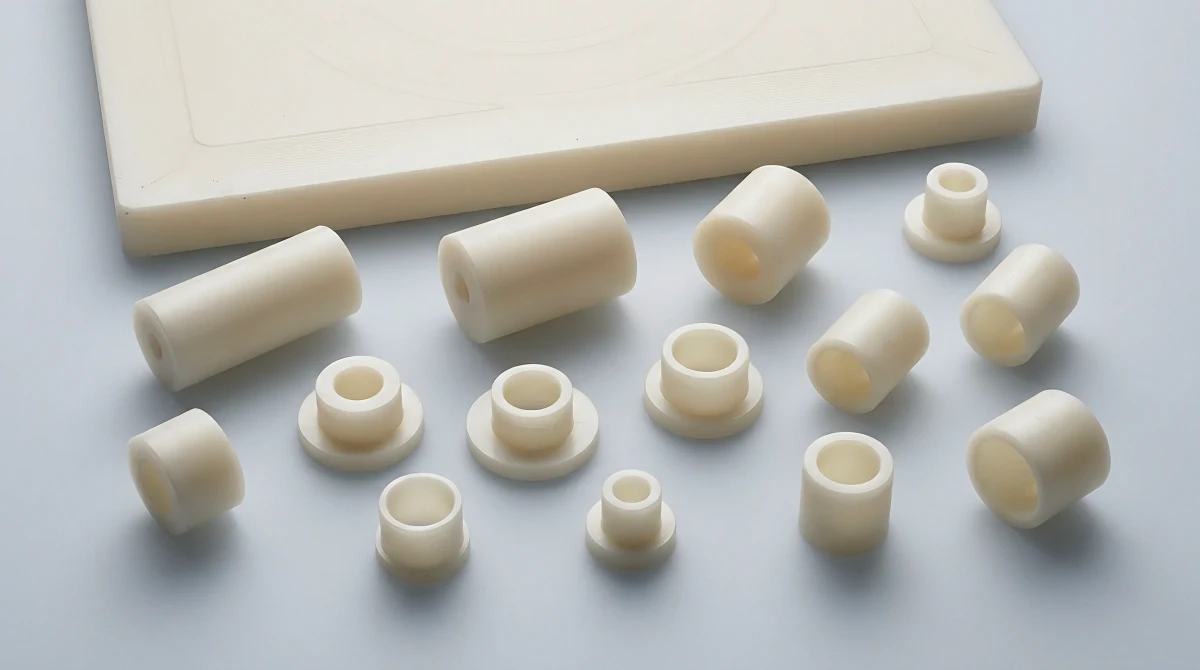
Cast and extruded PA6 share a name but not their stress, crystallinity, chips or moisture behavior, and a machined nylon part keeps changing size after the cut.

Cast or Extruded PA6 for a Machined PartCast PA6 is usually the better machining stock when the part is large, flat, stiff or close-toleranced. Extruded PA6 is the tougher, more elastic choice for smaller parts where impact strength and elongation matter more than the last hundredth of a millimeter.

Thermal Expansion of Machined Plastic Parts by Material and Size

Every machined plastic dimension has a temperature, and the material decides how many degrees of drift a given tolerance can absorb.

Thermal Expansion of Machined Plastic Parts per 10 DegreesThe coefficient of linear thermal expansion, CTE, is the fractional length change per degree. Plastic sheets print it in 10⁻⁶ per kelvin or in inches per inch per degree Fahrenheit, and the two convert by a factor of 1.8: one in/in/°F is 1.8 per °C.

PEI Ultem Stock for CNC Machined Parts

PEI holds stiffness and shape at heat, and it asks for dry cutting, careful fluids and an annealing decision before the first part is cut.

PEI Ultem Properties for Machined PartsPolyetherimide, PEI for short, is an amorphous thermoplastic, and Ensinger, which extrudes it into rod and plate, notes that it is commonly referred to as ULTEM plastic after the resin's trade name. Ensinger describes the material as having high mechanical strength and rigidity, exceptional creep resistance over a wide temperature range and very good hydrolysis resistance, and as inherently flame retardant with low smoke emission, which makes it a preferred material for aircraft interiors.

Request a Plastic CNC Quote

Send the 2D drawing and the 3D file, with the quantity and the stage of the project. An engineer replies within 1 working day.

The quote form, the mutual NDA and the private folder for your files are on Protolis Atelier, with Plastic CNC chosen.

Request a Quote